We remain fully operational. Our teams are working around the clock to ensure your deliveries continue safely.

DOWNLOAD THE APP


Customer Services
Copyright © 2025 Desertcart Holdings Limited
DOWNLOAD THE APP
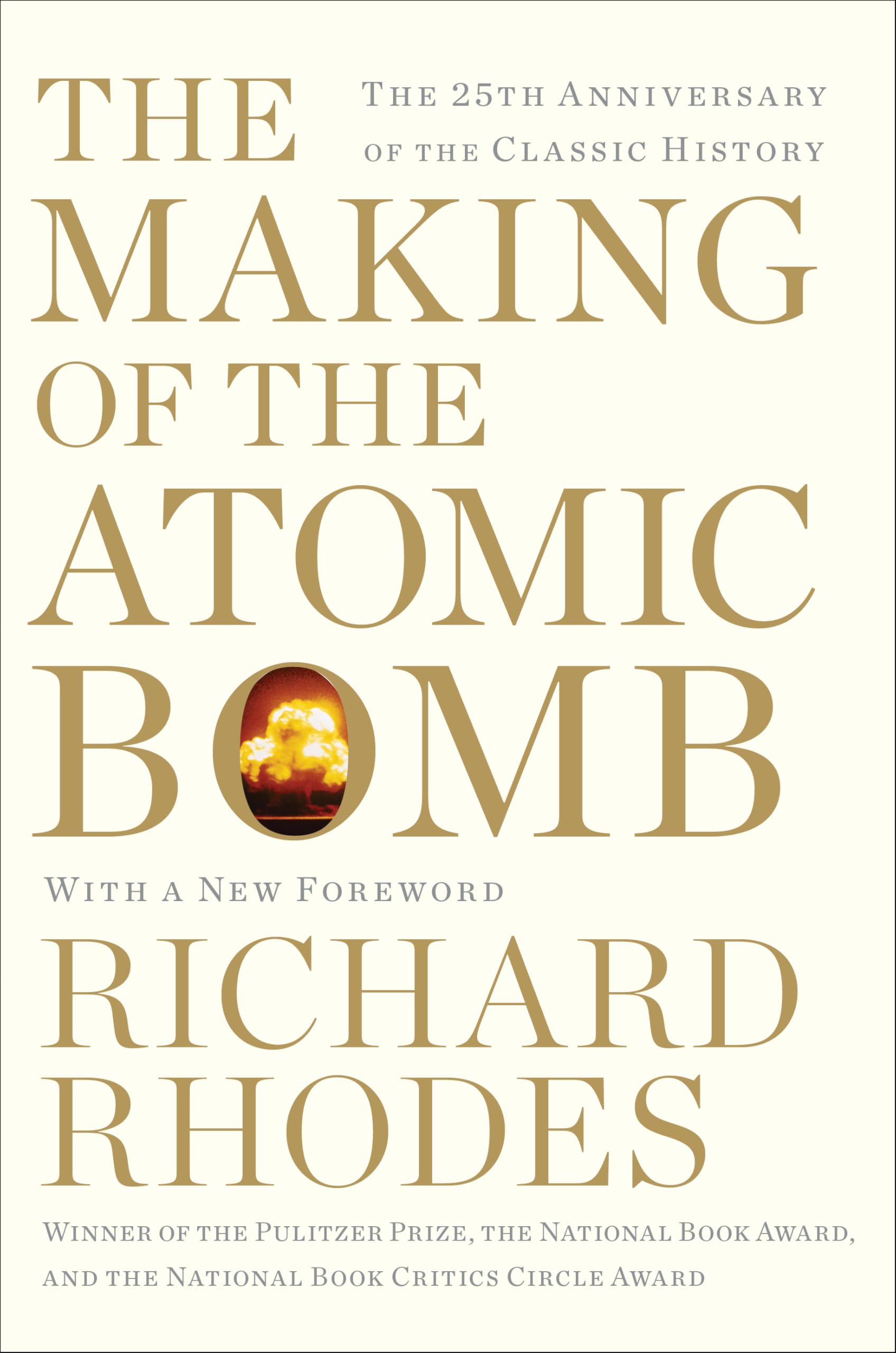
💥 Unlock the Secrets of History!
The Making of the Atomic Bomb: 25th Anniversary Edition Kindle Edition offers a comprehensive exploration of the development of nuclear weapons, featuring updated content and expert analysis, making it an essential read for history enthusiasts and professionals alike.

| ASIN | B008TRU7SQ |
| Accessibility | Learn more |
| Best Sellers Rank | #28,803 in Kindle Store ( See Top 100 in Kindle Store ) #2 in History of Physics #3 in Nuclear Physics (Books) #4 in Nuclear Weapons & Warfare History (Kindle Store) |
| Customer Reviews | 4.6 4.6 out of 5 stars (4,120) |
| Edition | 25th Anniversary ed. |
| Enhanced typesetting | Enabled |
| File size | 52.8 MB |
| ISBN-13 | 978-1439126226 |
| Language | English |
| Page Flip | Enabled |
| Print length | 1499 pages |
| Publication date | September 18, 2012 |
| Publisher | Simon & Schuster |
| Screen Reader | Supported |
| Word Wise | Enabled |
| X-Ray | Enabled |
J**A
The starting place in understanding deterrence and nuclear policy.
It took me over 20 years to finish The Making of the Atomic Bomb by Richard Rhodes, though I wasn’t reading it constantly throughout that period. I initially started it years ago and then picked it up again recently. The book is exceptional—thorough, detailed, and incredibly well-researched. It’s a critical work for understanding the 20th century, as it delves deeply into the scientific, political, and moral dimensions of the atomic bomb’s creation. It offers a perspective on history without the benefit of hindsight, which is invaluable. One of the most striking aspects of Rhodes' narrative is the way it presents the decisions and dilemmas faced by the key figures involved, like J. Robert Oppenheimer and General Leslie Groves. Given the information they had at the time, their actions and choices are more understandable, and the complexity of their situation is revealed. The book doesn’t provide neat answers or conclusions; rather, it shows that the development of the atomic bomb was an incredibly complicated process shaped by an array of factors—scientific, military, political, and ethical. In hindsight, we often view the arms race of the Cold War through a simplified lens, but this book makes it clear that understanding the atomic bomb’s origins is key to grasping the larger Cold War dynamics. Rhodes foreshadows the development of the hydrogen bomb, and the text makes it clear that the atomic bomb was just the beginning of a much broader and more dangerous arms race. In the end, reading this book forces you to come away with the realization that “it’s complicated.” The issues surrounding nuclear weapons—whether in terms of power, morality, or strategy—are far too complex to reduce to simple slogans or bumper-sticker conclusions. Rhodes’ narrative warns us about oversimplification, demonization, or the rush to arrive at easy answers. We do a disservice to history, to the people who made these decisions, and to ourselves if we attempt to understand the atomic age without first grappling with the thorough, nuanced history laid out in this book.
P**A
Fascinating, readable and comprehensive history of how our understanding of nuclear structure developed in the 20th century
This is much more than simply a history of how the first atomic bombs were developed. Richard Rhodes begins with what he calls the 'prehistory' of the Manhattan Project, starting with the discovery of radioactivity and continuing through the steps by which physicists, chemists and other scientists came to understand the structure of the atom, the existence of protons, neutrons and electrons, as well as the various particles that may be emitted through radioactive decay or as a result of processes such as bombardment or, eventually, nuclear fission. It is a fascinating look at how scientists, working in laboratories and with tools we would consider very primitive today, were able to slowly understand the structure of the atom, something that could not be seen or directly measured but had to be understood by applying theories and logic to the experimental results they were able to obtain. As the story reaches the time when Hitler began to take power in Germany, the scientists who were the leading researchers in physics in Europe begin to migrate to England and then to the United States. Early developments at the Max Planck Institute for Physics started Germany on the road to developing its own nuclear weapon, an effort thwarted by the Allies throughout the war and severely handicapped by the loss of scientists who had fled Germany and joined the efforts in the United States. Japan also had its own nascent effort to develop a nuclear weapon but was unable to make much progress, lacking the necessary resources and industrial infrastructure. Ultimately, only the United States had the scientists (many from Europe) and industrial capability to develop nuclear weapons, and by the end of the war the various facilities that had been constructed to enrich uranium, produce plutonium and support these efforts was altogether equivalent to the size of the american automobile industry at the time. The scientists who had developed the atomic bomb were not certain it would work, or what the effects would be, until the first bomb was tested on July 16, 1945, in the New Mexico desert. This 'Trinity' test took place just one day before President Truman met with Churchill and Stalin at the Potsdam Conference. The war in Europe against Germany had concluded on May 8, 1945, but the war in the Pacific against Japan continued. President Truman now knew that he had the atomic bomb available for use against Japan, which had so far refused to agree to an unconditional surrender. The book concludes with an accounting of the bombs effects on Hiroshima and Nagasaki, recounting stories of survivors and describing what it was like on the ground for those who survived the initial blast, some with lingering effects that led to death soon thereafter, and some with longer term suffering. It is a very sobering reminder of the terrible power of these devices (John Hersey's classic account Hiroshima , first published in The New Yorker in 1946, is an even more comprehensive and definitive story). The first atomic bomb used by one nation against another was dropped on Hiroshima in Japan on August 6, 1945. It had a yield equivalent to 13-18,000 tons (13-18 kilotons) of TNT (Rhodes book states 12,500 tons, wiki now gives the range I've indicated). The second atomic bomb used by one nation against another was dropped on Nagasaki in Japan on August 9, 1945. It had a yield equivalent to 20-22,000 tons (20-22 kilotons) of TNT. Those first two bombs, causing so much devastation, with yields of about 13-22 kilotons of TNT. Since that time, atomic weapons have not again been used by one nation against another. So far. The United States (as well as the Soviet Union) subsequently developed weapons as large as megaton capability, some that were hundreds and reaching a thousand times more powerful and destructive than the bombs dropped on Japan in World War II (the largest being the USSR's Tsar Bomba, aka "Big Ivan", at 50 megaton and which was tested in 1961, but only one seems to have been built). Our current inventory, as I understand it, is largely comprised of weapons in the hundreds of kilotons range, thus ten times or greater more destructive than those WW II weapons, with others still available to us (I believe) that go even larger and may be as much as a hundred times more destructive. The yields obtained by Pakistan, in 1998 tests of their own nuclear bombs, were reported to be in the 12 kiloton and 30-36 kiloton range, and it is thought that they may have developed warheads as large as 300-500 kiloton. This "25th Anniversary" version is notable for the Forward written by Rhodes, in which he reflects on the development of the bomb as well as the concerns that are as important as ever today, where we worry about countries still seeking to develop nuclear power and nuclear weapons for their own use. Rhodes cites the 1996 Canberra Commission on the Elimination of Nuclear Weapons, which asserted in its 'axiom of proliferation' that "As long as any state has nuclear weapons, others will seek to acquire them." Rhodes relates a discussion that he had with the Australian ambassador-at-large for nuclear disarmament, Richard Butler, who says "The basic reason for this assertion is that justice, which most human beings interpret essentially as fairness, is demonstrably a concept of the deepest importance to people all over the world. Relating this to the axiom of proliferation, it is manifestly the case that the attempts over the years of those who own nuclear weapons to assert that their security justifies having those nuclear weapons while the security of others does not, has been an abject failure."
R**R
I literally could not put the book aside, I read it in every free minute I found. As someone very interested in engineering and physics, but a layman, it was very easy to follow and understand the atomic concepts and how (in theory) it worked. A lasting impression formed when the last part of the book explains in detail the reality of having used this bomb ...
P**R
Great book for science lovers..
Z**S
その昔 Brighter than a Thousand Suns を読んだ。(その部分訳が日本語で出ていたかと思うが、それでは物足らず分厚いペーパーバックを読んだ。) それから幾星霜。映画Oppenheimer の脚本家はこの本などを参考にしたような話(本当かどうかはしらない)を読んだ。私が読んだ Brightger than a Thousand Sunsが書かれたころに比べたら機密解除でいろいろ明らかになってることもあるだろうと思い読み始めたが、最初の方を読んだだけでも丁寧にいろいろ書かれていることが分かる。 原爆を通常の市民の頭の上に2回も落とされた国の人間としては、原爆を作った側の人間にも葛藤を抱いていた人がいたということを知るのも無駄ではないと思う。 もちろん、原爆では物足りない、水爆が絶対い必要だと言っていた「水爆の父」ともいわれる Teller 氏みたいな科学者もいたが、彼も亡くなる前の1995年あたりには、「政治家に原子力兵器の管理を任せたのは誤りだった。」なんていうことを言い出していたらしいことを 映画 Oppenheimer の公開に合わせて最近の情報をあさって知った。 そこまでの歴史はカバーされてないと思うし、そもそも書かれたのは丁度Teller 氏がそういうことを言い始めたころだから書かれてないだろう。 しかし、書かれたころの知識を丁寧に描いていると読んでいてわかるので、おすすめできる作品だ。日本語訳もでているようだが、上に書いたような事情で先に英語版を読んでいる。映画Oppenheimerの影響で1960年代に日本の軍人のインタビューも含めた原爆の使用に関するNBCの番組、オッペンハイマーのインタビューなどのビデオが多数 youtube で公開されている。本を読みながらそれらも見ると考えさせられる。 大部なのでまだ終わりまで読めてないが、いい本だと思うのでお勧めの5星をつけた。
L**A
Excelente! Leitura fácil e cativante.
P**R
Richard Rhodes Buch gilt nicht umsonst als Standardwerk, wenn es um die Geschichte der Atombombe geht und wurde auch mit zahlreichen Preisen überhäuft. Wer das Buch bekommt, ist daher nur so mittelüberrascht, dass es ein Türstopper ist: Fast 800 eng beschriebene Paperbackseiten. Ich - kein langsamer Leser - habe fast drei Wochen gebraucht, was aber auch daran liegt, dass es keine ganz einfache Lektüre ist. Rhodes beginnt tatsächlich ganz grundlegend mit den Wissenschaftlerinnen und Wissenschaftlern, die die theoretischen Grundlagen gelegt haben. Und mit den theoretischen Grundlagen. Wie ausführlich das ist, mekrt man daran, dass der zweite Weltkrieg erst nach etwa einem Drittel des Buches ausbricht. Wer viel Wissenschaftsgeschichtliches liest, wird hier auch vieles kennen, aber dennoch: Die Detailverliebtheit ist schon beeindruckend und die Verflechtungen sind hier entsprechend klar. Ähnliches gilt für die Anfänge und den Verlauf des zweuten Weltkrieges. Viel habe ich über die Annektion von Tschechien nicht gelesen (Vielleicht sollte man den Teil der Geschichte mal denjenigen zu lesen geben, die meinen, man solle die Ukraine des Friedens willen aufgeben). Ähnliches gilt für die Eroberung Dänemarks und dass Norwegen vor allem deswegen besetzt wurde, um dort schweres Wasser herzustellen, war mir auch unbekannt. Erst überraschend spät beginnt der Teil, der durch den Film Oppenheimer bekannt ist: Das Manhattan-Projekt. Auch hier werden viele Details ausgebreitet, manche Diskussion, manches Meeting ist vielleicht doch etwas zu viel des Guten, aber man merkt Rhodes, dass er wirklich alle Aspekte der Entstehung abbilden wollte, inklusive der Politischen (und moralischen) Diskussionen hinter den Kulissen. Die Zündungen der drei Bomben (Trinitiy, Hiroshima, Nagasaki) wird minitiös begleitet und ist (trotz bekannten Ausgangs) spannend zu lesen. Insgesamt ist es eben tatsächlich das ultimative Werk für diesen Teil der Geschichte. Die Folgen der Abwürfe werden in den Buch nur angedeutet. Daher macht es auch nichts, dass es bereits über 20 Jahre alt ist.
Trustpilot
2 days ago
1 month ago