Desertcart purchases this item on your behalf and handles shipping, customs, and support to Sri Lanka.
🌟 Keep your cool with precision — because your food deserves the best!
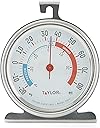
The Taylor Analog Refrigerator Freezer Thermometer features a large 3-inch colorful dial for easy reading, housed in a durable stainless steel casing that resists corrosion. It provides highly accurate temperature measurements from -20°F to 80°F, with clear freezer, refrigerator, and danger zones marked for quick reference. Designed for versatile placement, it can hang or stand inside any fridge or freezer. NSF-certified and backed by a 1-year warranty, this manual analog thermometer requires no batteries and delivers reliable, professional-grade performance to ensure food safety and freshness.


| ASIN | B000BPE88E |
| Additional Features | High Accuracy, Large Display |
| Age Range (Description) | Adult |
| Age Range Description | Adult |
| Best Sellers Rank | #5,047 in Kitchen & Dining ( See Top 100 in Kitchen & Dining ) #14 in Refrigerator Thermometers |
| Brand | Taylor |
| Brand Name | Taylor |
| Color | Silver |
| Customer Reviews | 4.5 out of 5 stars 12,787 Reviews |
| Display Type | Analog |
| Global Trade Identification Number | 00077784059241 |
| Immersion Depth | 3 inches |
| Included Components | Thermometer |
| Indoor Outdoor Usage | Indoor |
| Item Length | 3.25 inches |
| Item Type Name | Large Dial Fridge/Freezer Thermometer |
| Item Weight | 3.04 ounces |
| Manufacturer | Lifetime Brands Inc. |
| Model | 5924 |
| Model Name | TAYLOR-CLASSIC-LARGE-SCREEN |
| Outer Material | Stainless Steel |
| Part Number | 5924 |
| Power Source | Manual |
| Product Care Instructions | Hand Wash |
| Response Time | 0.5 seconds |
| Reusability | Reusable |
| Special Feature | High Accuracy, Large Display |
| Specification Met | NSF |
| Style Name | Freezer-Refrigerator Thermometer |
| UPC | 885727995705 786173569888 789542419159 077784059241 879488270560 |
| Unit Count | 1 Count |
| Upper Temperature Range | 80 °F |
| Warranty Description | Warranty |
Z**S
~~This is the product EVERYONE should have!! ~~ It is well-made, inexpensive, accurate, and can save money & avoid illness!!~~
This is the product EVERYONE should have. It always surprises me how many people do NOT have a thermometer in their fridge, and how many people rely on digital circuitry that is built-in to the unit alone without having any means of verifying the exact temp. As the price of this shows, it's a very small expense. And while this seems like an items of minimal importance, it can save a lot of money and a lot of grief. I like to think of myself as middle of the road when it comes to the level of strict with food handling/safety. I clean my kitchen using accelerated hydrogen peroxide, carefully clean the areas I prepare raw meats that make contact with it, don't prepare foods to be eaten raw with raw meat on the same surfaces or with the same tools, refrigerate food promptly if there are leftovers, etc. But I don't worry about illness from food to a point where it consumes me. I use generally sensible practice, and rely on that practice to ensure my health and the health of those I cook for are never compromised. Thus far it's worked well at least for me. As much as we hear talk about illness from incorrectly handled or cooked foods, we don't hear nearly as much about incorrectly STORED foods, which is equally or even more important. Foods left between 41 degrees F to 140 degrees, are in what is commonly referred to as "the danger zone". This is where bacteria multiplies at the fastest rate (sometimes many fold more than out of the danger zone, and it is not linear--> in some cases, food that is not refrigerated at the correct temperature can have more bacteria in it in under 3 hours than the same food stored correctly for 5+ days). So that is why we have fridges to begin with (i.e., slow bacterial growth). So you want your fridge to stay at 40 or below (preferably slightly below) and your freezer at 0 (preferably -10 if you put larger quantities of hot foods [ex: soup] directly in the freezer because it increases the temp more). If the temp goes above this for an extended period, there are various strains of bacteria that can multiply and can make even healthy people sick. As you generally use a fridge to extend the time food is safe to eat, a prolonged period of days of storage, even if just a few degrees above 40, can result in an explosion of bacteria which can cause illness ranging from gas and stomach cramps to a trip to the ICU. Likewise, if you store meat in a freezer for 10 months and it is not stored at the correct temperature, that can end pretty badly. Luckily, this is simple to avoid: keep your fridge/freezer at the right temp, verify it, and don't worry about it further. As the stakes are pretty high if one fails to keep the temp correct, is reliance on a built-in thermostat alone sufficient? NO! We cannot 'feel' 43 degrees versus 39, and built-in thermostats lack a way to verify and sometimes do not work properly. [Over]Reliance on them alone is a pretty big gamble and sets the stage for an outcome comparable to 'the GPS told me to drive off a cliff and I did because the electronic device can't ever be wrong, hence conscious action & judgment on my behalf was unnecessary.' So you get this thermometer to verify rather than assume. Ideally, you put one towards the front of a fridge (near the door area), and one towards the back close to where the cold air comes in...you will immediately notice the difference and how fridges do NOT maintain a completely constant temp. Some foods store better towards the colder areas, and others it does not matter. You only need one in the freezer. Another thing you will notice is that if you put large quantities of hot food in the fridge, most fridges will see a considerable rise in temp. While this is normally safe and the temp is quickly brought back down to safe levels, in cases of huge quantities of hot food (ex: a ton of soup), the rise in temp is above acceptable degree and time (so for large quantities of soup, a cooling paddle is advised). One more note that comes to mind is that most fridges take 12-24 hours for an adjustment of a thermostat to take full effect. On heavily stocked units with large quantities of liquid, this can take even longer. So the bottom line is that this allows you to take charge of your food for the price of under 20 bucks total. You don't have to passively rely on a thermostat that you would otherwise have no means of verifying was correct, and you don't have to worry that your fridge might be too warm but have no way to verify. If the power goes out, now you know if you have to throw all of the food out, or if this is an unnecessary waste of hundreds/thousands of dollars of good (and safe) food. Now you can verify the temps are correct, and you can also be 100% sure that when you adjust the fridge or freezer settings that the adjustment is what you wanted it to be. So my personal opinion is that this is a necessary kitchen tool, rather than a luxury, and that the benefits of this small investment are tremendous.
D**E
Great Fridge Thermometer... Bought 3, All Working Perfectly for a Year!
I bought three of these a year ago and they are still working perfectly. I originally ordered two of the Tru Temp Refrigerator/Freezer Thermometers (Model 3507) so that I can keep an eye on the temperature of a new Garage Fridge/Freezer that we recently purchased. I went in expecting that these types of thermometers would not be the most accurate products for the low price of around $5-6 each and I didn't need them to be perfect. The first thing I noticed when I opened up the box for the Tru Temps was that the two thermometers were different by close to 4 degrees, so immediately I was expecting the worst. I put them into the fridge right next to eachother on the same shelf and let them cool off for a while. Over the next several days, I would regularly check the thermometers and what I found was a lot of variation. The temperatures would be up and down constantly. This is to be expected with a garage fridge that has to work pretty hard to keep everything cool in the higher garage temperatures. What did concern me the most is that the two thermometers were almost always 6-8 degrees different from eachother, one of which would regularly jump above the safe fridge temperature. To me, this means at least one of them does not work, and possibly both and I had no idea what the real temperature of my fridge actually was. I didn't bother to do the ice bath test because I pretty quickly decided that I was going to return them. Instead I decided to test them against these Taylor brand thermometers before the Tru Temps went back. What I did was order three of these Taylor 5924 Models to compare. I received them and immediately saw that they were virtually the same temperature coming out of the box. I put all three on the same shelf in the fridge next to the Tru Temps. The Taylor thermometers were consistently the same temperature across all of them. They also seemed to keep a more consistent temp, jumping around a lot less than the Tru Temp models. Three of them all being the same temperature gives me a good comfort level that I know what the real temp of the fridge is. Now that I had my fridge set correctly, I kept two in the fridge and put the third one in the freezer. Long story short, the Taylors have been a much better product for the same price and the Tru Temps went back.
T**.
Perfect!
I was looking for a reliable and easy to read temperature guage for the inside of my new refrigerator/freezer and this fit the bill perfectly! Nice, large, easy to read dial and I just placed it on the bottom shelf of my refrigerator and that's it! I double checked it's displayed temperature with a digital unit and it's spot on! Couldn't ask for anything more!
D**S
Five stars. Accurate readings. Well made and highly recommended.
J**R
Works great
Easy to read, accurate, and exactly what I needed to keep an eye on my refrigerator temperature.
E**A
Get It! Peace of Mind Behind the Doors 😆
I just spent $500 to repair a refrigerator I bought new 15 years ago for $1000. So I’m not smart. But I’m lazy and didn’t want to go through the hassle of buying a new one. First it started freezing things in my refrigerator. I didn’t realize how not awful that was until it started not cooling things in there or in my freezer (and this was after the first $350 repair). I panicked and went to look at refrigerators in big box stores. I learned they don’t deliver in one day. But Amazon did send me this thermometer in a day. I was going to mentally roll over and give up and write off all my freezer food and condiments (it adds up fast, folks) when I discovered that I could turn the thermostat of my fridge off and back on to trigger it to run the compressor again. And the company that tried to fix it the first time came out the next day and fixed it this time under their guarantee (just the new part). I was able to monitor the refrigerator temperature with this product to make sure that my food was safe throughout the ordeal (or sort of risky-safe and I’m not sick with food poisoning two weeks later). I did buy two bags of ice for the freezer on the way home from my failed fridge buying expedition. Now that all is well, I love opening the refrigerator and seeing that all is still well. I trust Taylor quality. I have a barometer made by them that I inherited over 50 years ago! I still consult it when the tornado warnings start here. When it falls really low, my cat and I trust it and go into the closet (I hope the brand is still owned by the same company but I don’t know).
P**T
The Limitations of a Thermometer That Doesn't Use Fluid In a Glass Tube
I compared this thermometer with two mercury thermometers that I previously determined to be accurate based on the fact that they both indicate the exact same temperature at degrees ranging from minus 20 deg F to 90 deg F. This thermometer was consistently 3 degrees below my two mercury thermometers at a range of temperatures between minus 10 deg to 78 deg F. For a 5 dollar refrigerator thermometer that's accurate enough. Besides, I expected my mercury thermometers to be more accurate as mercury has a high coefficient of thermal expansion, properties that make for very sensitive and reproducible temperature measurement. (The coefficient of thermal expansion represents a material's degree of expansion divided by the change in temperature. Simply put, the fractional change in a material's size per degree change in temperature at a constant pressure) However, there is one limitation with this type of thermometer that doesn't have a temperature sensor that uses fluid in a glass tube. This thermometer is probably like most analog dial thermometers that use a bimetallic coiled strip that responds to temperature changes by coiling and uncoiling. Regardless of whether this thermometer uses a bimetallic strip, it's temperature sensor is not in direct contact with the air. Unlike mercury or alcohol thermometers where the glass filled column of liquid is in direct contact with the air, which makes them immediately responsive to changes in temperature, the temperature sensor in this dial thermometer is enclosed within the thermometer's sealed outer metal housing. That makes this style thermometer much slower to respond to temperature changes. For example: In order to determine this thermometer's accuracy I compared it to my two mercury thermometers. After two hours in my refrigerator I took all three out (the two mercury thermometers registered 38 deg, this dial thermometer said 35 deg) Once out of the fridge both mercury thermometers plateaued out at 75 deg in less than 3 minutes. It took 35 minutes for this dial thermometer to plateau at 72 deg. This extremely slow response time can be attributed to two things: 1. When I touched the thermometer 15 minutes after I removed if from the fridge the metal housing was still cold, so apparently it takes time for the metal to warm up. 2. The temperature sensor takes an extremely long time to warm up because it's insulated within the sealed outer metal housing, a metal housing that still felt quite cold 15 minutes after I took it out of the fridge.. Here's another example related to the refrigerator: I opened the fridge door to determine how long it took for the three thermometers to rise in temp. Within 15 seconds the two mercury thermometers began to rise from their baseline 38 deg temperature. After 60 seconds with the fridge door open, this dial thermometer still hadn't budged from it's 35 degree baseline temp. Does it matter that this refrigerator thermometer is very slow to respond to changes in temperature? Not if you just want to determine the baseline temp of your freezer or fridge. However, I wanted to determine the range of temperature variations within my refrigerator. In other words, the temperature within the fridge when the compressor goes off (the lowest temp) and the temperature that triggers the compressor to turn on (the highest temp). I was unable to do that because of this thermometer's extremely slow response time. I ultimately determined these values using my mercury thermometers. But there is one advantage to this thermometer's slow response time. The small numerical scale on my mercury thermometer means I have to lift it up in order to read it, and once my hand touches it the temperature starts to rise. This thermometer's big dial and slow response to temperature changes means you have ample time to read it before the temperature starts to rise. The other obvious advantage to this thermometer is the fact that it does not contain mercury. Although I used a mercury thermometer to determine this product's accuracy, I would never keep a thermometer with toxic mercury in my fridge on a permanent basis. If the thermometer broke in the refrigerator and released mercury vapors I'd be racing out to buy a new fridge. Even with its limitations, for 5 bucks I'm quite happy with this refrigerator thermometer.
B**G
Accurate
Works well, I checked it with another thermometer and they both read the same.
Y**G
Excellent quality and fast delivery
The best seller and quality products
L**S
Gran producto.
Excelente producto, de un tamaño grande y legible.
M**Y
Simple and effective, but question its accuracy at times
This is the ideal solution for quickly verifying your fridge temperature range. Found through testing at known temperatures that it can vary temperature readings by a couple degrees, which is no big deal for general use. We've had some fridge issues, so this is a great early warning tool to let us know if there's a problem to address right away. Great value for the price.
A**L
Extremely useful..
Strangely .... why cannot the fridge manufacturer... install such gauge builtin by default ? Product speaks usage for itself.. really good quality and accurate.. does the job well..
C**E
Celcius reading is important for me more than fahrenheit...
Easy to read, accurate. Recommended.
Trustpilot
2 days ago
1 month ago