Dakota: A Spiritual Geography
Product ID: 12498048
🌾Vivid Great Plains imagery
📚Timeless spiritual essays
🕊️Deep contemplative prose
Desertcart purchases this item on your behalf and handles shipping, customs, and support to Sri Lanka.
🌾 Embrace the quiet power of place and spirit — don’t miss this soulful literary pilgrimage.
Dakota: A Spiritual Geography by Kathleen Norris is a deeply moving collection of essays and poems that explore life on the Great Plains. Blending rich descriptions of South Dakota’s landscape with profound spiritual reflection, this New York Times bestselling author invites readers to contemplate faith, community, and the meaning of home in a modern world. Praised for its lyrical prose and timeless insights, Dakota offers a unique journey into the heart of American geography and spirituality.
| Best Sellers Rank | #217,000 in Books ( See Top 100 in Books ) #107 in Customs & Traditions Social Sciences #401 in Ecology (Books) #452 in Religion Encyclopedias |
| Customer Reviews | 4.4 out of 5 stars 397 Reviews |
J**S
JOURNAL CONCERNING LIVING IN SUCH AN OUT OF THE WAY PLACE IN AMERICA
I have often wondered what it is like to live in such an out of the way section of the United States so I decided to read this book. Kathleen Norris moved here because this is her ancestral home, but she does spend part of her year in beautiful Hawaii not that this part of South Dakota does not have its own particular beauty. Ms. Norris spent summers in this town, Lemmon, as a child while visiting grandparents. She writes about the landscape, the vast skies, the wide open spaces and how once this land belonged to the ocean. Now it is high plains country. The land is so open and treeless house lights can be seen for miles away. She writes of her religion, Protestant, Methodist and Presbyterian, to be exact. She fills in at her church while the Presybyterians are looking for a minister. She has gone back to Presbyterian, yet she is involved in Benedictine Abbeys where she loves to go and enjoy. She was close friends with Father Anthony and other elderly monks who are now deceased. She writes of Father Anthony, writings of hundreds of years ago by the Benedictines. She seems to not believe in any religion, yet believe in all. This book is about a spiritual journey plus more. South Dakota is dry, but fierce storms burst along the land. So many places are so far away from Lemmon, South Dakota, so close to the North Dakota border. Larger towns are hard to get to, too far. Lemmon is far from the Black Hills and Rapid City, an area that is a mecca for tourists especially in summer. The winters are long, hard, cold,very cold. The town seems lonely, yet not. People in this small town get to know each other more than they want or need to. Citizens who like to volunteer are given more than they need or want. Volunteer work is always needed. Ms. Norris feels her towns people are too static and do not welcome or appreciate change and chase away those who want to make improvements. Town people want everything to stay the same. What works stays. What was good enough form mama is good enough for me. There is so much gossiping, knowing much about each other., many people into others affairs. I always thought living in a far away place is for people who want to get away from humanity. It's true in a way, in a way not so. There are Indians in this area, very poor, people don't relate to Indians in these parts. Indians don't much relate to whites. Ms. Norris tries to get them to tolerate, know and like each other. and she introduces town people to culture. Kathleen and her husband work at part time jobs, teaching, library work, teaching creative writing to teen age girls, different small jobs, but getting to know people. She is trying to get her fellow small town citizens to get to know the world and not be so insular, whether they want to or not. She gives readers geography directions across the land where the countryside leaves the east and becomes west, tiny towns with small populations growing smaller and smaller. Young people need excitement, family men and women need jobs. This is high plains country, empty open land, sunflowers, sage, treeless, old country churches. Old deserted dwellings falling apart. Ms Norris is impressed with Hope Presbyterian Church, tiny congregation, members with degrees, members interested in world events. Ms Norris finds a "Benedictine Abbey and a tiny Presbyterian Church in the middle of nowhere absolutely and perfectly complementary." Some South Dakota natives, such as Kathleen Norris who was not born in South Dakota, have degrees, have lived in several places, then decide to return to western South Dakota. Then there are abbeys which Kathleen enjoys. Abbeys entertaining angels unaware. Kathleen has so much fun at the abbeys. These religious buildings with religious fill her with joy, the monks and nuns are filled with fun, love entertaining. I would never believe these places could possibly be. Kathleen Norris' search for self, search for God, her personal walk through life which she has written to share with readers. A great read. I have learned much, enjoyed much. so read
S**S
A beautiful book
“Nature, in Dakota, can indeed be an experience of the holy.” I ran across a review of Dakota on Goodreads, and couldn’t believe I had not heard of this book before. As a native North Dakotan and someone who is on a faith journey herself, Dakota seemed to be a must read for me. The author, Kathleen Norris, has had an interesting journey in her own right. She was born in Washington DC, but spent summers in South Dakota with her grandparents. Eventually, she found her calling as a writer (poetry, to be exact) and furthered her career in New York City. Like many of us who left small towns and suburbia for urban centers, Ms. Norris felt that she had outgrown the religion she grew up with. And yet, she still had a spiritual longing. In Dakota, through a series of essays and poems, the reader is able to journey with Kathleen Norris as she navigates her spiritual inheritance and finally makes peace with it. “Ironically, it is in choosing the stability of the monastery or the Plains, places where nothing ever happens, places the world calls dull, that we discover that we can change. In choosing a bare-bones existence, we are enriched, and can redefine success as an internal process rather than an outward display of wealth and power.” This is such a beautiful book. Norris’ writing is breathtaking and in Dakota, she bares her soul in an effort of devotion and instruction. I will have to read this again and again.
J**D
From the Big Apple to Lemmon-a moving journey.
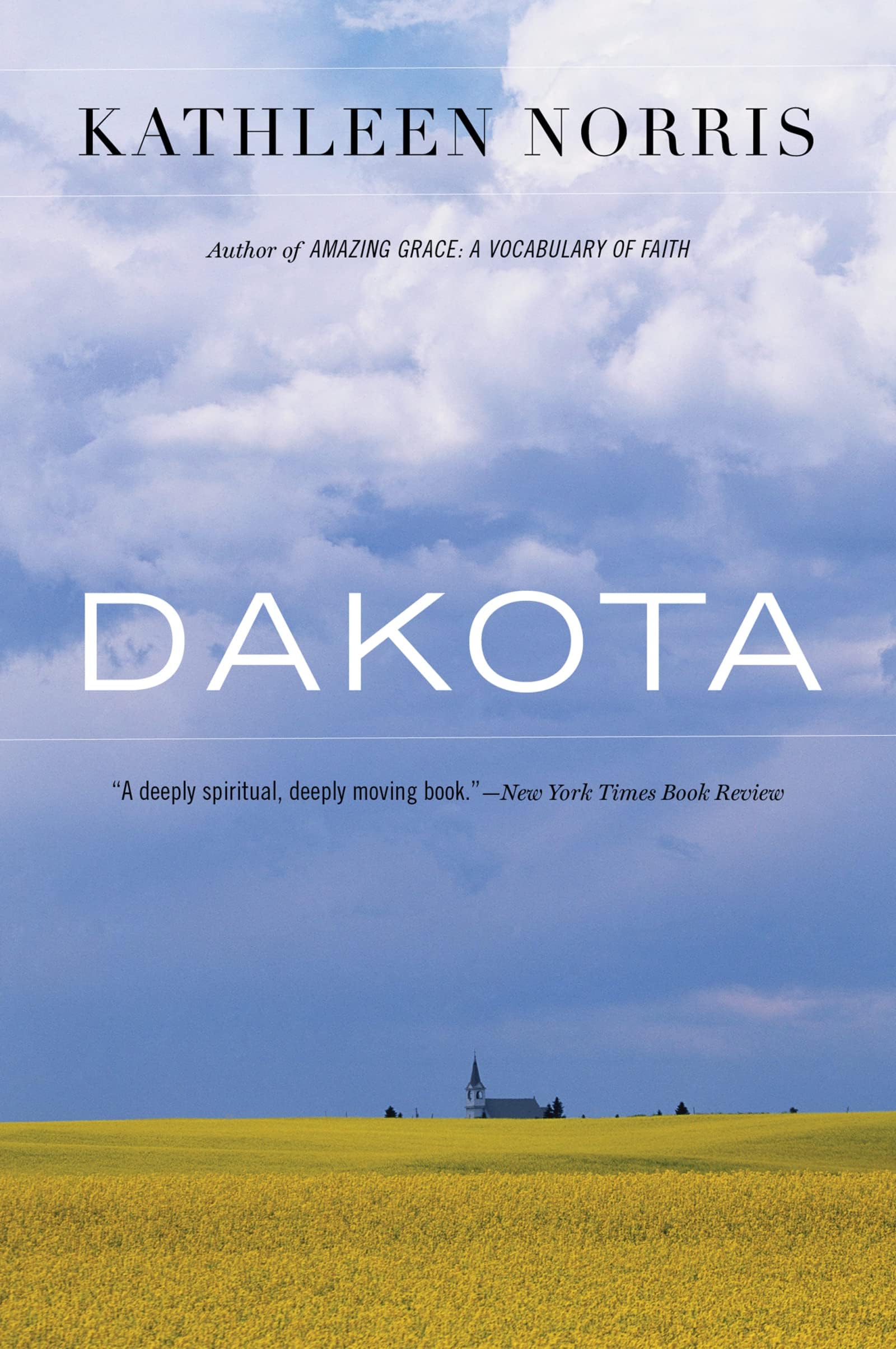
This was one of the most enjoyable and stimulating reads I have had for a long time. It is doubtful whether any other reader of this book is so far removed, geographically, from Lemmon, South Dakota, (where the author Kathleen Norris lives), as myself. Yet, living in the open spaces of the wheatbelt in Western Australia allows me to probably identify with the author's situation more than a New Yorker (and NY city is where Norris relocated from - back to her family roots in SD). Her instinctive knowledge and portraits of small town life is applicable not only to her own patch, in the far northwest of SD, but also, in so many respects, to other lands. Kathleen Norris gives a nice blend of Dakotan history-interwoven with topical,personal and spiritual issues. The chapter on the small church at Hope gives a great insight into the dynamics of a small farming/ranching community. 'Getting to Hope' filled me with the same. Presumably, the great colour picture on the cover of 'Dakota' was of this prairie church that somehow typifies the spiritual geography,described by Norris in her text. The author's ecumenical bent is obvious by the fact that, although solidly Protestant, she values the monastic life and, as a Benedictine oblate, she takes the reader with her, 'on retreat,' behind the walls, giving a realistic appraisal of the community of Catholic monks and making some interesting comparisons between monastic life and that of small towns. Visiting 'the Big Apple' Norris is told by a dying friend, " I like the person you are becoming...those monks are good for you. Don't let them forget me." Norris notes:" Suddenly I saw...what monks are for. Their hospitality allowed us to say our goodbyes and allowed my friend a chance to bless me and charge me with keeping her memory." Any lingering notions that Norris had of monks being an anachronism went out the window and into the Manhattan night! In a sense, 'Dakota'did much the same for me. I read it in mid- January as I spent time in my parents home, usually alone, cleaning up after my step-father's death (on Christmas Day). Birth, death, new life are important subjects and Norris has the ability and strength of writing to gently make her reader reflect on these great issues. She writes for all, yet writes for one. (I suppose it is appropriate that I write this review on my birthday). In writing this book Norris has crossed many boundaries-far wider than the Great Plains. She has not made me want to visit South Dakota- I have wanted to do that for a long time- but she has ensured that when I do I will certainly take-in her remote part of the state. However, one doesn't have to physically travel to Dakota to make a great journey- that happens when you commence to read this book. Highly recommended.
V**N
"Tell me the landscape in which you live, and I will tell you who you are."..Jose Ortega y.Gassett
Having read several books by this author, I finally decided to purchase "Dakota, A Spiritual Geography" written in 1993. I bought the paperback version (2001) used. After enjoying reading about her life on the high plains, in Lemmon. S.D., I googled Lemmon, S.D. to see what this town looks like today. This website brings the story together - the town did not disintegrate - it is modern and worth a visit. How nice to see how her town evolved in the past eighteen years. The author is right - one usually drives thru the Dakotas fast after stopping at the few tourist attractions, tho many people admire the Badlands (I thought it was spooky!) I enjoyed her "weather reports" and wonder how anyone can live in this part of the country. Seeing the flooding of little towns along the rivers in the Dakotas is heart rending. Kathleen Norris blends her spiritual journey with her uncanny ability to write from the heart, teaching the reader how to "think". I did quite a bit of underlining (I, too, live in a small town). Here is a paragraph from page 51..."The sad truth is that the harder we resist change, and the more we resent anyone who demands change of us, the more we short-change ourselves. Who could be more impoverished than the man who, on hearing news of a former teacher, exclaimed in a tavern, "That old cow? She used to make me read. Said I couldn't graduate till I read all she wanted. Well, I showed her, I haven't read a book since." Obviously, from the web site of Lemmon, S.D. there have been many changes. Perhaps Kathleen Norris assisted. In her book she attempted to make education, the arts, and finding peace thru contemplation a priority. Perhaps she will write another book about the modern Lemmon of today.
D**L
Some Spiritual Morsels in a Textbook-Like Setting
Some of Kathleen Norris's books are thick and hard to plod through. This one is much shorter--220 pages--but for me it was slow going because for a third of the book I was plowing through so many facts and figures and they are not my forte. I turn 65 in three days--maybe I want to forget about my schooldays. She is very thorough in giving us a description of the landscape and climate of the area in the High Plains. We become aware of how climate extremes can take over people's lives and determine the patterns of their days. Life in the Dakotas doesn't sound easy and it didn't appeal to this indoor woman who enjoys creature comforts. I found myself getting hungry and thirsty for more personal stories as she requires us to make it through the "textbook" portion of her book first. It seemed as though she were writing about the land and the climate for so long even though it's about a third of the book but then more facts are woven in with the personal stories. You can never escape the plains and maybe this was her point. Many of the farmers become more reclusive as a result of the lives they lead so close to the land and dependent on the climate for their survival. Norris even moans about the fact that many of them spurn reading. To me this is rather understandable. Her most inspirational stories revolve around The Hope Presbyterian Church and the monasteries because so many of these people aren't reclusive--they reach out to their fellow humans as well as to God. I've learned much about monks. I never pictured them as being as social, as humorous, or as caring as so many of them are. I used to feel that one had to be rather introverted and reclusive to choose such a life. So I was inspired by their people-centered spirituality. Hospitality is part and parcel of what a monastery is all about. But the liturgy of the hours seems to make it all possible--the monks are addicted to their daily communal prayers and rituals which strengthen them spiritually, making them stronger in faith and more able to connect to others. Just the fact that they live with the same people day in and day out is incredible--the way they tolerate one another's idiosyncrasies in their cloistered environments. I'd be ready for a padded room! I know that some reviewers are left thirsting for more stories about the geography of the place and others are left wanting more stories about the inhabitants of the place. It's just a matter of taste. For me there were some nuggets amidst a lot of dry stuff. I'm one who can be satisfied with just a few lines of geographical description so this one was a bit too detailed for me.
S**N
I left, but the roots are deep
I grew up in South Dakota on the Eastern Plains...and never understood the differences between the halves of the State. West River might as well have been a foreign country! So I learned alot about the landscape, way of life and people of the West River.. And yet...I had to nod and chuckle through all of the descriptions of the people...so few and far between. The attitudes and perspectives of the local communities are universal in a more remote area. Libraries? We already have enough books in ours! Why would we need or even want more? Outsiders? They must be part of the witness protection program, so be suspicious. I hear these same comments today when I return to visit family! I'm one who left the region for greater opportunities, but always have that common pride of being a Dakotan. It's one of those places where six degrees of separation probably are closer to three degrees, if one asks enough questions. I've recommended this read to all my extended family who, like me, moved away in younger years. The people who remained? May not appreciate parts of this book...it's too close to home.
B**Y
Highly recommended. Especially for those that are originally from North ...
Highly recommended. Especially for those that are originally from North or South Dakota or have roots there. Kathleen helps many people with Dakota roots understand why they think and act the way they but understood why. Also she weaves well those that are very spiritually grounded especially Orthodox, Catholics Lutherans and other old school church types from the area. References the Desert Fathers a lot. Which i enjoy how that is woven in with glimpses of he own spiritual journey.
S**R
Insightful!
I have read and re-read and read again ! This is one of those books that nourishes me anew with each reading. This is a book that encourages contemplation. And highlighting.
L**D
An intelligent, lyrical Masterpiece
I already ownned Kathleen Norris' ACEDIA AND ME, a book I cherish. DAKOTA, written fifteen years earlier, did not disappoint, but drew me into a physical and spiritual landscape of great beauty, described in lyrical prose. Her honed skills of perceptions shine in the twelve brief monthly "Weather Reports", besides selected historical and social data needed for the understanding of its people and nature. I read it with great pleasure and recommend it warmly. Louise Harwood
R**L
insightful
Norris brings the joy of faith, and the struggles of being a person of faith in the present world into context. She is witty and well grounded in her understanding of life.
Trustpilot
2 months ago
2 weeks ago