
DOWNLOAD THE APP


Customer Services
Copyright © 2025 Desertcart Holdings Limited
DOWNLOAD THE APP
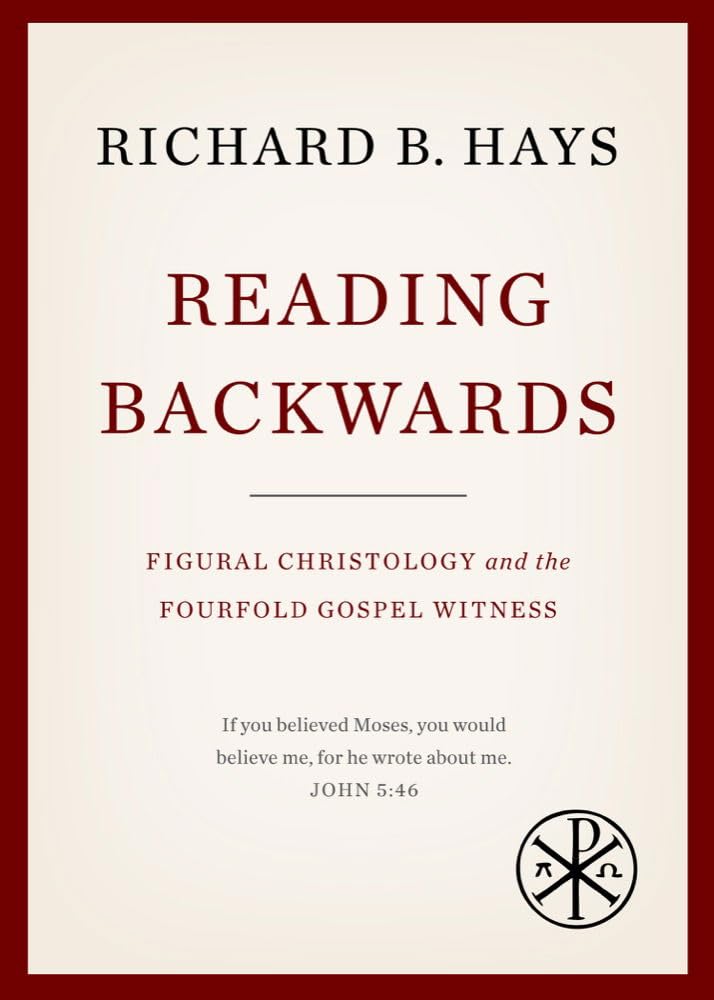
Reading Backwards: Figural Christology and the Fourfold Gospel Witness [Hays, Richard B.] on desertcart.com. *FREE* shipping on qualifying offers. Reading Backwards: Figural Christology and the Fourfold Gospel Witness Review: Illuminating the Gospels Through the Lens of the Old Testament - In Reading Backwards, Richard B. Hays offers a compelling exploration of how the four Gospel writers interpreted Israel's Scriptures to reveal the identity of Jesus. Hays demonstrates that the Evangelists did not merely use the Old Testament to support their narratives but engaged in a figural reading that saw the events and figures of the Hebrew Scriptures as prefigurations of Christ. Each chapter delves into one of the Gospels, uncovering the unique ways in which the authors employed Old Testament texts to portray Jesus as the embodiment of Israel's God. Hays's analysis is both scholarly and accessible, making complex theological concepts understandable for a broad audience. His approach encourages readers to appreciate the depth and richness of the Gospel narratives and to see the continuity between the Testaments. This book is a valuable resource for anyone interested in biblical studies, theology, or the interpretive methods of the New Testament writers. It challenges readers to reconsider how they read Scripture and to recognize the profound connections that the Gospel authors saw between Jesus and the sacred texts of Israel. Review: A masterpiece! - The purpose of this work is to provide us with a perspective of the testimony that the four Gospels give us of the Deity of Jesus, "viewed in light of the intertextual engagement with Israel's Scripture" (ix). The author takes as his starting point the illustration of Martin Luther, who in defense of the Old Testament, affirms: "Here you will find the swaddling cloths and the manger in which Christ lies" (1). Richard Hays proposes in this book the figurative reading of the Gospels, showing us the ways how the four evangelists "unwind the swaddling cloths" in which the Law, the prophets and the Writings involve Christ in the Old Testament. His thesis is that the four canonical Gospels show us that throughout the Old Testament, Christ is mysteriously prefigured, something we can discern by reading the Old Testament retrospectively, in the light of the Gospels. In this way, the Gospels teach us "how to read the OT, and - at the same time - the OT teaches us how to read the Gospels" (4). In other words, we must learn to read the Old Testament "by reading backwards from the Gospels" (4). This means, not only that we must correctly interpret the fulfilled predictions about Jesus in the New Testament, but rather that we must learn to listen to the echoes of the Old Testament Scriptures in the Gospels, since often the scriptural references "are woven seamlessly into the fabric of the story"(17). Starting from that premise, the author convincingly demonstrates his thesis, starting with the Gospel of Mark, followed by that of Matthew, Luke and John. Guiding us through well-known passages - such as Mark 4:35-41; 6:30-44; Matt. 18:15-20; 28:18-20; Lk. 13:10-17; or Jn. 10:22-30 - Richard Hays helps us sharpen our ears to hear the echo of the Old Testament Scriptures, allowing us to acquire a much richer understanding of many passages that, despite being so familiar, we can now read them in a fresh and deeper way. Although its content was originally exposed orally, and its content was only slightly revised for publication, its reading is fascinating. I greatly appreciate the concise manner in which the author expresses himself. In just 109 pages, if we exclude the bibliographical notes and the works cited, the author is able to take us through the four Gospels and show us true gems of biblical interpretation in unexpected passages. In that sense I can only agree with the review of Books & Culture when referring to this book as "a masterpiece".
| Best Sellers Rank | #507,138 in Books ( See Top 100 in Books ) #989 in Jesus, the Gospels & Acts (Books) #2,012 in Literary Movements & Periods #8,258 in Christian Theology (Books) |
| Customer Reviews | 4.7 out of 5 stars 143 Reviews |
B**Y
Illuminating the Gospels Through the Lens of the Old Testament
In Reading Backwards, Richard B. Hays offers a compelling exploration of how the four Gospel writers interpreted Israel's Scriptures to reveal the identity of Jesus. Hays demonstrates that the Evangelists did not merely use the Old Testament to support their narratives but engaged in a figural reading that saw the events and figures of the Hebrew Scriptures as prefigurations of Christ. Each chapter delves into one of the Gospels, uncovering the unique ways in which the authors employed Old Testament texts to portray Jesus as the embodiment of Israel's God. Hays's analysis is both scholarly and accessible, making complex theological concepts understandable for a broad audience. His approach encourages readers to appreciate the depth and richness of the Gospel narratives and to see the continuity between the Testaments. This book is a valuable resource for anyone interested in biblical studies, theology, or the interpretive methods of the New Testament writers. It challenges readers to reconsider how they read Scripture and to recognize the profound connections that the Gospel authors saw between Jesus and the sacred texts of Israel.
S**N
A masterpiece!
The purpose of this work is to provide us with a perspective of the testimony that the four Gospels give us of the Deity of Jesus, "viewed in light of the intertextual engagement with Israel's Scripture" (ix). The author takes as his starting point the illustration of Martin Luther, who in defense of the Old Testament, affirms: "Here you will find the swaddling cloths and the manger in which Christ lies" (1). Richard Hays proposes in this book the figurative reading of the Gospels, showing us the ways how the four evangelists "unwind the swaddling cloths" in which the Law, the prophets and the Writings involve Christ in the Old Testament. His thesis is that the four canonical Gospels show us that throughout the Old Testament, Christ is mysteriously prefigured, something we can discern by reading the Old Testament retrospectively, in the light of the Gospels. In this way, the Gospels teach us "how to read the OT, and - at the same time - the OT teaches us how to read the Gospels" (4). In other words, we must learn to read the Old Testament "by reading backwards from the Gospels" (4). This means, not only that we must correctly interpret the fulfilled predictions about Jesus in the New Testament, but rather that we must learn to listen to the echoes of the Old Testament Scriptures in the Gospels, since often the scriptural references "are woven seamlessly into the fabric of the story"(17). Starting from that premise, the author convincingly demonstrates his thesis, starting with the Gospel of Mark, followed by that of Matthew, Luke and John. Guiding us through well-known passages - such as Mark 4:35-41; 6:30-44; Matt. 18:15-20; 28:18-20; Lk. 13:10-17; or Jn. 10:22-30 - Richard Hays helps us sharpen our ears to hear the echo of the Old Testament Scriptures, allowing us to acquire a much richer understanding of many passages that, despite being so familiar, we can now read them in a fresh and deeper way. Although its content was originally exposed orally, and its content was only slightly revised for publication, its reading is fascinating. I greatly appreciate the concise manner in which the author expresses himself. In just 109 pages, if we exclude the bibliographical notes and the works cited, the author is able to take us through the four Gospels and show us true gems of biblical interpretation in unexpected passages. In that sense I can only agree with the review of Books & Culture when referring to this book as "a masterpiece".
K**K
The Impotance of Knowing the OT
This will help those who want to properly get an understanding on the mindset of how the Gospel writers put pen to parchment. By taking a look backwards and give understanding of what the OT spoke about.
C**S
Interesting and a Useful
These are a series of public lectures. They may be somewhere below "high academic theology" but not by much. The reasoning is erudite and scholarly and highly founded in Bible scholarship. Greek is used extensively but translations are always provided. Deep understanding of the arguments does assume a lot more familiarity than an ordinary bible student like me has. As LDS I was a bit surprised at the author's assertions that the OT is neglected in Protestant teaching. I grew up with an urgency and insistence in identifying Jesus Christ as the God of the Old Testament. Many examples were familiar in a but-of-course way but many others were new and revelatory. My Catholic friend who recommended it had recommended it to a Methodist bible study he was participating in. Because these are lectures (albeit to a scholarly audience) they are more accessible to interested students of the scriptures without academic experience than one would expect from a work conceived to be read as opposed to heard.
P**D
Hays brilliantly lays out the diverse ways in which all of ...
Hays set’s out his “twofold thesis that the OT teaches us how to read the Gospels and that–at the same time–the Gospels teach us how to read the OT.” He boils this down even further in saying that “Scripture is to be reinterpreted in light of the cross and resurrection.” If we under scripture as unveiling God’s story, this should seem obvious. And yet, how often is such reading discouraged. Goldingay, for example, acknowledges that “The biblical gospel is…a narrative about things God has done.” And yet in his method he does not “discus the way what is concealed in the Old is revealed in the New.” “Moses” he writes, “suggests that his teaching, and the Old Testament by extension, is not a repository of concealment but a repository of revelation. The New certainly assumes that there are things that are revealed in the New, but that is not a basis for reading them into the Old. They are new.” Hays disagrees. For example, in writing about Jesus’ claim to be the “bread of life” in reference to the the crowds question about manna, Hays writes that “According to John’s Gospel, that is the true meaning of what Moses wrote.” The Gospel writers are teaching us how to re-read scripture in light Jesus death and resurrection. Hays brilliantly lays out the diverse ways in which all of the Evangelists do this, and concludes with a final chapter on why such diversity is important, albeit complicated. One reason why such reading is crucial is that allows us to see (as intended, I believe) that all of the Gospel writers, and not just John, have a “high Christology” if we are reading correctly. I’ll end with this quote, which seems appropriate for the review, from Hays: “To read Scripture well, we must bid farewell to plodding literalism and rationalism in order to embrace a complex poetic sensibility. The Gospel writers are trying to teach us to become more interesting people–by teaching us to be more interesting readers.” Hays “Reading Backwards” helps us to become such people. [As an aside, I do hope this book comes down in price. It is very expensive for a 109 page book.]
M**N
making a difference
I'll leave to others to write a delineated review and comment simply that with only a quarter stretch yet in the book to read, I can honestly say I see the differences in the Gospels, that they do make a difference; and Dean Hays shows how wonderfully they all contribute to our understanding. His presenting of the Road to Emmaus in The Art of Reading Scripture was noteworthy and again it is in Reading Backwards. And standing out as a cameo that invites us to Jesus and to witness for Him, is Philip's answer to Nathanael in John 1:46. Nathanael asks, "Can anything good come out of Nazareth?" Philip responds, "Come and see." Don't miss the reflection on Philip's insightfulness.
S**N
A Needed book on understanding the Bible
I am so frustrated with the majority of sermons I hear using the Bible as a fix-it manual ("how to fix your finances', 'how to fix your marriage', etc.). What I love about writers like Hays is that he shows us that (surprise! surprise!) the Bible is really about God, who he is and his plans to deal with an alienated world. Whether one agrees or not, Hays shows Jesus to be truly divine (somehow the Hebrew God in human form), plus shows that the New Testament cannot be fully understood without understanding the OT. This is a wonderful contribution to BIBLICAL hermeneutics as well.
C**.
Very Interesting Book
Our son gave this book to my husband for Christmas and he found it so valuable that he asked me to purchase three more copies to give to friends and family. For the last few weeks he has used this book as the basis of the Bible study he teaches at our church. There are several people in the class who had asked whether or not the Old Testament is worth studying and reading or if it might be better to just focus on the New Testament. This book will make it clear that all of scripture is about Christ and how little we can understand the New Testament if we ignore the Old Testament. The book has made the class very, very interesting and worthwhile. I plan to read it myself as soon as I can wrest it away from my husband.
Trustpilot
2 weeks ago
1 week ago