


Desertcart purchases this item on your behalf and handles shipping, customs, and support to Sri Lanka.
🚀 Mini PC, Mega Impact: Power your productivity in a sleek, 4K-ready package!
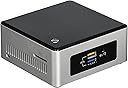
The Intel NUC5CPYH is a minimalist yet powerful mini PC featuring a dual-core Intel Celeron N3050 processor clocked at 2.16 GHz, integrated Intel HD Graphics with 4K HDMI output, and versatile connectivity including 4 USB 3.0 ports and 802.11ac Wi-Fi. Its compact 4x4 inch form factor supports SATA3 2.5-inch HDD/SSD storage, making it an ideal choice for professionals seeking a space-saving, energy-efficient desktop solution with modern multimedia capabilities and robust wireless networking.




| ASIN | B00XPVRR5M |
| Additional Features | Microphone |
| Aspect Ratio | 16:9 |
| Best Sellers Rank | #118 in Desktop Barebones |
| Brand | Intel |
| Built-In Media | Fan and Heat Sink Included |
| CPU Model | Celeron |
| CPU Model Number | Celeron N3050 |
| CPU Model Speed Maximum | 2.16 GHz |
| CPU Speed | 2.16 GHz |
| Cache Memory Installed Size | 2 |
| Cache Size | 2 |
| Color | Black |
| Connectivity Technology | Ethernet, HDMI, USB, Wi-Fi |
| Cooling Method | Fan |
| Customer Reviews | 4.0 out of 5 stars 498 Reviews |
| Display Resolution Maximum | 3840x2160 |
| Display Type | LCD |
| Global Trade Identification Number | 00675901321464, 00735858293167, 05032037071277 |
| Graphics Card Description | Integrated |
| Graphics Card Interface | Integrated |
| Graphics Coprocessor | Intel Integrated Graphics |
| Graphics Description | Integrated |
| Graphics Ram Type | DDR DRAM |
| Hard Disk Description | HDD |
| Hard Disk Interface | Serial ATA |
| Hardware Interface | HDMI, USB |
| Human-Interface Input | Keyboard |
| Item Dimensions | 5.39 x 4.92 x 4.57 inches |
| Item Type Name | Intel NUC PC with Intel Celeron N3050 |
| Item Weight | 1170 g |
| Keyboard Description | [IN] |
| Keyboard Layout | QWERTY |
| Manufacturer | D&H |
| Memory Clock Speed | 1600 MHz |
| Memory Slots Available | 1 |
| Memory Speed | 1600 MHz |
| Model Name | BOXNUC5CPYH |
| Model Number | BOXNUC5CPYH |
| Model Year | 2015 |
| Native Resolution | 3840 x 2160 |
| Number of Component Outputs | 4 |
| Operating System | Windows 8.1 |
| Personal Computer Design Type | Mini PC |
| Power Plug Type | Type A - 2 pin (North American) |
| Processor Brand | Intel |
| Processor Count | 1 |
| Processor Series | Celeron |
| Processor Speed | 2.16 GHz |
| RAM Memory Technology | A8 |
| RAM Type | SDRAM |
| Ram Memory Maximum Size | 8 GB |
| Resolution | 3840 x 2160 |
| Speaker Type | Headphone |
| Specific Uses For Product | business, personal |
| Specification Met | Energy Star Certified |
| Style Name | Minimalist |
| Total Number of HDMI Ports | 1 |
| Total Usb Ports | 4 |
| UPC | 755034342007 735858293167 675901321464 |
| Video Output | HDMI, VGA |
| Video Output Interface | HDMI, VGA |
| Video Processor | Intel |
| Warranty Description | 3-year limited warranty |
| Wireless Compability | 802.11ac |
| Wireless Network Technology | Wi-Fi |
| Wireless Technology | Bluetooth |
A**R
Installing Linux in a NUC
Installing Linux in my new NUC was something of an adventure. Hopefully, this review will make it more boring for the next person.If you're installing Windows, you need to find another review. First off, this model of NUC has the latest Intel wireless chips (as of Dec. 2015). These are supported in the 4.x kernel, but won't work in any distro with a 3.x kernel. I tried two flavors of Ubuntu 15.10, and the latest Fedora. The built-in Wi-Fi, Blue-tooth and USB 3.0 all work out of the box. It is recommended that you update to the latest BIOS. I downloaded the firmware from Intel, and installing it was easy (once I finally got into the BIOS, see below). Getting into the BIOS was the first hurdle. I have an older HD TV that doesn't have an "over-scan" adjustment (which means that the top and bottom edges get cut off). So I hooked it up with a VGA cable. Booted it up and got a blank screen with no response to the keyboard. Did some Googling and found the NUC BIOS won't work without the correct hardware. It needs to have a compatible video, keyboard and mouse, or it won't even boot. I switched to a HDMI cable, and it booted right up. So if you don't see a splash-screen saying "Intel NUC", then doesn't it like your hardware. I've read that the USB 3.0 ports mess with some wireless keyboards, but my Logitech K400 works fine. The standard BIOS defaults seem to work fine with Linux. I looked, but didn't even see any options for turning off "Fast Boot" or "Secure Boot". So unless you have a specific reason, I would just accept the factory defaults and leave the BIOS alone. I first tried booting from a Linux DVD and pretty much everything worked. The top and bottom edges of the desktop didn't show on the screen. But I kept clicking past the edge of the screen till I found the Menu button. Set the video resolution one step down and now I have full screen. Didn't get sound through the HDMI cable, but I think there may be a system setting to fix that. After I updated the BIOS, the NUC would no longer boot off the DVD. It would start to load Linux, then just hang up halfway through. I hit F10 during startup, and found the BIOS now showed two different options for booting the DVD in either Legacy mode or EFI mode. Tried EFI mode and it booted right up. So, depending on your boot media, you have to try both modes to see which one works. Installing Linux onto a blank hard drive requires creating an EFI boot partition (which has to be FAT32). I suspect that if I had just told the installer to use the entire hard drive, it would have figured everything out by itself. But I wanted room to install a second Linux distro, or maybe even Windows someday. So I manually partitioned the hard drive to leave some empty space. This took a couple of tries to get the boot loader in the right place. I tried telling the installer to put the boot files in the boot partition, but that didn't work. The next time I just told it to put the boot loader on the hard drive, and the installer put it where the BIOS could find it. Modern Linux distros can use EFI booting. But different distros use slightly different installers, and there is no standard look or labeling. If possible, just let the installer do all the work. If you're doing it manually, don't be surprised if it takes you a couple of tries to get it to boot properly. UPDATE The BIOS on this PC seem to be very poorly done. I had it set it up for UEFI booting, so I switched off the Legacy boot option. That somehow killed the F2 option to get into the BIOS settings. I had it set up to boot into Linux just fine, then after a few times it started giving me a blank screen on bootup. Sometimes the Linux Recovery Mode will fix it, sometimes not. I've been building PCs and installing Linux for 15 years, and never had a PC give me this much trouble. The hardware itself seems to run fine. But right now I never know from one time to the next whether it will boot up or not.
U**B
Nice Little Box
Right now, this is a *very* new device. The bang for the buck is pretty amazing. Getting 4K video in something this low power (and low cost) is way beyond the previous generation of parts. It's also powerful enough to make a nice little standalone server. Drop in a 4 or 8 GB ram stick and a 2.5" ssd. This gizmo is quite responsive. I *assume* it runs Windows fine, that was not my target for this device. I brought it up under Linux. ...... and .... Intel has had the CPU out for only a little while. Linux is busy catching up with all the subtle ins and outs of the new device. That's a normal situation when a new chip comes out. Install any of the (as of July 18th 2015) standard Ubuntu builds and you will get a kernel in the 3.x series. This beast needs a kernel from the 4.x series. (If you are lost by this point, don't buy this as a Linux box right now). The issues are *not* specific to the NUC. All of the Braswell CPU based parts have exactly the same problem. It's not the board, it's simply the Linux world catching up with a bunch of new features. Returning the box and getting a new one will *not* fix the errors in kern.log. You *can* install a 4.x kernel from Ubuntu's nightly build process. They all are likely to have issues in them. Right now kernel 4.2 takes care of the video memory timeout check errors that 3.19 has when run on this device. It probably brings in a number of other interesting issues, but at least it takes care of the most obvious problems. The last post in this thread: [...] Gives a basic recipe for how to update the kernel. The exact files used in that post are no longer correct. They change far to often to keep something like that up to date. You will need to browse the folder they are in to get the current file names. If you really want to go into all this, Intel does have a NUC forum. If Ubuntu is not your favorite Linux, I'm sure that your distribution will have ways to get to a 4.x kernel. Just make sure the route is one you are willing to deal with *before* you buy one of these boxes. If none of this makes any sense *and* you want to run Linux - wait a while to buy this gizmo or any other board based on this very nice chip set. Let the people work out the issues and generate a stable released build with the 4.x kernel. There also is a bit of messy screen as Grub does it's video switching thing. I suppose one of these days I'll dig deep enough into the config files to fix it. It's also possible I'll just ignore it until Grub's "auto" feature works with the newer graphics. It's a pretty minor issue. ===== Just in case you *are* looking to install Win 7 on this box, there is a non-trivial process involved there as well: [...] Just like every Windows release ever, the install disk only handles hardware that was on the market when the disk came out. In this case it's USB3. In years gone by it was a whole variety of things. The fix has always been to get the drivers for the device into the install stream. Depending on the driver and Microsoft's whims, that can be pretty easy or (as in this case) a bit more difficult. It does indeed install (Yes, I bought another one of these...) it's just a bit of a hassle to do. Any time you put an "old" OS onto "new" hardware, these things come up .... If you take a look at the box it comes in (yes this is an edit a bit later ... who every reads the box !!!) it mentions Windows 8 compatibility but makes no mention of Windows 7 or before. The listing probably could mention this. There's a *lot* of information on the box and in the instructions (never read them ...) that might be helpful. A few highlights: Warranty is 3 years Input voltage range is 12 to 19V (will not go to ~10V for a full automotive install) The infrared sensor comes out the front panel. The power adapter says it's good from 100V to 240V AC 50/60 Hz. (Those of you on 25 Hz may be out of luck) It took exactly 4 weeks for the latest one to get from the factory in China to my doorstep. ============ Simply to save people digging through the comments: Under the kernel patch I'm running, there still is an issue with the WiFi drivers. There may be a workaround. I don't run WiFi on my box so it's not as big a deal to me as it may be to you. Some of the newer kernels have it fixed. with the incorporation of a newer Intel driver. Bios update is located here: [...] ====== Thanks to Oscar's comment below: For the wifi, download the firmware iwlwifi-7265D-13.ucode, place it under /lib/firmware and you're done. Both WiFi and Bluetooth work ok (at least in Ubuntu with 4.1.3 kernel). Direct download link to the firmware: [...] There is now a way to take care of the WiFi and Bluetooth drivers on Ubuntu. I suspect it also works on other versions of Linux. I'd say that's enough (plus Win 10 being out with all the drivers) to bump it up a star. Even if you NUC is dated *after* the bios release date, it probably does not have the latest BIOS. It's always worth checking. Bob
A**7
Decent system with a few minor issues
I bought two of these to use as small storage nodes as aprt of a GlusterFS cluster, and they've worked pretty well for that usage. Each system is using 4GB of DDR3-1600 RAM and a 250GB SSD. The resultant cluster isnt all that fast (it gets about the same performance as a mid raunge USB 2.0 flash drive), but for my usage of storing backups, it works very well, especially considering the price. Pros: * Extremely energy efficient, average usage when the cluster is idle is less than 5W, and it rarely goes over 10 even when I'm heavily utilizing the systems. * Very compact. I could probably fit 20 of these in about the same space as a regular ATX tower case. * Quiet. This is a big one for me, they use an axial blower instead of a regular fan, so even though the 'fan' is running at over 3k RPM, it's pretty much silent. * Easy to set up. It took me maybe 3 minutes to put together each system, and most of that time was spent fighting with the RAM packaging. THe only tool needed was a regular phillips head screewdriver. * Very well designed firmware configuration interface. For me, this is just icing on the cake, but the firmware configuration interface is very well designed and easy to use. * Good Linux support. All the hardware is supported by upstream drivers in the Linux kernel, which means it's pretty trivial to get Linux installed. * Indepensive. This is literally the least expensive general purpose x86 system I've ever seen. The configuration I used cost only about 250 USD, and almost half of that was the RAM and SSD. Cons: * Takes a long time to POST. This is more of an annoyance than anything else, but the system takes about 90 seconds to even POST before it even thinks about handing off execution to the bootloader. * Has issues with hot-plugging monitors. This is more of an issue for me than it is likely to be for anyone else because I normally run these headless, but at least on Linux, no monitors that are connected after boot are recognized as even existing. * CPU is the performance bottleneck. Based on everything I've tested, the CPU is literally the slowest component in this system. Compiling software on one of these is painfully slow (building GCC with most stuff turned off takes well over 8 hours), and I'd imagine that running Windows on one of them is not a pleasant experience. I expected this to be a slow system given the price, but I had forgotten just how much Intel marks things like this up (you could get an equivalent AMD processor for maybe 30 USD, or a whole ARM based system with similar performance for 35 USD). Overall, I would probably recommend these to people looking to set up small micro-servers, but I would not be willing to use this as a home computer.
J**.
What a little gem!
Purchased this (along with an Samsung 850 EVO 120GB SSD and Kingston 8GB SODIMM) to replace an aging home-built midtower HTPC in a bedroom, with the intention of using it pretty much strictly for Kodi, Amazon Instant Video, and a Steam streaming box. Because of this I opted for a Linux install as Windows would be overkill. I prefer Windows but am familiar enough with Linux that it was little trouble. Note that out of the box this had BIOS rev. 27 installed, this was updated to rev. 31 before the OS install. Ubuntu 15.04 installed easily via USB and runs with no issues. Note that until 15.10 is available with the 4.x kernel (I believe late October), the Cherrytrail GPU support has some issues, but no obvious showstoppers except for Steam (more below). My media storage is a headless Windows box with a RAID setup and a MySQL database to sync multiple Kodi clients. Everything went perfectly with Kodi and it performs wonderfully playing remote 1080p HD. This was my main concern and I couldn't be happier with it. Firefox runs like hot garbage at this point - it may be an artifact of the GPU support issues in the 3.x kernel, but I'm not sure and don't really care, because right now not play back Amazon Instant Video in HTML5 and requires using a 3rd part repository to get Flash playback working - which runs like crap anyway. Installed the latest stable Chrome (not Chromium) which runs like a champ and plays Amazon in HTML5 with no issues. Steam install took a little doing, but this is a Linux thing and nothing specific to this machine. At this time Steam streaming is definitely affected by the GPU issues - the stream will work, but video decoding is hosed. I installed FTL locally and that runs fantastic however. I hope the GPU fixes in the new kernel will get the streaming working. This was a "nice to have" item and not a dealbreaker. All in all this little guy is fantastic. It's almost completely silent, and looks attractive - or can easily be hidden pretty much anywhere you want. The performance and build quality at this price point is shockingly awesome. I'd expect with Windows 10 I wouldn't have run into the few minor issues that I did. I'm an instant believer in the NUC after this - we had intended to give a rebuilt Ivy Bridge desktop as a Christmas gift for the SO's mom, but now I will absolutely be going with a new i3 NUC instead. If you are looking for a more robust HTPC solution than a Roku/AppleTV/etc., you cannot go wrong with this, and if you don't mind a little tinkering, it's trivial to get Ubuntu (or OpenELEC or you distro of choice I'd assume) up and running.
A**R
Bad Experience.
so far - disaster get this one couple days ago . Tried a couple of 4gig mems I had around , they booted once - apparently a power mismatch issue. got a proper 1.35volt mem - booted and installed 8.1 ok. Drivers are NOT out of the box and not on windows update. Got the intel utility going - and installed all drivers - some fail. After much too many auto or manual attempts , my status is as follows: 1. all device manager drivers seems installed ok. 2. hdmi 1920 resolution is bad - driver seems to simply not work (10.18.14.4234), the display is over scanned and the ugly intel interface has no option handle it. fonts are not smooth and seems like generally none slic view... 3. write speed to brand new 120GB SSD are pretty bad. even manual drivers extract is skewed like im on usb 1.0... (read and write to ssd) windows reboot and boot times are not really feeling 'ssd' 4. usb logitec keyboard/mouse over usb takes a while to get going , sometimes stalling for several seconds... I did not expect this from an inuc....pretty damn disappointing. if I cannot get this resolved soon i'll be returning it... ------------------------------------------------------------------------------------------------------------------------------------------------------------------- ok the main issue is resolved or worked around by moving to a different LCD 1080P screen. Its still a driver compatibility issue with the SAMSUNG LCD (swapping hdmi cables did not help) For now this would be a keeper cause its aimed as a present for my old man... still you expect a better XP overall from NUC (my third device) -------------------------------------------------------------------------------------------------------------------------------------------------------------------------- update 09-13-15 the device was working ok for a while with a crucial GB(CT8G3S160BM.C16FER and today i can no longer see its boot bios. taking off parts one by one again i am left with a memory component , but there is not even a method of troubleshooting it. very frustrating xp continues. After two NUC that have been working for years and still working, this one is a bad ENG design. its that at that same day1 xp i had when i attempted to use other ddr3 laying around and got it booted once(possibly 1.5volt issue, but current brand is 1.35v) so go figure. this one might require returning... ------------------------------------------------------------------------------------------------------------------ update 09/14/15 Ran full bios recovery and got bios working again. Upgraded bios from 022 to 040(latest*) Attempted to boot os which hang on logo screen , eventually loading but painfully slow. Removed SSD and tried to boot live ubuntu (e-os), black screen after grub(choosing live option) Replaced 8GB memory with a working module from a second NUC - no effect. I do not know how to further isolate the HW condition...
S**T
meh.
Thi unit is "OK". Its a nice little basic computers. I installed 8gb ram and a 160gb SSD (older intel ~250MB/s) The CPU power is good for web browsing, what what not. I was able to get it to lag up on it with a few tabs, Word 2016, Outlook 2016 and music playback. But it wasn't bad. I tried it as a HTPC, I love the build in. IR (CIR) MY recover remote was able to control it in Kodi just fine. Combined with the intel remote touchpad/keyboard for ym iPhone when I needed a full KB/M It worked really well. the bad: The fan is annoyingly loud... Its high pitch and never seems to turn off. I read around that some flex in the fan case from being put on too tight caused it, I took it apart and adjust the fan it actually did help but its still annoying. I ended up giving it to my daughter for her room and swaping the laptop she was using for a desktop with the nuc. I used the i5 laptop for my HTPC. We will see how the NUC works with her Paint Tool Sai in time. I think she is going to find it slow and start asking me about it. Im not sure I will but another Nuc for a while, we have a i7 broadwell Nuc at work I played around with and its fast for sure, but also loud. This really was the last use case I have for a Desktop (HTPC/Server) and I think I will just stick to using my old i5 laptop as a HTPC.. Its quiet, fast, dual HDDs, Dual memory slots. Plus it has its own KB/Mouse/Monitor the nI need it. And a integrated UPS! Edit: Ended up getting a MacMini (2012, i7 Quad) for my home server. Very quiet, very fast (Ivy Bridge i7), very power efficient. The i5 laptop is back with my kid as the nut was way to slow for her growing needs (Paint Tool Sai and Photoshop). As for my this NUC, I modded it to be quite. Its working beautifully now hooked to my TV for whatever moments I need a PC up there, not much anymore so all and all this was a waste... but its nice to have. See pic for mod. 80mm fan running off 5v USB, top cut off to reveal heatsink, added better atts, really I got board one day. .
S**G
Awesome HTPC setup with Openelec or Ubuntu.
Bought this unit to replace a bulky HTPC that was drawing a ton of power. I replaced a quad core AMD processor, AMD R7-260x video card, and 450 watt power supply that had a very audible cpu fan and video card fan with this tiny almost silent box that does all of the same things. Also I'm now using Ubuntu Linux instead of Microsoft Windows, so I did not have to purchase a new Windows license. In short, go to the kodi dot tv forums and go to the linux section. There is a complete how-to guide on setting up Ubuntu with kodi (formerly XBMC), and I also use plex media server on the back end to stream to other devices in my house. It works very well with minimal user set up (I have a USB attached disk so had to manually edit my fstab entry, but once configured, it works great, sips power (I'm using 6 watts) and just plain works. It's small, inobtrusive, and very quiet. As the software matures, setup and configuration will only get easier. My projector (BENQ W1070) will display 3d and this unit has no problem outputting a 3d image. I'm aware it probably won't do 4k @ 60 fps well (at least not yet without optimzations), but my projector won't do that anyway so in a few years I'll upgrade to something newer. I've had this device for awhile now and am glad I got it. It's a great little system.
S**T
removed hard drive and verified that my sodimm was good. still no post
installed windows 7 on it no problem last night. left it overnight to install a large update package. checked on it this morning, and lights are all on, but screen is black. tried to wake it up but nothing. with no way to wake the screen, did a hard shutdown. tried to restart and will no post. now, for those who are thinking "you screwed it up by shutting down while it might have been doing something..." your OS can be corrupt, but your computer should still post (see the initial startup splash). the only thing that could cause the computer to fail to post is a peripheral issue. removed hard drive and verified that my sodimm was good. still no post. returned. seems like an otherwise solid product if it worked.
A**R
Works Great with Openelec
This is a good product for HTPC based on OpenElec. You need to install RAM and SSD/HDD for getting it working. For running openelec you dont even need a HDD/SSD, you can install OS into USB though I have not checked that yet. The latest Openelec 6.0 with kernel version 4.0 and higher should be used. This NUC is not powerful enough for windows system smoothly, so it should be avoided . Linux based system should work well with kernel version greater than 4.0. I managed to get it work using following parts. RAM Kingston 4GB KVR16LS11/4 http://www.amazon.in/gp/product/B00CQ35GYE?psc=1&redirect=true&ref_=oh_aui_detailpage_o01_s00 SSD Transcend 64GB TS64GSSD370 http://www.amazon.in/gp/product/B00K9HID2G?psc=1&redirect=true&ref_=oh_aui_detailpage_o01_s01 Keyboard Logitech K400R http://www.amazon.in/gp/product/B008QS7TRK?psc=1&redirect=true&ref_=oh_aui_detailpage_o02_s00. TIP: the small receiver does not work nicely from 10 feet, its recommend to use the USB extender that comes with it. Though 4GB ram and SSD might seem to be overkill for this kind of set up, I plan to install full Linux Dstro like Ubuntu/Mint in future to get most out of it. For strictly running Openelec Rasberry PI2 might be a good alternative, but I find NUC a little more versatile for my use. I also managed to configure Logitech Harmony 650 remote with this NUC and it can power the NUC and shut it down nicely. All KODI functions can be accessed using this remote. Update 1 I tested this with playback of 1080p trailer of Mad Max encoded in h264 with bit rate of 16Mbps and it played it perfectly with cpu load under 20%. You can safely ignore the complains of other users who can't yet figure out how to play full HD video. Update 2: I played a 720p video encoded in HEVC or x265 and this little thing managed to play it smoothly. Though CPU usage went up to 50% and I am yet not sure if it was through hardware acceleration or software or both, but nonetheless it's a good sign.
や**ぃ
きちんと動作しています
たぶんWindows系だと世代的な問題も出てくると思いますが、AlmaLinux9.3で問題なく動作します。 BIOS設定画面が無駄に高解像度なせいで、小さなモニター繋いで表示されなくて焦りました。 取説の類いが何もありませんが、部品の欠品やコネクタ破損などはなく、まだまだ現役で使います。 同じものを過去に使ったことがあれば普通に使えます。
A**N
Muy recomendable
Esta mini pc tiene un tamaño y peso muy bueno y viene con soporte para la pared incluido y funciona de manera my fluida solo debo especificar que el modelo que yo compre venia sin RAM ni disco duro, el empaque excelente y su funcionamiento muy bueno yo al uso como emulador retro y centro multimedia y funciona de maravilla muy recomendable.
M**L
Pequeño, pero matón
Lo configuré con un SSD de 120 GB Kingston A400 (aconsejo 240 o más) y 8 GB de RAM Kingston KVR16LS11/8 y un teclado inalámbrico Logitech K400 Plus. Sistemas operativos: Windows 10 Home 64 bits y Linux Mint Mate 18.3, 64 bits, en dual boot. Es para un famiiiar que lo quiere utilizar, esencialmente, como multimedia center. En Windows 10, le instalamos Microsoft Office. Linux Mint ya viene con Libre Office, etc... FIRMWARE: en Modo UEFI, con secure boot desactivado para facilitar la instalacion dual boot con Linux Mint. Disco particionado en GPT. El FIRMWARE (antiguamente Bios), permite seleccionar el sistema operativo que quieres instalar: Windows 10, Windows 8, Windows 7, Linux, etc. Acivé la configuración Windows 10. Por qué? Porque si optamos por Linux, en el administrador de dispositivos de Windows 10 nos aparecerá un punto de exclamación en los drivers de 3 dispositivos. Linux funciona igual de bien con esta configuración y nos ahorramos dolores de cabeza con los drivers de Windows 10. A uno de los puertos USB 3 traseros, le hemos conectado una dock Tacens 5PORTUMDUO2 con 2 discos duros de 3.5", para almacenar películas, vídeos, fotos etc. Va conectado al router con un cable de red y a la TV mediante un cable hdmi. Sonido compatible DTS y resolución 4K a 30 fps. Lleva WiFi 2.4 Ghz y 5G. Como servidor de red, en Linux Mint instalamos el Samba Server y System-conf-samba a partir de los repositorios oficiales, con el administrador de software que viene ya con el sistema operativo y así poder compartir el contenido de los discos USB con los diferentes dispositivos de la casa (PC, Iphone, smartphones, tablet, TV, etc). Otro software instalado: Kodi 17.6, tanto en Windows 10 como en Linux. INICIO: en Windows 10, 32 segundos todo cargado. En Linux Mint Mate, 18 segundos. -------------- CONCLUSION: Me parece un excelente producto por su relación calidad precio. Lleva funcionando una semana y no se calienta y es perfectamente silencioso. Es más pequeño de lo que parece en las fotos. Caja de aluminio con ventilaciones laterales. Un producto con la calidad Intel. Si es para utilizar como Media Center o NAS, es ampliamente suficiente. Y diría también, ocasionalmente, para algunas tareas de ofimática (Word, Excel...) y no es necesario gastarse más dinero. Si es para trabajos más exigentes y una mayor fluidez, personalmente optaría por el Intel BOXNUC7I3BNH. Es difícil ponerle algún pero dado su relación calidad precio. Gran servicio de Amazon. LLegó en 24 horas.
P**N
Rock solid choice
These boxes are absolutely rock solid. They are easy to setup and run perfectly. I have tried them with Ubuntu Linux 16.04 and Windows 10 and they are totally reliable. You get a good feel about the quality as soon as you open the box. When you switch it on the BIOS setup has a Windows style GUI, again giving you a quality feel. Operating system installation with Windows and Linux is totally smooth with no issues - just click, click next. In stark contrast if you are considering Gigabyte Brix as an alternative - don't. I have recently bought two Gigabyte Brix devices and they are unreliable having frequent operating system crashes, both with Window 10 and Linux (not actually supported by Brix). I feel quite burned by this as I spent many hours trying to resolve the problems. Not so with the Intel NUC.
Trustpilot
1 day ago
3 weeks ago