
DOWNLOAD THE APP


Customer Services
Copyright © 2025 Desertcart Holdings Limited
DOWNLOAD THE APP
Full description not available
K**R
If you really, really love wood . . . .
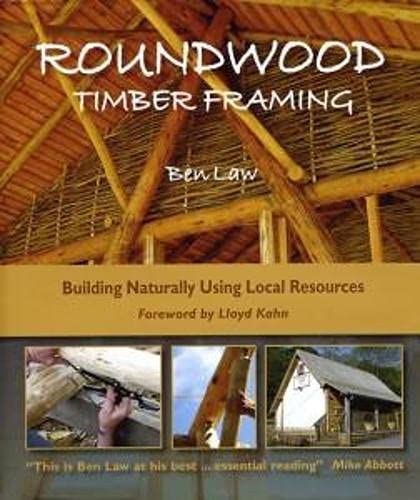
Roundwood Timber Framing by Ben Law is filled with great photos and layout, passionate writing, and some challenges for we Americans. Law lives in England. He uses mostly metric measurements and presents word challenges to this wordsmith and amateur builder: cruck, bender, jowl, disco jowl, ping, wang, feltch. I recommend that you read the two glossary pages before beginning the book.A cruck is at the heart of this building style; it is essentially an A-frame that is braced and then surrounded by a box frame. The multiple crucks are made on the floor, then lifted erect one by one, pulling a log ridge pole up and onto their tops as they are lifted. This produces a strong structure but fills the living or working space of the building with angled poles. The building process requires a crew and/or special lifting equipment.The book chapters include tree species used for specific parts of the construction--some species are not found here but for which we have substitutions that are not given in the book, tools--some not commonly found here, and how to hand chisel the various pegged joints that keep everything tight together. Many of the tools are specialized and would add to the cost of constructing a single home or shop building.I applaud Ben Law's eco-sensitive outlook. He eschews concrete foundations, opting for one-square-meter gravel foundation pits topped with square "york stone," for which we Americans would almost certainly substitute concrete. Alas, he does not address the issue of frost heaving. He uses coppiced trees typically harvested from the building property, greatly reducing the need for oil-consuming and polluting transportation. Insulation is often sheep's wool, with which we on this side of the pond have zero experience. I recommend dense-packed cellulose which has high R-value and is made from recycled paper materials.If you love wood as I do, have lots of trees on your property as I do, and have lots of nearby stout, willing friends to help--I don't--this building style is unique, beautiful, strong and uses a renewable resource, although I suspect that a stickbuilt house actually uses fewer trees for its construction.My final complaint is that there is no index.
M**N
impressive but not practical
This book is beautiful but it's more laid out like a coffee table book with lots of glossies and only shows some basic elements of building with round wood. Law is very skilled and I believe is committed to ecologically sound building but his massive scale-- very large buildings (his own large home is a "showcase") negates the push for lightening our carbon footprint. The reader is left with a few big issues:the author is in England and uses Chestnut which is not available in North America;round wood building requires a huge investment in tools and equipment: think "timber frame tools" and double or triple the cost;putting up these structures will require a large, skilled crew;all structures featured are hybrids which include lots of milled lumber (the author probably has his own bandsaw mill which is shown in some pictures);The cruck frame appears redundant and, although it does eliminate the need for angle bracing on the gable ends it causes lots of extra labor and money to work with and around;these structures will require lots of exterior maintenance, especially gable end walls that have small overhangs.If you are wealthy and can afford to spend lots of time and money to apprentice yourself for a year or so, then invest in tools (include at least 5K for a starter bandsaw mill) and hire two or three skilled timber framers and put them through the apprenticeship, you will eventually have a showpiece. If you are not wealthy you will learn a few tips and might consider including a few round logs in your timber frame structure which would be more feasible.
Q**S
Excellent book—seems that Ben rarely messes around
Excellent book—seems that Ben rarely messes around. This book has a lot of depth, especially for those of you who have spent many hours scratching your head over roundwood timber framing joinery and design. I know I have! Couple this book with the equally well made DVD and you're on track to get jumpstarted on roundwood timber framing. Only bit missing is the experience. So get on it...
D**I
Gift
I bought this for my husband for Christmas. He loves the book, and has shared parts of it with me. Before he went on disability, he was a carpenter, and loves to these types of books.
Y**E
... with several other reviewers in that the book had nice pictures but to use it as a building guide ...
I have to agree with several other reviewers in that the book had nice pictures but to use it as a building guide pulled up short. Everything is in metric measurements and European terminology,As well as materials.
T**E
quality photos
It is a quality book. Good binding. Exceptional photography compared to other construction books. I haven't read the text yet, so can't comment on that.
O**N
How Ben Builds Big Lag-Bolted Buildings with Large Crews and Industrial Equipment
I dislike this book outright. I bought it to research building methods for designing my hand-built home. The methods described are a highly industrial way to use round timbers to build interesting buildings. To build a conventionally-sized building Ben's methods require large groups of people, industrial equipment like cranes, and much more. I thought I was getting a book about resource-conscious building, using wood in the round; instead I got a book about how to make big lag-bolted structures, if you have a massive budget and work crew. The joints Ben teaches you are not bad, and he gives decent instructions on how to use scribe-rule, but his cruck-frame building style crowds the interior with diagonal members, and is simply inefficient. We're not at a loss for building methods; we have a variety of traditions to draw on today, and most of them can be adapted to round wood building; I'm at a loss for why Ben, a supposed green-woodworker, is teaching a method that requires lag-bolts to hold everything together. My last objection to this literary piece is the blatant commercialization of Ben's image and "greenwood" aesthetic. If you're over-the-hill and want a catalogue of ideas for your next modern housing project, this might interest you. If you want to build something yourself, and use wood in the round, I recommend any of the other good books out there on timber framing and architecture; not this one.
M**N
I liked this book
I liked this book, (and the dvd, available separately). But, and its quite a big but, they are both cunningly designed to try and make you go on one of his courses, which is a shame. They could have been a little more technical, and a little less coffee table.
P**E
A nice book but not very detailed in terms of instructions
A nice book but not very detailed in terms of instructions. I wouldn't use it as a main source for telling me how to construct anything personally.
M**K
Highly recommended.
This has to be one of the best textbooks on this unique subject. Highly recommended.
M**T
fantastic, his house is a work of such love ...
arrived on cue, well packaged, I watched a TV program about this chap, fantastic, his house is a work of such love and beauty and then a family wonderful. I also bought his other books too.
J**N
a great coffee table book but i found it lacking in ...
a great coffee table book but i found it lacking in the technical info required to actually build a roundwood structure. Particularly with regard to the construction of the joints and the raising of the frame etc
Trustpilot
1 week ago
2 weeks ago