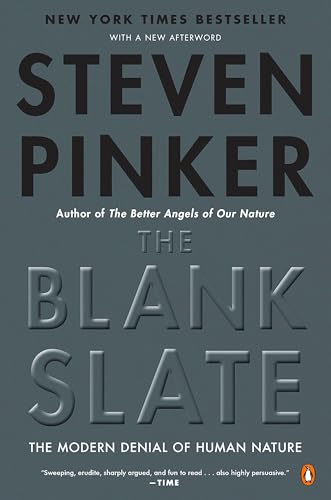


The Blank Slate: The Modern Denial of Human Nature [Pinker, Steven] on desertcart.com. *FREE* shipping on qualifying offers. The Blank Slate: The Modern Denial of Human Nature Review: An important book for the modern world - Steven Pinker is a prominent member of a new cohort of science populizers with genuine scientific credentials (which includes, in the area of brain studies, such authors as Joseph LeDoux, Antonio Damasio, Daniel Dennett). His latest book is by far his most political therefore his most important. As it turns out, the data show that we have much in common as members of the human species, and the news is not all bad. In the Blank Slate, Pinker directly addresses the major ideological impediments which prevent the widespread adoption of an enlightened, scientifically valid view of humanity. People have opposed the idea of human nature, Pinker argues, due to the adherence to three ideas: the Blank Slate, the Noble Savage, and the Ghost in the Machine. After presenting empirical and philosophical arguments against this trio of ideas, Pinker turns to directly addressing the fears accompany the denial of human nature. Specifically, people fear that human nature bolsters the acceptance of inequality (and hence injustice) and prevents progress and perfectability of people and society. Pinker counters that such fears are founded upon an exaggerated and overly simplistic view of the manner in which our genes influence our thoughts and actions. Such influences always remain beneath our consciousness and volition; they are one of the ultimate causes of our behavior, but never the sole cause or the immediate cause. This relates to another major fear: the fear of biological determinism, the absence of free will. Pinker also discusses the fear of nihilism, the fear that once our actions and preferences are understood to be rooted in biology, our lives will loose meaning and morality. Again, Pinker shows that such fears are founded upon misunderstanding and oversimplification, as well as the confusion between ultimate casues and mechanism, on the one hand, and the immediate and proximate causes on the other. In general, many progressives on the political Left have embraced the Blank Slate and the Noble Savage to provide the foundation for ideologies of cultural transformation and reform, in the service of redressing injustices and inequalities. Unfortunately, as Pinker demonstrates, the evidence (as well as our own common sense experiences) indicates that we are neither Blank Slates or Noble Savages. The sum total of our inherited tendencies, our human nature, is neither wicked or noble. Nonetheless, there is the fear, found on both the political Left and Right, that embracing human nature also means normalizing and sanctioning the unseamly side of ourselves. But, as Pinker argues, "natural" is an empirical judgement; "good" is a moral one. Some critics have argued that no one really believes in the Blank Slate any more, and that Pinker is fighting "straw men." I think, however, that Pinker does a good job of showing that Blank Slate positions are often the implicit default in matters of public discussion and policy making; Blank Slate ideas continue to misguide efforts, even when the Blank Slate is not intentionally invoked. The third notion which Pinker disputes, the Ghost in the Machine, is far more important to people committed to the political Right, because the Ghost is frequently equated with the immaterial spiritual soul. The major implication of modern neuroscience has been that the workings of the human mind can be adequately explained by the workings of the human brain, as Pinker has shown in more detail in his previous book, How the Mind Works. The more we learn about brain function, the more it has taken over the job description previously assigned to the soul or to the Ghost. The Ghost remains in the mind of many as the only possible foundation for Free Will, and hence meaning and morality. Free will and an inherited human nature are not necessarily contradictory, however, as long as one avoids a simplistic biological determinism in which genes directly control our actions and opinions. In place of all these fears, Pinker constructs an empirically-supported view of our human nature, addressing in turn 1) the reliabilty and veracity of our perception and our understanding of the world; 2) the sources of interpersonal conflict as well as the sources of a realistic (non-supernatural) morality; 3) the hot-buton topics of race, gender, violence, and child rearing. This is were some of the real meat, the empirical data, is to be found; and this is where Pinker makes good on his claims that accepting the idea of human nature is neither dangerously reactionary or bebasing. An acquaintance of mine wondered just who this book was intended for, since it appeared to be written above the level of your average person. So be it: Science can be popularized by good writing and clear thinking, but it cannot be greatly simplified without significant loss of coherence and cogency. The book is intended for us: for whoever has the motivation to pick it up or to read this review. If you've read this far, do yourself a favor and read Pinker's book. It's not only fascinating and well-argued; it's important. Review: An essay rather than a dogma - Mr. Pinker tries to start a reflexion on what makes us what we are. This book is more a synthesis of his ideas than a scientific work. It gives occasions to question what we believe to be obvious, while it is only the result of the mainstream idea which has been invading the medias and the families for decades : the idea that the human mind is a mere "blank slate" and that, subsequently, all our behaviours, and more generally, our plagues, come from our environment, ie, family, "society" or "culture". I agree that Mr. Pinker sometimes simplifies his opponents' viewpoints, and he sometimes lacks of nuance and in-depth analysis. But I don't think he ever pretended to release a scientific work. I think that, first of all, Mr. Pinker wants us to change our references and to be able to accept the very idea of an open debate on the human nature. I personally loved changing my mind on so many topics, or at least finding out that other approaches were possible, where I used to be entrenched in a one-explanation approach. For instance I used to believe that parenting was the alpha and omega of what makes a person what she/he is. Steven Pinker's book ruined this certainty. I am happy I ceased accusing my parents of all my difficulties in life. This by no means implies that parenting is not a good and important thing. It only gives an opportunity to change glasses about what it means to be a mother or a father. There are dozens of other fascinating examples of what "the Blank Slate" can bring to the reader. Maybe this explains the violence behind the debates about human nature. The book invites us to ask ourselves about our ability to question our certainties with GOOD FAITH, i.e., our ability to admit that facts could invalidate sometiles (but not all the times) our opinions. Even if we are not forced to follow Mr. Pinker in ALL his developments (I don't say I do), it is still an interesting approach, which brings lots of factual, solid information often ignored by most of us. It is a good start for reflexion, and by no means a dogmatic or "reductionnist" work (I always wonder why this word, "reductionnist" is used by people who precisely reduce the whole human experience to social and familial patterns and reject any other approach). Some of the reviews here on desertcart.com come from people who visibly have difficulties dealing with FACTS and are really very aggressive (hence my 5 stars, in order to compensate such undue attacks). When FACTS tend to question our opinions, we have two choices : 1. We admit that we could be wrong and try to start a discussion to redefine our point of view; or 2. We attack the man who states these facts and pretend him to be a stupid / fascist / chauvinist person. I don't say I always fall in the first category, but I think it is a good way to discuss books like Mr. Pinker's (instead of personal and aggressive attacks, or, worse, commentaries written by people who didn't read the book since they reproach to Mr. Pinker ideas that he never expresses). It is true that Mr. Pinker sometimes adopts a biased presentation of facts. But the nice thing is that he quotes all his references and exposes every step of his reasoning, which allows a true discussion and an open, honest debate. I really enjoyed very much reading this book.
| Best Sellers Rank | #45,493 in Books ( See Top 100 in Books ) #9 in Evolutionary Psychology (Books) #66 in Popular Psychology Personality Study #136 in History & Philosophy of Science (Books) |
| Customer Reviews | 4.6 4.6 out of 5 stars (1,901) |
| Dimensions | 9.3 x 6.06 x 1.16 inches |
| Edition | Reprint |
| ISBN-10 | 0142003344 |
| ISBN-13 | 978-0142003343 |
| Item Weight | 1.12 pounds |
| Language | English |
| Part of series | Allen Lane History |
| Print length | 560 pages |
| Publication date | August 26, 2003 |
| Publisher | Penguin Books |
| Reading age | 18 years and up |
M**T
An important book for the modern world
Steven Pinker is a prominent member of a new cohort of science populizers with genuine scientific credentials (which includes, in the area of brain studies, such authors as Joseph LeDoux, Antonio Damasio, Daniel Dennett). His latest book is by far his most political therefore his most important. As it turns out, the data show that we have much in common as members of the human species, and the news is not all bad. In the Blank Slate, Pinker directly addresses the major ideological impediments which prevent the widespread adoption of an enlightened, scientifically valid view of humanity. People have opposed the idea of human nature, Pinker argues, due to the adherence to three ideas: the Blank Slate, the Noble Savage, and the Ghost in the Machine. After presenting empirical and philosophical arguments against this trio of ideas, Pinker turns to directly addressing the fears accompany the denial of human nature. Specifically, people fear that human nature bolsters the acceptance of inequality (and hence injustice) and prevents progress and perfectability of people and society. Pinker counters that such fears are founded upon an exaggerated and overly simplistic view of the manner in which our genes influence our thoughts and actions. Such influences always remain beneath our consciousness and volition; they are one of the ultimate causes of our behavior, but never the sole cause or the immediate cause. This relates to another major fear: the fear of biological determinism, the absence of free will. Pinker also discusses the fear of nihilism, the fear that once our actions and preferences are understood to be rooted in biology, our lives will loose meaning and morality. Again, Pinker shows that such fears are founded upon misunderstanding and oversimplification, as well as the confusion between ultimate casues and mechanism, on the one hand, and the immediate and proximate causes on the other. In general, many progressives on the political Left have embraced the Blank Slate and the Noble Savage to provide the foundation for ideologies of cultural transformation and reform, in the service of redressing injustices and inequalities. Unfortunately, as Pinker demonstrates, the evidence (as well as our own common sense experiences) indicates that we are neither Blank Slates or Noble Savages. The sum total of our inherited tendencies, our human nature, is neither wicked or noble. Nonetheless, there is the fear, found on both the political Left and Right, that embracing human nature also means normalizing and sanctioning the unseamly side of ourselves. But, as Pinker argues, "natural" is an empirical judgement; "good" is a moral one. Some critics have argued that no one really believes in the Blank Slate any more, and that Pinker is fighting "straw men." I think, however, that Pinker does a good job of showing that Blank Slate positions are often the implicit default in matters of public discussion and policy making; Blank Slate ideas continue to misguide efforts, even when the Blank Slate is not intentionally invoked. The third notion which Pinker disputes, the Ghost in the Machine, is far more important to people committed to the political Right, because the Ghost is frequently equated with the immaterial spiritual soul. The major implication of modern neuroscience has been that the workings of the human mind can be adequately explained by the workings of the human brain, as Pinker has shown in more detail in his previous book, How the Mind Works. The more we learn about brain function, the more it has taken over the job description previously assigned to the soul or to the Ghost. The Ghost remains in the mind of many as the only possible foundation for Free Will, and hence meaning and morality. Free will and an inherited human nature are not necessarily contradictory, however, as long as one avoids a simplistic biological determinism in which genes directly control our actions and opinions. In place of all these fears, Pinker constructs an empirically-supported view of our human nature, addressing in turn 1) the reliabilty and veracity of our perception and our understanding of the world; 2) the sources of interpersonal conflict as well as the sources of a realistic (non-supernatural) morality; 3) the hot-buton topics of race, gender, violence, and child rearing. This is were some of the real meat, the empirical data, is to be found; and this is where Pinker makes good on his claims that accepting the idea of human nature is neither dangerously reactionary or bebasing. An acquaintance of mine wondered just who this book was intended for, since it appeared to be written above the level of your average person. So be it: Science can be popularized by good writing and clear thinking, but it cannot be greatly simplified without significant loss of coherence and cogency. The book is intended for us: for whoever has the motivation to pick it up or to read this review. If you've read this far, do yourself a favor and read Pinker's book. It's not only fascinating and well-argued; it's important.
B**D
An essay rather than a dogma
Mr. Pinker tries to start a reflexion on what makes us what we are. This book is more a synthesis of his ideas than a scientific work. It gives occasions to question what we believe to be obvious, while it is only the result of the mainstream idea which has been invading the medias and the families for decades : the idea that the human mind is a mere "blank slate" and that, subsequently, all our behaviours, and more generally, our plagues, come from our environment, ie, family, "society" or "culture". I agree that Mr. Pinker sometimes simplifies his opponents' viewpoints, and he sometimes lacks of nuance and in-depth analysis. But I don't think he ever pretended to release a scientific work. I think that, first of all, Mr. Pinker wants us to change our references and to be able to accept the very idea of an open debate on the human nature. I personally loved changing my mind on so many topics, or at least finding out that other approaches were possible, where I used to be entrenched in a one-explanation approach. For instance I used to believe that parenting was the alpha and omega of what makes a person what she/he is. Steven Pinker's book ruined this certainty. I am happy I ceased accusing my parents of all my difficulties in life. This by no means implies that parenting is not a good and important thing. It only gives an opportunity to change glasses about what it means to be a mother or a father. There are dozens of other fascinating examples of what "the Blank Slate" can bring to the reader. Maybe this explains the violence behind the debates about human nature. The book invites us to ask ourselves about our ability to question our certainties with GOOD FAITH, i.e., our ability to admit that facts could invalidate sometiles (but not all the times) our opinions. Even if we are not forced to follow Mr. Pinker in ALL his developments (I don't say I do), it is still an interesting approach, which brings lots of factual, solid information often ignored by most of us. It is a good start for reflexion, and by no means a dogmatic or "reductionnist" work (I always wonder why this word, "reductionnist" is used by people who precisely reduce the whole human experience to social and familial patterns and reject any other approach). Some of the reviews here on Amazon.com come from people who visibly have difficulties dealing with FACTS and are really very aggressive (hence my 5 stars, in order to compensate such undue attacks). When FACTS tend to question our opinions, we have two choices : 1. We admit that we could be wrong and try to start a discussion to redefine our point of view; or 2. We attack the man who states these facts and pretend him to be a stupid / fascist / chauvinist person. I don't say I always fall in the first category, but I think it is a good way to discuss books like Mr. Pinker's (instead of personal and aggressive attacks, or, worse, commentaries written by people who didn't read the book since they reproach to Mr. Pinker ideas that he never expresses). It is true that Mr. Pinker sometimes adopts a biased presentation of facts. But the nice thing is that he quotes all his references and exposes every step of his reasoning, which allows a true discussion and an open, honest debate. I really enjoyed very much reading this book.
W**O
I did read The Blank Slate by Steven Pinker as a paperback, but still it was so heavy at times that I did not have strength to read it more than half an hour at a time at some times. The book is not even a heavy or dull read, as Steven Pinker is a great writer, who can really present his case in readable and enjoyable form The problem was that this book is so laden with heavy truths about humans, humanity, perception, mind and the processes that govern it, that it is at times really difficult to absorb it all in one go. This is really no complaint, but a praise. In less than 500 pages Steven Pinker gives more solid information that many writers do achieve after a lifetime at book-writing. He just has this fantastic gist for finding the real big names in the diverse fields that he does present in this book. The Blank Slate: The Modern Denial of Human Nature (Penguin Press Science) Jaakko Wallenius [...] [...]
S**D
MITの言語学者であり,いまもっとも説得力のある進化心理学の説き手の一人であるピンカーによる遺伝と環境についての論争が何故いかに本質とずれてしまうのかについての大作.ヒューマンネイチャー(人間の本質)が何なのかについては欧米では劇的な大論争があるのだがその論争の本質となぜそうなのかをすばらしく優雅に解説してくれる. ブランクスレートというイデオロギーの根源,なぜそれがイデオロギーとして20世紀に君臨し,また21世紀にも影響力をもち続ける勢いなのか,そしてホットイッシューについてのピンカーの胸をすくような解説.ルソー,ホッブスにさかのぼる根源,社会科学者のナイーブさとさらに輪をかけて悪用する人たち.さばきの見事さ,相変わらずの軽快な語り口,わくわくして読みました.
C**R
Precious and vast knowledge on all types of academic disciplines and aspects of politics, education and everyday life. This will help to understand the hidden assumptions behind different academic and political opinions. It will shed light in a rational way on many topics. One of my top 10 books.
A**U
Este es un libro absolutamente esencial para todo universitario en las ciencias y las humanidades. Pensado y escrito en la tradición de "no enseñar qué pensar, sin cómo pensar" este es un libro erudito, rico en información y referencias científicas. En un extremo está el sistema de valores determinista de la tradición judeo-cristiana que nos dice que la naturaleza humana está dada por los mitos de esa tradición y que guardan cierta relación con las determinaciones innatas biológicas de nuestra especie; en el otro extremo, nos dice el autor, está otro sistema de valores determinista que es "la tabula rasa", en la que se presenta la teoría de "una naturaleza humana inexistente": es decir una teoría del ser humano que parte de la premisa de que la naturaleza humana no existe, todo es producto de la cultura. Somos como una hoja limpia (una tabla rasa), sin determinaciones biológico-evolutivas en donde todo es producto de la socialización, la cultura, y la construcción social. Esto incluye cosas como la sexualidad humana y el género (tan utilizada políticamente por las feministas de tercera ola) en la que nos dicen que todos los niños y niñas nacen bisexuales y a través de la educación y la cultura el género y las preferencias sexuales les son construídas. La evolución biológica biológica, dice la teoría de la tabula rasa (la negación moderna de la naturaleza humana, como indica el subtítulo de este libro indispensable). Todo es una vulgar construcción social maleable por el ser humano. Steven Pinker recorre así, distintas facetas de la política, la cultura, las humanidades y las ciencias, y todo aquel ámbito en donde se ha estado utilizado de manera hiper-tóxica la ideología de la tabula rasa con fines políticos (como el feminismo), para transparentar y cuestionar las falsas y destructivas premisas de las que parte.
A**R
Arrived well packaged
Trustpilot
2 weeks ago
2 months ago