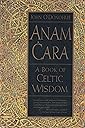
Anam Cara: A Book of Celtic Wisdom
Product ID: 199778
" Anam Cara is a rare synthesis of philosophy, poetry, and spirituality. This work will have a powerful and life-transforming experience for those who read it." —Deepak Chopra John O'Donohue, poet, philosopher, and scholar, guides you through the spiritual landscape of the Irish imagination. In Anam Cara, Gaelic for "soul friend," the ancient teachings, stories, and blessings of Celtic wisdom provide such profound insights on the universal themes of friendship, solitude, love, and death as: Light is generous The human heart is never completely born Love as ancient recognition The body is the angel of the soul Solitude is luminous Beauty likes neglected places The passionate heart never ages To be natural is to be holy Silence is the sister of the divine Death as an invitation to freedom Review: A reminder of the silent companion - John O’Donohue was an Irish poet, priest and philosopher, a proponent of a specific kind of Celtic spirituality which formed the lens through which his philosophy could be seen. His first and best known work is ‘Anam Cara’, published in 1997. ‘Anam cara’ is the Celtic phrase for ‘soul friend’. In a sense, this book is review proof. To anyone who has read my other reviews on fiction and non-fiction this may be seen as a departure. Personal philosophical contemplation of the big issues—life, death, eternity, etc.—are so subjective that to apply the same kind of critical analysis to them that I would apply to a novel misses the meat of the matter and becomes a stab in the air of Intellect. Just as all books are not created alike, so all reviews of those various books should also not be alike. The anam cara can be found in another person although, whether one finds THE anam cara or AN anam cara in another person or not, there is the presence that travels with the individual from birth to death. An individual’s life span, like the seasons, is a cycle. O’Donohue traces the phases of the cycle throughout the book in explorations of solitude, friendship, love and death. These are all big abstract concepts but O’Donohue brings them inside our eyelids with his intimate, poetic language. Donohue’s contemplation of the large themes is as intimate as poetry and as spiritual as any church service and yet this former priest never preaches. His pleasure in the novelties of creation and his meditations on the threshold of conscious and unconscious existence are contagious. He brought to my awareness a few insights that seem obvious except that I never thought to articulate them but here he has presented them to me. Consider what he says about the human face: “The human face carries mystery and is the exposure of the mystery of the individual life. It is where the private, inner world of a person protrudes into the anonymous world. While the rest of the body is covered, the face is naked. The vulnerability of this nakedness issues a profound invitation for understanding and compassion. The human face is a meeting place of two unknowns: the infinity of the outer world and the unchartered, inner world to which each individual alone has access…Your feet bring your private clay in touch with the ancient, mother clay from which you first emerged. Consequently, your face being at the top of your body signifies the ascent of your clay-life into intimacy and selfhood.” He invokes the cyclical view of life repeatedly. It is inherent in the fact that he was born and died a Celt: “The Celtic mind was never drawn to the single line; it avoided ways of seeing and being that seek satisfaction in certainty. The Celtic mind has a wonderful respect for the mystery of the circle and the spiral. The circle is one of the oldest and most powerful symbols. The world is a circle; the sun and moon are too. Even time itself has a circular nature; the day and the year build to a circle. At its most intimate level so is the life of the individual. The circle never gives itself completely to the eye or to the mind but offers a trusting hospitality to that which is complex and mysterious; it embraces depth and height together. The circle never reduces the mystery to a single direction or preference.” Generally, O’Donohue’s imagery and metaphor is fresh and vibrant although he does use a phrase such as ‘neon consciousness’ or ‘neon awareness’ a bit too frequently for my taste. Once was fresh; more than that the impact is diluted. He also quotes people without citation. He will write, “Dostoevsky said…” or “Goethe said” without providing the specific source of the quote. I don’t doubt O’Donohue; I believe in his integrity. I would just like to read the original for myself to see the context in which the quote appeared. Those are relatively minor quibbles. One of O’Donohue’s great achievements is to shed a fresh light on things we either take for granted or have never articulated. He presents them to us in a novel context, which is really what the best writers do for us. The chapter on death is worth the price of the book for me. It provides the wisest, most consoling, most clear-eyed outlook toward death that I have encountered. He describes the Irish mourning tradition in which women keen and provide a sad liturgy, a ritual for externalizing the loss of the departed. This is followed by the wake: “Its ritual affords the soul plenty of time to take its leave. The soul does not leave the body abruptly; this is a slow leave-taking.” He provides a calm reassurance that assuages any fear of dying that touches me more than most anything else I’ve read about death. He died unexpectedly in his sleep in 2008. The cause of death was not disclosed outside the family. Reading his calming words, I could imagine them echoing through his consciousness in his last moments. His cycle was complete. Review: A MUST for Christians who are looking for answers that are right in front of us, in nature. - The late John O'Donahue, sheds his identity as a former Catholic priest in search of more answers by going to the source of his Celtic roots, and he delivers. This man is not only a poet, but a philosopher, to be highly esteemed, who obtained his degree in Germany, in German! Not only does he demonstrate his extraordinary enlightenment and give some of this gift to us, that we may recognize and correct behavioral habits from recycling pain addictions, but he also opens up a whole new world to the reader, to recognize that the environments that we live in, are alive--living and breathing like us--such that when we visit them, we become a part of them. For this reason, those living in environments of desolation, pick up the vibration of that environment, losing hope, and those visiting jolly streams, where nature is singing, also morph and materialize into a piece of that joy as part of the living environment in which you visit or abide. I cannot thank this author enough for opening my heart to the joys of blessing and appreciating things like water, which has the humility to take up the form of whatever contains it. John O'Donahue is such a very meticulously sensitive writer, that his words will send new ripples of excitement up and down your body when you recognize that everyone, including and especially yourself has a very huge role in this overwhelming world...That we are indeed made of God's dreams that have been in the making of the 4.5 billion years the Earth has been existing. As a biologist of the Christian faith who was seeking "more", I am so glad I was directed to this author. Upon reading this book, I naturally grabbed his book of Celtic blessings, and started applying them to my daily life as well. If you are stuck in a rut, and you have reverence for God, and would like a more intricate view of appreciating God in the nature around us that is often and wrongly shunned for pagan worship (when we are actually glorifying God for these things), this is the book for you. I personally think religions who admonish inquiry into God's beauty in nature or those who cast the fear of sin of investigating and appreciating how nature was revered by the ancients does nothing but pull you away from God. Fear-based religion is nothing but dictating what or what you can't do, based on fear of sin...All that is garbage here, where it belongs, and God is celebrated as a source of only Love, Light, and accessible Beauty all around us.
| Best Sellers Rank | #124,643 in Books ( See Top 100 in Books ) #1 in Celtic Religions (Books) #68 in Inspirational Spirituality (Books) #111 in Friendship (Books) |
| Customer Reviews | 4.7 out of 5 stars 3,480 Reviews |
B**B
A reminder of the silent companion
John O’Donohue was an Irish poet, priest and philosopher, a proponent of a specific kind of Celtic spirituality which formed the lens through which his philosophy could be seen. His first and best known work is ‘Anam Cara’, published in 1997. ‘Anam cara’ is the Celtic phrase for ‘soul friend’. In a sense, this book is review proof. To anyone who has read my other reviews on fiction and non-fiction this may be seen as a departure. Personal philosophical contemplation of the big issues—life, death, eternity, etc.—are so subjective that to apply the same kind of critical analysis to them that I would apply to a novel misses the meat of the matter and becomes a stab in the air of Intellect. Just as all books are not created alike, so all reviews of those various books should also not be alike. The anam cara can be found in another person although, whether one finds THE anam cara or AN anam cara in another person or not, there is the presence that travels with the individual from birth to death. An individual’s life span, like the seasons, is a cycle. O’Donohue traces the phases of the cycle throughout the book in explorations of solitude, friendship, love and death. These are all big abstract concepts but O’Donohue brings them inside our eyelids with his intimate, poetic language. Donohue’s contemplation of the large themes is as intimate as poetry and as spiritual as any church service and yet this former priest never preaches. His pleasure in the novelties of creation and his meditations on the threshold of conscious and unconscious existence are contagious. He brought to my awareness a few insights that seem obvious except that I never thought to articulate them but here he has presented them to me. Consider what he says about the human face: “The human face carries mystery and is the exposure of the mystery of the individual life. It is where the private, inner world of a person protrudes into the anonymous world. While the rest of the body is covered, the face is naked. The vulnerability of this nakedness issues a profound invitation for understanding and compassion. The human face is a meeting place of two unknowns: the infinity of the outer world and the unchartered, inner world to which each individual alone has access…Your feet bring your private clay in touch with the ancient, mother clay from which you first emerged. Consequently, your face being at the top of your body signifies the ascent of your clay-life into intimacy and selfhood.” He invokes the cyclical view of life repeatedly. It is inherent in the fact that he was born and died a Celt: “The Celtic mind was never drawn to the single line; it avoided ways of seeing and being that seek satisfaction in certainty. The Celtic mind has a wonderful respect for the mystery of the circle and the spiral. The circle is one of the oldest and most powerful symbols. The world is a circle; the sun and moon are too. Even time itself has a circular nature; the day and the year build to a circle. At its most intimate level so is the life of the individual. The circle never gives itself completely to the eye or to the mind but offers a trusting hospitality to that which is complex and mysterious; it embraces depth and height together. The circle never reduces the mystery to a single direction or preference.” Generally, O’Donohue’s imagery and metaphor is fresh and vibrant although he does use a phrase such as ‘neon consciousness’ or ‘neon awareness’ a bit too frequently for my taste. Once was fresh; more than that the impact is diluted. He also quotes people without citation. He will write, “Dostoevsky said…” or “Goethe said” without providing the specific source of the quote. I don’t doubt O’Donohue; I believe in his integrity. I would just like to read the original for myself to see the context in which the quote appeared. Those are relatively minor quibbles. One of O’Donohue’s great achievements is to shed a fresh light on things we either take for granted or have never articulated. He presents them to us in a novel context, which is really what the best writers do for us. The chapter on death is worth the price of the book for me. It provides the wisest, most consoling, most clear-eyed outlook toward death that I have encountered. He describes the Irish mourning tradition in which women keen and provide a sad liturgy, a ritual for externalizing the loss of the departed. This is followed by the wake: “Its ritual affords the soul plenty of time to take its leave. The soul does not leave the body abruptly; this is a slow leave-taking.” He provides a calm reassurance that assuages any fear of dying that touches me more than most anything else I’ve read about death. He died unexpectedly in his sleep in 2008. The cause of death was not disclosed outside the family. Reading his calming words, I could imagine them echoing through his consciousness in his last moments. His cycle was complete.
T**G
A MUST for Christians who are looking for answers that are right in front of us, in nature.
The late John O'Donahue, sheds his identity as a former Catholic priest in search of more answers by going to the source of his Celtic roots, and he delivers. This man is not only a poet, but a philosopher, to be highly esteemed, who obtained his degree in Germany, in German! Not only does he demonstrate his extraordinary enlightenment and give some of this gift to us, that we may recognize and correct behavioral habits from recycling pain addictions, but he also opens up a whole new world to the reader, to recognize that the environments that we live in, are alive--living and breathing like us--such that when we visit them, we become a part of them. For this reason, those living in environments of desolation, pick up the vibration of that environment, losing hope, and those visiting jolly streams, where nature is singing, also morph and materialize into a piece of that joy as part of the living environment in which you visit or abide. I cannot thank this author enough for opening my heart to the joys of blessing and appreciating things like water, which has the humility to take up the form of whatever contains it. John O'Donahue is such a very meticulously sensitive writer, that his words will send new ripples of excitement up and down your body when you recognize that everyone, including and especially yourself has a very huge role in this overwhelming world...That we are indeed made of God's dreams that have been in the making of the 4.5 billion years the Earth has been existing. As a biologist of the Christian faith who was seeking "more", I am so glad I was directed to this author. Upon reading this book, I naturally grabbed his book of Celtic blessings, and started applying them to my daily life as well. If you are stuck in a rut, and you have reverence for God, and would like a more intricate view of appreciating God in the nature around us that is often and wrongly shunned for pagan worship (when we are actually glorifying God for these things), this is the book for you. I personally think religions who admonish inquiry into God's beauty in nature or those who cast the fear of sin of investigating and appreciating how nature was revered by the ancients does nothing but pull you away from God. Fear-based religion is nothing but dictating what or what you can't do, based on fear of sin...All that is garbage here, where it belongs, and God is celebrated as a source of only Love, Light, and accessible Beauty all around us.
V**N
Anam Cara, Soul Friend, provides, peace, guidance and inspiration for living your life.
Anam Cara, Soul Friend, is a superb book. It has been enjoyed by many people I have gifted it to. Every adult would benefit from at least reading chapters one, four and five. They provide, peace, guidance and inspiration for living your life unto death and beyond.
J**K
Soul Forming
I have read so many books on spirituality, religion, philosophy, and anything to help me understand myself. At 53 years old I started to feel it was never meant for me to know what I was missing. I was so wrong. This small book, this small part of Mr O’Dnohue’s soul, just set my world on fire. The flow of thoughts, the circular nature of revelation just destroyed my biases. I have never been so alive. Thank you John for this work and may I one day have the chance to thank you in your wholly formed soul.
A**R
Great
Great read and audio book also.
K**O
Take your time, it will reward you.
At first, I found this book challenging to get through - and that was exactly the problem: I was trying to just “get through” it, to quickly absorb the information as one might do with a typical guidebook. This is not that type of book. And yet it is. I needed to slow down, read passages several times, and truly contemplate what John was sharing - as it is rich and poignant. Poetry is like that - it often takes several readings and maybe a different pacing to really connect with what is being expressed. Sometimes it makes sense right away, and sometimes it hits you later on as an “aha!” moment. Towards the end of the book, I had finally hit my stride and understood how to read John’s book and the words really began to sink in. Now I cannot ever forget them. I look forward to sitting with more of John O’Donohue’s wisdom.
E**D
The Church will survive in Ireland
Anam Cara is one of the most beautiful books I have ever read. Beautifully written, poetic, with sonnets to love, friendship, the senses (particularly on the eye), growth, old age ("Old age offers the opportunity to integrate and bring together the multiplicity of directions that you have travelled...where your longing can be awakened and new possibilities come alive for you." P.232). Then, there is his paean to Sophia, Lady Wisdom. I once read that in the first half of life we are all nut gatherers, with little time for contemplation. Somewhere after fifty, wisdom begins to seep in, or perhaps we start to notice it for the first time and for those who listen, the second half of life can rival the first half. This book has given me heart that the Church, pummeled as it has been, will survive in Ireland. The spiritual gene is powerful. The Celts' pagan spiritual rites created the foundation for embracing Christianity with great enthusiasm. This helped them withstand 800 years of English occupation. I see in Ireland, as in America, the fundamental requisite for a change in Church hierarchical governance. It will, it must, happen. Eileen Gould I also bought the CD of Anam Cara to hear the enchanting voice of John O'Donohue. And this review is a reminder to reread the book.
G**Y
The Fear of Love
There was time in the U.S. of A. when we were big on community. Doubly impressive when you consider that in any neighborhood, any business, and military group, there were poor people, and rich. Italians, Polish, Irish, Asian, Black, Hispanic. Baptists, Presbyterians, Catholics, Jews, and, well, you get the picture. Not so much anymore. We've separated ourselves into ethnic groupings, sexual ones, political ones, religious ones, and we rarely speak to anyone outside our groups. We're tribalized now. Some even hold up the word tribe with pride, as if we didn't realize that tribalization was the cause of the world's problems for millennia. It still exists in its original form in certain parts of the world, and it looks like its negatives may never disappear now, given the sociological state of things here. But to be as fair as I can be on the subject, it's been said that tribes provided protection, an opportunity to devote oneself to one's given interests, as long as those interests served the tribe. And in a world replete with change today, such groupings can provide an emotional sanctuary for those within them. But I don't see much of these benefits on display in today's tribes. I recall inviting one group I adhered to into the home I shared with a new wife so they could meet her. Oh, they were polite enough, but there was no welcoming to the "clan," no "we so enjoyed meeting you," no "we'd love to have you over for dinner, real soon!" In fact they gathered into their cultish group in our living room and ignored us. And I've seen similar encounters play out at work. In neighborhoods. Over and over. It took me a long while to understand what was in back of a return to tribes in such an interdependent, multicultural world: It was fear. Fear of newness. Fear of change. An internalized fear built of the need in this modern world to struggle for everything that means survival. Personal survival. Survival of everything one believes in a world that's constantly changing. All this settled into personal interactions around me for years as I did what I could to banish these social fears in the interactions around me and sought to find a remedy. Then there is was in this book (I have to say it was already present in social rhetoric, although all but unheeded.) Anam cara is a Celtic term that roughly means a real true friend. Often construed as that old romantic chestnut, a soul-mate, it does mean something like that. It means someone you can confide anything to, one who won't judge you, no matter how deeply you fall though whatever cracks are around you. And, by extension, it means a group of people that are inclusive, accepting, not exclusive and shunning. A community, in fact. The book speaks to the need for anam cara as the antidote to personal emptiness. It's about love. Not just the one-on-one intimacy of romance, but love of all. Of everyone. Everything. We will never conquer hate, anger, judgment, and their basis - fear - until we can fill our individual emptinesses with love. Only then can we project it outward, and I fear we can't do so by pulling up our emotional socks for ourselves, because we're too good at hypocritically saying "I love you" to those around us. We have to take the seemingly giant step of committing ourselves to others. To all others. The Celtic culture apparently had the need to do so, and they did. They succeeded, too, for quite a while. This book is anam cara-lite, but in a world, a nation of individuals so in need of such commitment, it's the only place to start. My rating: 18 of 20 stars
L**A
Sabedoria celta
É um livro com uma linguagem simples, porém profunda. Fala bastante sobre os sentimentos, principalmente, aqueles que os antigos celtas cultivavam.
J**S
Great read
Very deep subject, well worth the read. Highly recommend.
M**F
a deep journey into the soul
Remarkable insights expressed in gentle term to fundamental questions of who we are and what we are doing here in this dimension This book leaves a lasting feeling of gratitude for the wisdom of the celts
C**N
An extraordinary treaty of Love and Friendship
I just discovered John O'Donohue and I am fascinated by his wisdom. This book is the best I have ever read about Friendship - the divine gift. John talks to your soul and touches it! Lucia
A**A
Amazing
So deep, so beautiful. I loved reading it and I don't usually read much. Thank you for creating this book.
Trustpilot
2 weeks ago
3 weeks ago