We remain fully operational. Our teams are working around the clock to ensure your deliveries continue safely.

DOWNLOAD THE APP


Customer Services
Copyright © 2025 Desertcart Holdings Limited
DOWNLOAD THE APP
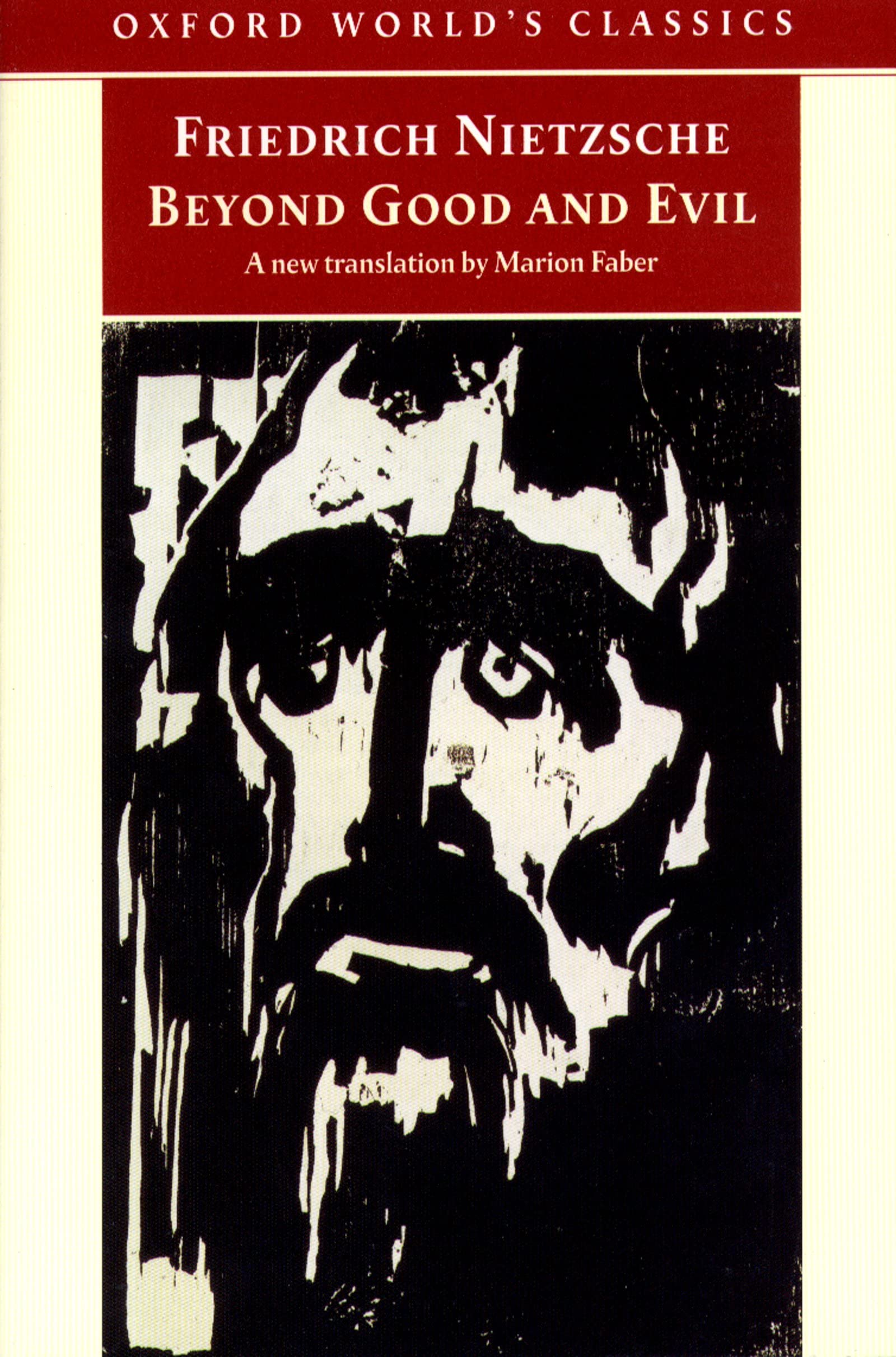
Buy Beyond Good and Evil: Prelude to a Philosophy of the Future (Oxford World's Classics): Read Books Reviews - desertcart.com Review: Newbies, Start With This One! - I'm a newbie to Nietzsche's works, though I'd come to Beyond Good and Evil through the proverbial back door. After having read prominent 20th century texts from Camus to Derrida, I figured it was time to read something by Nietzsche, perhaps the most famous first figure to doubt what was "knowable." Nietzsche, anticipating the cynicism and angst that would become the hallmark of existential texts, was equally scornful of religion AND science (both, which he argued, were reductionist and misleading). The ultimate skeptic, Nietzsche warned readers about believing to deeply in "certain truths" often framed within the dichotomy of binary opposites (good vs. evil, black vs. white, heaven vs. hell; in short, everything the Western world bases its moral framework on). I've given Beyond Good and Evil five stars, but there are some problems with the book that the unintiated may want to know. First, although this is the most straight-forward and accessible of Nietzsche's works, it's still a difficult read. Second, although Nietzsche's writing style is full of verve and gusto (or, to use N's own word, "brio") and although this style makes for delightful anti-philosophic reading, his points do become burdensome after a while. After reading the introduction and the first 30 pages or so, I found myself saying, "Okay, okay, I got it." Nietzsche's misogyny, his failure to provide concrete examples (occassionally) and his belief in a human two-level caste system ("...life itself in its essence means appropriating, injuring, overpowering those who are foreign and weaker" (152-153)) may challenge (or turn off) some readers. Neverhtheless, at 180 slim pages, Beyond Good and Evil accomplishes its task before it becomes tiresome. Review: What was on Zarathustra's mind on those mountains? - Beyond Good and Evil clarifies much of what is left in the air in Thus Spoke Zarathustra and hinted at in the Gay Science. It helps to be familiar with TSZ, or at least the Gay Science coming into reading this text, given the subtlety of the allusions to his former writings and concepts, and the elaborateness of the traps the author lays for cursory readers. For newcomers, hopefully BGE will prove to be a catalyst to further interest in the man's thought; if that's the case you have much to look forward to. Happy hunting.
| ASIN | B006A2IO3M |
| Accessibility | Learn more |
| Best Sellers Rank | #458,058 in Kindle Store ( See Top 100 in Kindle Store ) #63 in Philosophy of Good & Evil #80 in Good & Evil Philosophy #218 in Modern Philosophy (Kindle Store) |
| Customer Reviews | 4.5 4.5 out of 5 stars (107) |
| Edition | Annotated |
| Enhanced typesetting | Enabled |
| File size | 9.0 MB |
| ISBN-13 | 978-0191605260 |
| Language | English |
| Page Flip | Enabled |
| Print length | 244 pages |
| Publication date | November 5, 1998 |
| Publisher | OUP Oxford |
| Screen Reader | Supported |
| Word Wise | Enabled |
| X-Ray | Not Enabled |
H**H
Newbies, Start With This One!
I'm a newbie to Nietzsche's works, though I'd come to Beyond Good and Evil through the proverbial back door. After having read prominent 20th century texts from Camus to Derrida, I figured it was time to read something by Nietzsche, perhaps the most famous first figure to doubt what was "knowable." Nietzsche, anticipating the cynicism and angst that would become the hallmark of existential texts, was equally scornful of religion AND science (both, which he argued, were reductionist and misleading). The ultimate skeptic, Nietzsche warned readers about believing to deeply in "certain truths" often framed within the dichotomy of binary opposites (good vs. evil, black vs. white, heaven vs. hell; in short, everything the Western world bases its moral framework on). I've given Beyond Good and Evil five stars, but there are some problems with the book that the unintiated may want to know. First, although this is the most straight-forward and accessible of Nietzsche's works, it's still a difficult read. Second, although Nietzsche's writing style is full of verve and gusto (or, to use N's own word, "brio") and although this style makes for delightful anti-philosophic reading, his points do become burdensome after a while. After reading the introduction and the first 30 pages or so, I found myself saying, "Okay, okay, I got it." Nietzsche's misogyny, his failure to provide concrete examples (occassionally) and his belief in a human two-level caste system ("...life itself in its essence means appropriating, injuring, overpowering those who are foreign and weaker" (152-153)) may challenge (or turn off) some readers. Neverhtheless, at 180 slim pages, Beyond Good and Evil accomplishes its task before it becomes tiresome.
A**K
What was on Zarathustra's mind on those mountains?
Beyond Good and Evil clarifies much of what is left in the air in Thus Spoke Zarathustra and hinted at in the Gay Science. It helps to be familiar with TSZ, or at least the Gay Science coming into reading this text, given the subtlety of the allusions to his former writings and concepts, and the elaborateness of the traps the author lays for cursory readers. For newcomers, hopefully BGE will prove to be a catalyst to further interest in the man's thought; if that's the case you have much to look forward to. Happy hunting.
J**R
Not for the Casual Reader
Let me put it this way…if you use a high liter, have two.
J**E
What is the Good?
Nietzsche was brilliantly crazy or crazy brilliant, perhaps it was both. Not an obvious genius, but his wisdom is counter-intuitive and worthy of reflection. He was perhaps the most brilliant philosopher of his time, certainly not the most conventional--but arguably the most sagacious about many matters. It is a shame that he descended into madness. He is not to be read quickly, because in so doing you will miss the point. Worth reading and reflecting on, particularly if you study philosophy seriously.
F**G
Master of Master
You can easily find, it is not the book for everyone, but would enjoy if you really agree and enjoy it.
E**N
Excellent
I found it a wonderfully interesting read. It is dense, so prior knowledge of Western intellectual history is very helpful.
J**E
Five Stars
Fast delivery! Exactly as described.
A**R
Some important errors in an otherwise good translation
I am not providing a review of the book itself, as Beyond Good and Evil is simply beyond the need for critical input. Nietzsche, right or wrong, is simply brilliant, positively enjoyable to read, and easily misunderstood by those who do not read deeply. This, rather, will be a review of the translation. Marion Faber's translation is, for the most part, well done. She keeps alive much of Nietzsche's wit and rhetorical spirit, but there are some major flaws in this translation. The first is positively unacceptable: the paragraphing in this text is not Nietzsche's own. Walter Kaufmann is guilty of the same sin; I guess they are trying to make Nietzsche more "accessible". Nietzsche has quite a unique style, and usually indicates where a different subject is being pursued by having a dash before the sentence. Faber and Kaufmann both opt to break up Nietzsche's paragraphs along these dashes, which really does Nietzsche a disservice. If Nietzsche wanted his work to be broken up into those paragraphs, he would've done it himself. This further does a disservice to the reader, because he is missing a key anomaly of punctuation and style. If you don't want to spend the time figuring Nietzsche out, then don't bother reading his works at all. The second major problem I had with this translation was the laughable attempts to make Nietzsche's language sound more politically correct. This is simply a ludicrous endeavor. If you want a book that is inoffensive, go read something else. Nietzsche is not a writer meant to be understood and appreciated by everyone. The German word for 'man' ought to be translated as 'man', not 'human'. The most ridiculous instances are when Faber translates 'overman' as 'overhuman', a clunker of a word that really unnecessarily bogs down the text. Words like 'man' and 'human' are not interchangeable, and it really is necessary to have continuity in the terms. But, thanks to the translator, anyone will surely miss key aspects in Nietzsche's application of the term 'man' and when he uses 'human' (and he does distinguish between them). Between the translation by Kaufmann and that of Faber's, I would probably recommend Faber, as her work is livelier than Kaufmann's. But it isn't without it's major problems that really should've been avoided, because she had to work to put them in. Mistranslations of terms are much more forgivable (that's the difficult part, and she has errors here too), but tampering with the style and structure simply did not and should not have been done.
R**S
Nice clean copy, arrived on time. Would recommend seller
S**.
Brilliant read good book and the original one
B**W
A classic of a book , really recommend but do not rush it . Read when u feel like as any book ever . Also I love this publisher, books are super smooth pages fold back nicely and softly .
T**N
The translation is not great in my humble opinion only, better to buy the penguin classic by RJ Hollingdale, his understanding of the nuances needed in English to express deep German concepts is remarkable.
A**Y
I brought the book as I am studying it in college, it came in excellent condition and in the recommended time frame
Trustpilot
1 month ago
2 months ago