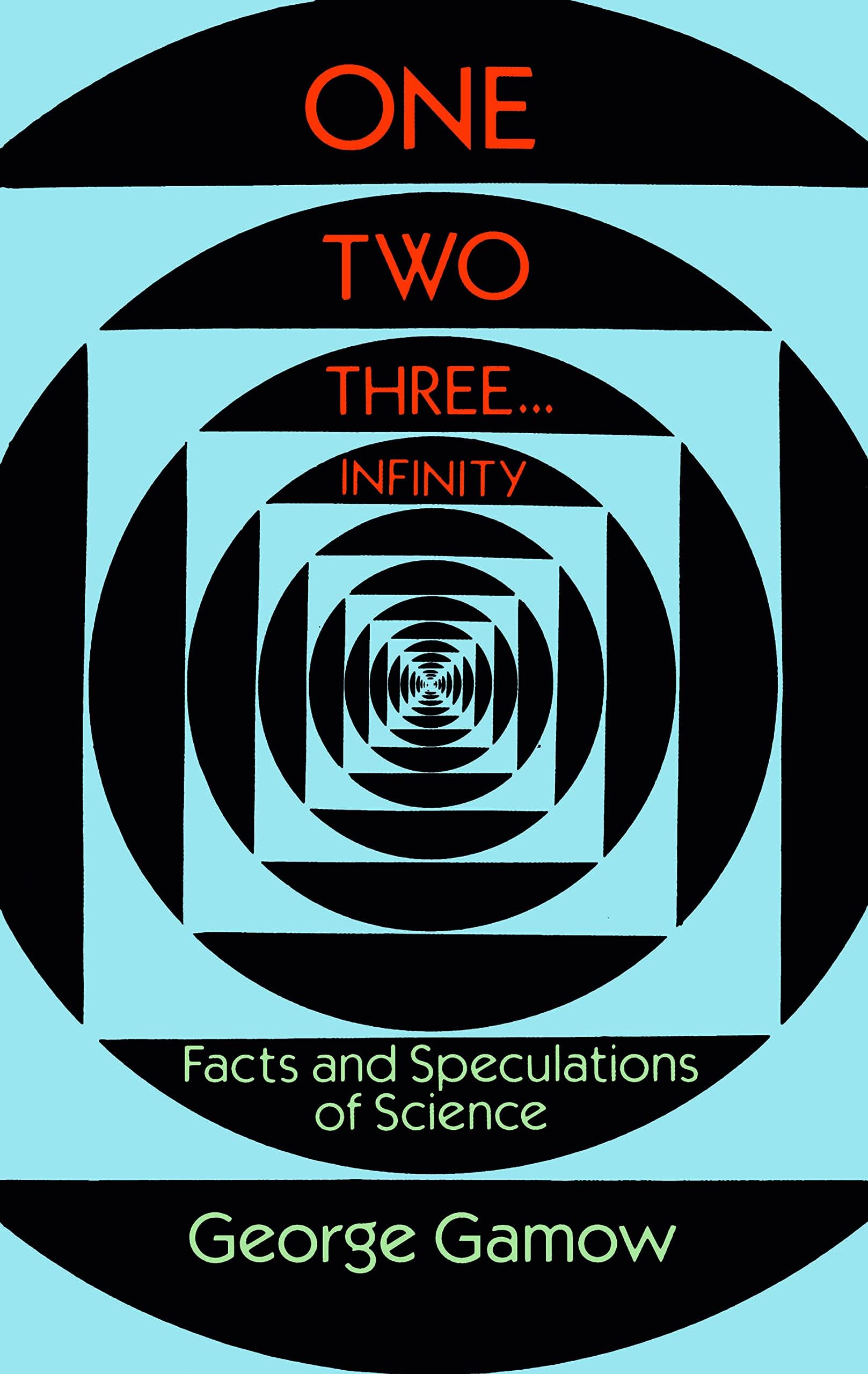
One Two Three . . . Infinity: Facts and Speculations of Science (Dover Books on Mathematics)
Product ID: 235290
Desertcart purchases this item on your behalf and handles shipping, customs, and support to Sri Lanka.
". . . full of intellectual treats and tricks, of whimsy and deep scientific philosophy. It is highbrow entertainment at its best, a teasing challenge to all who aspire to think about the universe." — NewYork Herald Tribune One of the world's foremost nuclear physicists (celebrated for his theory of radioactive decay, among other accomplishments), George Gamow, possessed the unique ability to make the world of science accessible to the general reader. In the pages of this book, readers grapple with such crucial matters as whether it is possible to bend space, why a rocket shrinks, the "end of the world problem," excursions into the fourth dimension, and a host of other compelling topics for the scientifically curious. Includes over 120 delightful pen-and-ink illustrations by the author. Accessible Science : George Gamow, a renowned nuclear physicist, makes complex scientific concepts accessible to general readers, bringing the world of science to life. Wide Range of Topics : Among the topics scrutinized are the macrocosm and the microcosm, theory of numbers, relativity of space and time, entropy, genes, atomic structure, nuclear fission, and the origin of the solar system. Engaging Writing Style : Gamow's good humor and pedagogical prowess make exploring scientific concepts delightful and captivating, keeping readers engaged throughout the book. Illustrated Explanations : With over 120 pen-and-ink illustrations, Gamow enhances the understanding of concepts, machine components, and techniques, making the book visually engaging and aiding comprehension. "In One Two Three . . . Infinity, as in his other books, George Gamow succeeds where others fail because of his remarkable ability to combine technical accuracy, choice of material, dignity of expression, and readability." — SaturdayReview ofLiterature Whatever your level of scientific expertise, chances are you'll derive great pleasure, stimulation, and information from this unusual and imaginative book. It belongs in the library of anyone curious about the wonders of the scientific universe. Review: You want your 10-year-old to win a Nobel prize some day? - Then give her this book! It seems that almost all the reviewers had the same experience: we read this book at an early age, and it was so fascinating, so inspiring, and so magical that it directed us into math and science for the rest of our lives. In my case the book was loaned to me when I was about 12, by my best friend's father. As a result, when I wrote MY first math book (which cannot begin to compare with Gamow's!) thirty-five years later, I dedicated it to my friend's father in gratitude. The book explains how mathematics and science really works, in language which a young person with an eighth grade education can understand. Everyone thinks it takes a genius to understand relativity, but there are lots of fifteen-year-olds walking around with a decent understanding of Special Relativity simply because they read this book. But don't be misled into thinking this book is just for young people. It's for anyone who thirsts for knowledge and understanding, anyone who realizes that it doesn't require an alien life form to understand physics and math. Gamow discusses some of the great unsolved problems in mathematics (at least two of which - the four-color problem and Fermat's Last Theorem - have been solved since the book was written), the theory of relativity, the usefulness of imaginary numbers (square roots of negatives), geometry of more than three dimensions, and many other topics which most people think are accessible only to those anointed with stratospheric IQ's. But Gamow's writing is so clear and entertaining that you'll come away wondering why EVERYBODY doesn't understand those topics. A particularly vivid memory I have of the book is Gamow's demonstration that there are different sizes of infinity. He didn't originate the idea, of course; it was first thought of by a mathematician named Georg Cantor. But once again Gamow makes the mathematics so clear and accessible that I was enthralled. You will be too. Review: ~ 20 years ~ another personal experience with this book - It is great to see that this book is still available after so many years (this book was written way way before 1988 as noted here). It's also a joy to see so many positive comments on the book. This book is a beautiful piece of work on sciences. As said, if you want to have your children into the world of science, try this book, I myself am a testimony. My personal story with this book is very long. It went back to my high school time in 1980's in China. I was a normal kid just like a typical high-school student in China in that era - love to play around but was bound by the endless homework and exams. I was lucky enough for getting good scores in all my science programs without much trouble, but didn't really have much passion on sciences. This book came to me accidentally when I looked into one of my classmate's book collections. By just browsing couple pages, I was totally into it! The book was a translated Chinese version (of course, barely started my English class at that time), and my classmate got it from the library (thank god, we did have libraries after the deadly culture revolution). It may be hard for you to understand what I did at that time: without a copier, I copied the whole physics part of the book by hand writting! This book inspired me to be a physicist - an idea that has never been changed ever since. Now, >20 years passed, as a physicist working in one of the best institutes in the world. I can't help writing another personal experience on this book. The beauty of this book just can never be exaggerated. Of course, we do not want/need all our kids to become scientists. But if you want them to enjoy the fascination of sciences, even just as a hobby, this book is one of the keys to open the door! As in some reviews, it may be a pity that there is no newer edition of this book, considering much of the contents have indeed been updated now. However, enough books have been messed up by "updates". For this book, enjoying sciences is the most important inspiration to our kids, and they will NOT be confused if they later realize that some contents in the book should have been updated. Renovations/innovations are always the cases for sciences anyway.
| Best Sellers Rank | #80,346 in Books ( See Top 100 in Books ) #14 in Fractal Mathematics #38 in Scientific Research #53 in Relativity Physics (Books) |
| Customer Reviews | 4.6 out of 5 stars 681 Reviews |
S**Y
You want your 10-year-old to win a Nobel prize some day?
Then give her this book! It seems that almost all the reviewers had the same experience: we read this book at an early age, and it was so fascinating, so inspiring, and so magical that it directed us into math and science for the rest of our lives. In my case the book was loaned to me when I was about 12, by my best friend's father. As a result, when I wrote MY first math book (which cannot begin to compare with Gamow's!) thirty-five years later, I dedicated it to my friend's father in gratitude. The book explains how mathematics and science really works, in language which a young person with an eighth grade education can understand. Everyone thinks it takes a genius to understand relativity, but there are lots of fifteen-year-olds walking around with a decent understanding of Special Relativity simply because they read this book. But don't be misled into thinking this book is just for young people. It's for anyone who thirsts for knowledge and understanding, anyone who realizes that it doesn't require an alien life form to understand physics and math. Gamow discusses some of the great unsolved problems in mathematics (at least two of which - the four-color problem and Fermat's Last Theorem - have been solved since the book was written), the theory of relativity, the usefulness of imaginary numbers (square roots of negatives), geometry of more than three dimensions, and many other topics which most people think are accessible only to those anointed with stratospheric IQ's. But Gamow's writing is so clear and entertaining that you'll come away wondering why EVERYBODY doesn't understand those topics. A particularly vivid memory I have of the book is Gamow's demonstration that there are different sizes of infinity. He didn't originate the idea, of course; it was first thought of by a mathematician named Georg Cantor. But once again Gamow makes the mathematics so clear and accessible that I was enthralled. You will be too.
T**L
~ 20 years ~ another personal experience with this book
It is great to see that this book is still available after so many years (this book was written way way before 1988 as noted here). It's also a joy to see so many positive comments on the book. This book is a beautiful piece of work on sciences. As said, if you want to have your children into the world of science, try this book, I myself am a testimony. My personal story with this book is very long. It went back to my high school time in 1980's in China. I was a normal kid just like a typical high-school student in China in that era - love to play around but was bound by the endless homework and exams. I was lucky enough for getting good scores in all my science programs without much trouble, but didn't really have much passion on sciences. This book came to me accidentally when I looked into one of my classmate's book collections. By just browsing couple pages, I was totally into it! The book was a translated Chinese version (of course, barely started my English class at that time), and my classmate got it from the library (thank god, we did have libraries after the deadly culture revolution). It may be hard for you to understand what I did at that time: without a copier, I copied the whole physics part of the book by hand writting! This book inspired me to be a physicist - an idea that has never been changed ever since. Now, >20 years passed, as a physicist working in one of the best institutes in the world. I can't help writing another personal experience on this book. The beauty of this book just can never be exaggerated. Of course, we do not want/need all our kids to become scientists. But if you want them to enjoy the fascination of sciences, even just as a hobby, this book is one of the keys to open the door! As in some reviews, it may be a pity that there is no newer edition of this book, considering much of the contents have indeed been updated now. However, enough books have been messed up by "updates". For this book, enjoying sciences is the most important inspiration to our kids, and they will NOT be confused if they later realize that some contents in the book should have been updated. Renovations/innovations are always the cases for sciences anyway.
G**E
For a certain mindset, not a casual read but fantastic.
This is a very interesting read, but I've been attempting to read this while on my lunch break at work. It is NOT a "pick up a book and read for a second" type of book. This book, while in the preface explaining that it was originally meant for children, has very mind boggling concepts regarding infinity and a mindset has to be adopted to read with ease. Fantastic concepts, not finished with the book at this point as I've struggled to find the time to dig into it.
Y**U
Science... simplified
This is a great book for those who enjoy questioning the universe, math, science, or practically anything. Despite being forced to read this book by my parents I found the book interesting and enticing. It had me hooked on page one. George Gamow has crafted a masterpiece of complex principles made of simplified literature of things meant for college students, high school students, and teachers and adults and has changed it so that even an elementary school student can understand and enjoy. I could read this book over and over and still be fascinated. I read this book cover to cover and found every sentence just as interesting as the last. It can keep you interested for hours on an otherwise boring subject. I would much rather read this book than have to take a course o the same subject. Instead of being bored five days a week by pointless lectures and tests and quizzes I could read this exciting book at my own pace and speed yet learning the exact same things. It doesn't bore you with pages upon pages of boring, emotionless writing, but instead adds visual depictions and a bit of emotions that makes it much more interesting than your typical textbook or any other educationally directed piece of literature. This book takes complex principles and changes them for the "average" person to read comprehend. If you are a kid and your parents want you to read this take my word for it. It is much more interesting than it seems.
J**K
A powerful, life-changing book
A short note (trying not to be mawkish) - I read and re-read this book in seventh grade, in 1957. This book changed me. It opened my eyes to worlds suspected but not yet discovered; it became a guide for me. Of course I went into the sciences (physics and engineering), and while that would probably have happened anyway, I must at least partly credit this book. Years later I had the great pleasure of hearing Dr. Gamow (GAM-off) speak at UC Santa Barbara. He was old (at least to me) and his accent was heavy, but that lecture sparkled and effervesced as his books. As others noted, when Dr. Gamow led his explorations into the wonders of physics, he did not hesitate to develop the elegant mathematical concepts along the way, clearly and understandably. He assumed his audience was intelligent enough to apprehend the concepts. There may be more modern writings, more up-to-date coverage of physics for initiates; but I know of none that alternately glows and scintillates as this one does. This book is a jewel, a gift.
B**L
Fantastic Book - Then and Now
Like so many other reviewers, I have fond memories of this book as a child. It really is a book that piques the interest of anyone with even the faintest appreciation of numbers and science and makes a great gift. Gamow's description of "how to count infinities" created a life-long interest in transfinite numbers. For a one-two "punch" one might consider this book as a starting gift and a few years later follow up with "Gödel, Escher, Bach: An Eternal Golden Braid" by Hofstadter. There are a few issues with some of the information contained in the book (e.g. the age of the universe as ~3 billion years) but these are easily noted and are themselves useful for demonstrating how scientific knowledge is constantly being updated. For some reason I find the hand drawn sketches in the book much more effective than the slickest, computer generated graphic.
J**S
A grand tour of science by a master
I'm happy to join the list of reviewers who owe something personal to this marvelous book. As a liberal arts undergraduate in 1955, I borrowed "1,2,3..." from my physics-major roomate. I liked it so much that he kindly gave me his copy. Its influence contributed to my later decision to become an engineer, and marked the beginning of my lifelong interest in science. On recently re-reading the 1961 edition, I was impressed all over again by Gamow's friendly, conversational, agenda-free style. Since he never talks down, never hand-waves, and always goes straight to the essence of a topic, this decades-old book still seems fresh and contemporary. And yes, the dry, slightly pixilated humor still works. I once met a man who had taken a course from Gamow at the University of Colorado. He said he would never forget the sight of the professor careening around campus in an open convertible -- in the middle of January!
M**F
Out of date, but a good historical perspective
I read this book long ago after it was first published. It is well written and entertaining at times. This book and another oldie, Microbe Hunters, helped inspired me to pursue a career in science. However, on rereading it, it's hard to recommend it except for a historical perspective. Time has passed it by, and there have been significant advances in math and physics since it was written. The four-color map theorem and Fermat's last theorem have been proven. The standard model of particle physics has superseded most of the discussion of elementary particles. Enormously more is known about heredity and genetics than what is in the book. The book is more suited these days to those who have read books about modern math and science and want to know how we got where we are. For that purpose, it still ranks high.
D**.
Really good
Great book! Everybody should read it at least once
A**A
What a wonderful book of science
This book teaches the reader upto minute details on everything around them. Also, about the universe it explores the idea that gave birth to Big Bang Theory and Theory of Black Hole and theory of Information Loss
C**S
One Two Three . . . A Fascinating Exploration of Math and Science
This book by George Gamow is a fantastic read for anyone curious about math and science. It’s filled with engaging explanations of complex concepts like infinity, number theory, and the nature of the universe, all presented in a way that’s both accessible and fun. The mix of history, theory, and playful illustrations keeps you hooked from start to finish. Whether you're a beginner or already into science, this book offers a fresh and thought-provoking perspective. Highly recommended!
C**M
Magnifique livre
Excellent livre que tout scientifique devrait avoir lu. Je ne regrette pas de l'avoir acheté d'occasion, car il est en assez bon état. J'ai fait ce choix parce que j'ai été très déçu par les rééditions faites par la maison ZINCREAD des livres MR TOMPKINS et GRAVITY, du même auteur génial George Gamow, qui sont pleines d'erreurs et avec des figure placées n'importe comment.
I**.
make math interesting
I bought this book for my daughter as a gift. She likes it. (I read this book 30 years ago when I was in junior high school.)
Trustpilot
3 days ago
4 days ago