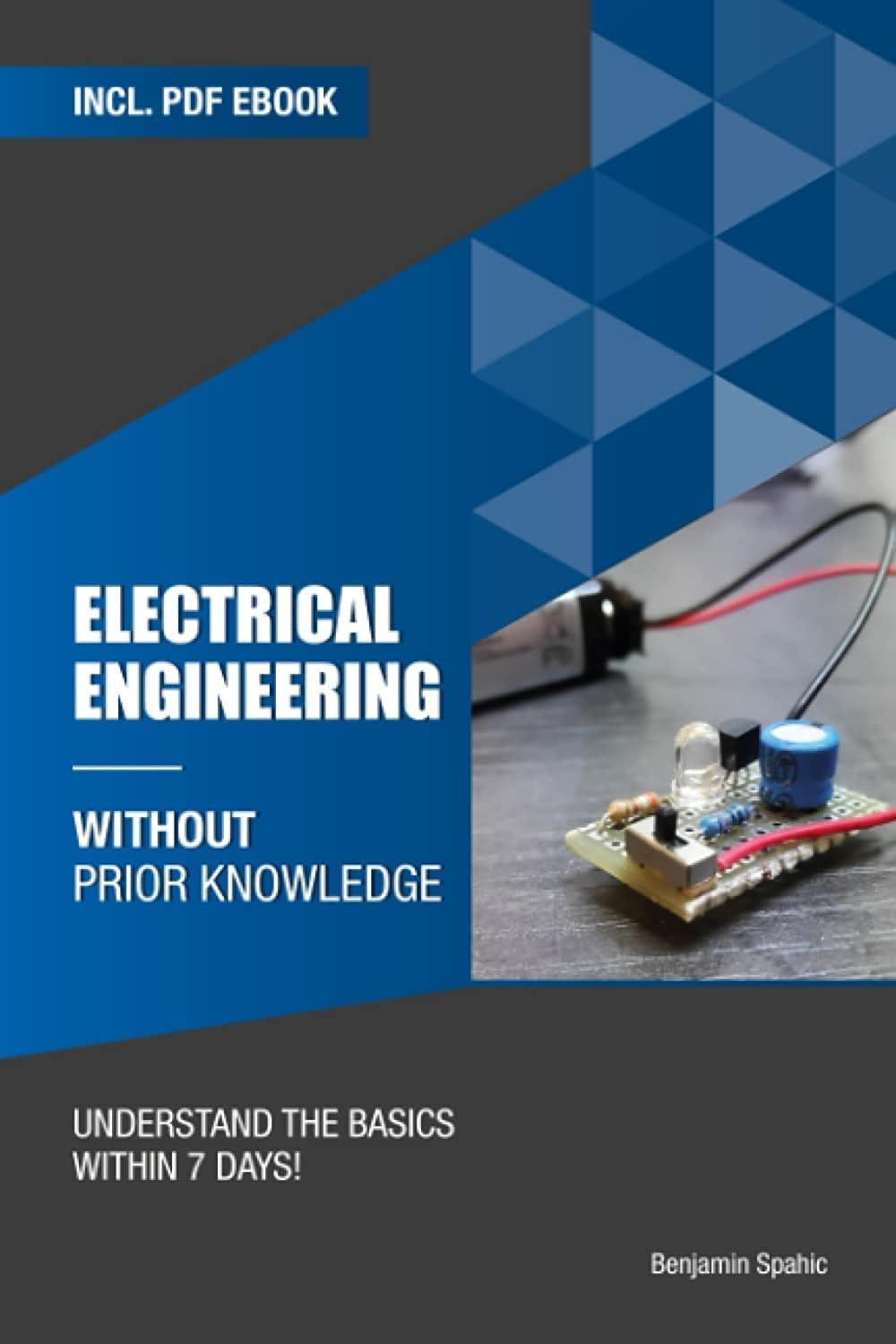
Electrical engineering without prior knowledge: Understand the basics within 7 days (Become an Engineer Without Prior Knowledge)
Product ID: 247101443
Buy anything from 5,000+ international stores. One checkout price. No surprise fees. Join 2M+ shoppers on Desertcart.
Desertcart purchases this item on your behalf and handles shipping, customs, and support to Sri Lanka.
Electrical engineering without prior knowledge: Understand the basics within 7 days (Become an Engineer Without Prior Knowledge) [Spahic, Benjamin] on desertcart.com. *FREE* shipping on qualifying offers. Electrical engineering without prior knowledge: Understand the basics within 7 days (Become an Engineer Without Prior Knowledge) Review: Even People with Common Sense Would Pick This Book - The content is well organized and allows beginner to understand basic electrical engineering knowledges also lays strong foundation for future electrical engineers. Review: Great general coverage of electrical engineering. - I liked the basic format, easy to follow. THings I did NOT like is that this was more for general utility electrical material and less general or RF related, though principles still can be extended. Great for basic coverage, as it is intended. Overall well written and good book for reference.






| Best Sellers Rank | #8,815 in Books ( See Top 100 in Books ) #1 in GIS Programming #1 in Engineering Design #1 in Imaging Systems Engineering |
| Customer Reviews | 4.4 out of 5 stars 604 Reviews |
J**N
Even People with Common Sense Would Pick This Book
The content is well organized and allows beginner to understand basic electrical engineering knowledges also lays strong foundation for future electrical engineers.
D**G
Great general coverage of electrical engineering.
I liked the basic format, easy to follow. THings I did NOT like is that this was more for general utility electrical material and less general or RF related, though principles still can be extended. Great for basic coverage, as it is intended. Overall well written and good book for reference.
A**A
Becoming an electrical engineer
is not in my future, and never was - just enough to appreciate what is involved, and ask intelligent questions of those who actually are electrical engineers or contractors.
S**S
Terrific review that restores the basics
If you've forgotten Calculus or never taken it, this distills the critical math you need to know to move forward with electronics/electricity. Same with the fundamentals of electronics. While some areas could use more explanations (historical anecdotes are always helpful), the fact that all of the critical and fundamental concepts are brought to one place so that you know what to study deeper is what makes this book an excellent read. It's almost a cliff notes book on refreshing the basics, but goes deeper to help concepts click. You won't be designing circuits from this book - think of it more like an EE fundamentals course book - a college EE freshman book. It's quite well written.
T**R
Not as it seems
I ordered this book because I am interested in learning more about how electricity works and more especially how electrical components work like resistors, relays, capacitors, etc and this book day says electrical engineering basics in 7 days so I assumed it would be pretty simple to understand but once I opened it and read maybe 12 pages I realized that this book is basically the learning blocks for algebra, trigonometry, calculus, etc. I had no expectations of having to re-learn all of that. This would be a great book for someone in high school or starting college to help understand their mathematics courses
S**E
Good for European readers, not good for North American readers
First publication was in Germany on May 23, 2020. Learning anything can be a challenge. This book makes it more of a challenge for readers living in North America because it uses European standards. To represent voltage, almost all books written in US English use either a capital "V" or capital letter "E" (Electromotive force). This book uses a capital letter "U" to represent voltage. The formulas for alternating current use 50 Hz (which is the European standard) instead of 60 Hz which is the North American standard. The schematic diagrams use the Europan conventions: Resistor: a rectangle, inductor: filled-in rectangle, battery: a circle. So, if the audience is someone "without prior knowledge" this book would be good for European readers, but not good for North American readers.
M**R
He gets right to the point
He gets right to the point. Not overloaded with words, just information. It's an easy read for me, however, I have an extensive background in electronics spanning many years as first a technician, and then as an engineer working in industry. However, I liked the style, and it lends itself to a great reference book in electronics. And I feel it would work well for the novice as well as the seasoned professional who has been out of electronics and needs a handy reference book.
T**N
Good deal
Very quick to get a digital copy from author. Was also very kind in talking a bit! Seems well written too!
Trustpilot
5 days ago
3 weeks ago