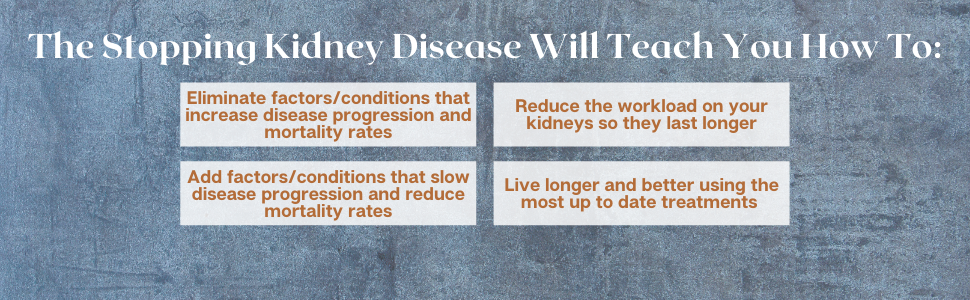
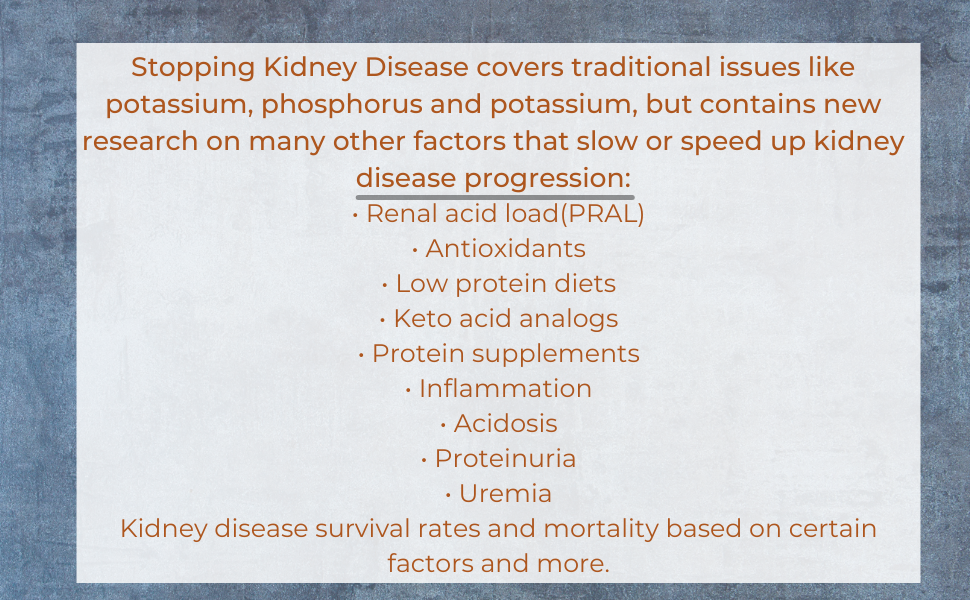
Kidney disease is on the rise, and is a silent killer. Imagine my surprise to learn through blood and urine tests that I, who thought I was in great health for my age, already have advanced kidney disease. I'm only into 100 pages but so far, I cannot help but be tremendously impressed. I'm not a medical doctor. For the past 3 years, my primary care doctor has sent me to have blood and urine drawn, and the report came back with a low "eGFR". The doctor only asked me if I was experiencing any problems with my kidneys -- a bit sluggish, and to my knowledge at that point, nothing unexpected given my age and certainly no pain. As it turns out this year my eGFR is what it was last year, only 57, when that of a healthy, young person is 100-120. So looking that up on reputable websites, come to find out that means Stage 3 kidney disease, and not only that, but that kidney disease is progressive and there are only 5 stages. My doctor still only asks if I have kidney pain or "problems" and I say no and that's it. The author of this book, although, like myself, not being a medical doctor either, does, like myself, believe in taking control of one's own health, and for laypeople, that means intensive self-study and research. He has done an impressive amount of that. I have books written by physicians who don't discuss a fraction of the confirmed information out there, just directing you to nephrologists. Well thanks but I prefer prevention and intervention to big pharma and surgery. Having had gall-bladder surgery years ago, in my experience, doctors are in a state of denial about the changes to your body when you lose an organ causing lasting problems that need to be managed. They don't say you could have repeat gallstones, that you could have gastrointestinal irritation, that many people, myself included, have to take anti-diarrheals and considerable fiber capsules and drinks to avoid "accidents", and this does not go away. So I would draw the line at having any kind of surgery on my kidneys. And I thank this author for this book. It is written in easy to understand language; the studies are summarized, however - if you are not medically trained or have done medical reading, just skip reading the studies, as you may misinterpret what they are saying. One caution also, whenever we read medical studies we need to know who sponsored them (Big Pharma sponsors many studies as the book The Truth About the Drug Companies by Maria Angell, former editor New England Journal of Medicine, details), how large, the study methods, and so forth. But when we see numerous studies that agree with one another and when we see a book author smart enough to even include studies, and that author's conclusions (such as about inflammation in the body being a major factor in disease) completely concur with numerous other books with citations written by physicians and specialists, then these are good indicators of trustworthy information. In only 100 pages, I've already gotten so many questions I had about kidneys and how they function answered. It is not fair to submit a review prior to reading the entire book so there will be an update to this review. Meantime, if only for the first 100 pages, it already has been worth the price. PROMISED UPDATE: I've now completed my first reading of this book; as is usual I will go back over it and make more notes, mark some passages. The book might benefit by editing for brevity and clarity, but that would depend on the reader. Some readers will enjoy Hull's conversational and down-to-earth style; others will want less digression. If I could put this entire book on a word processor, I think I'd eliminate a lot of overlap and repetition, get it down to more manageable size. I might also just summarize and cite the relevant studies, such as is done in the books of Sherry Rogers. That having been said, among all of the verbiage, I found quite important and interesting facts that were new to me even if it did take quite a bit of time to go through 500 pages. The use of statin drugs to lower cholesterol is endorsed in this book. Before deciding on whether to use these drugs, I recommend reading the books The Cholesterol Hoax by Sherry Rogers, MD, The Cholesterol Myth by Steven Sinatra, MD, and some of the other books on statin drugs available on Amazon. There are many reasons to avoid statins ... you just want to get all of the information before deciding, and this book does not explain the pros and cons of this class of drugs. This book lets us know that kidney disease is not curable and is progressive, but we can lower the demands we make on our kidneys and thus help them function better, putting us into remission. A strict low-protein diet is recommended along with a proprietary supplement developed by the author. I checked the current price on the website and it is about $180.00 per month, putting it out of my price range. The diet consists of whole, plant-based foods, essentially a vegan diet (a separate diet book is sold). In addition, regular exercise, stress reduction, and being smart about supplements and vitamins are included ... the chapter on the latter is especially interesting. To summarize Pros: If your blood tests low for eGFR, then you should read this book. A lot of helpful information for people with low kidney function. Conversational style and (except for the studies) can be understood by the average person. Cons: The most important of the studies could be summarized and cited; the rest just cited. Could be edited for brevity and clarity and repetition eliminated.