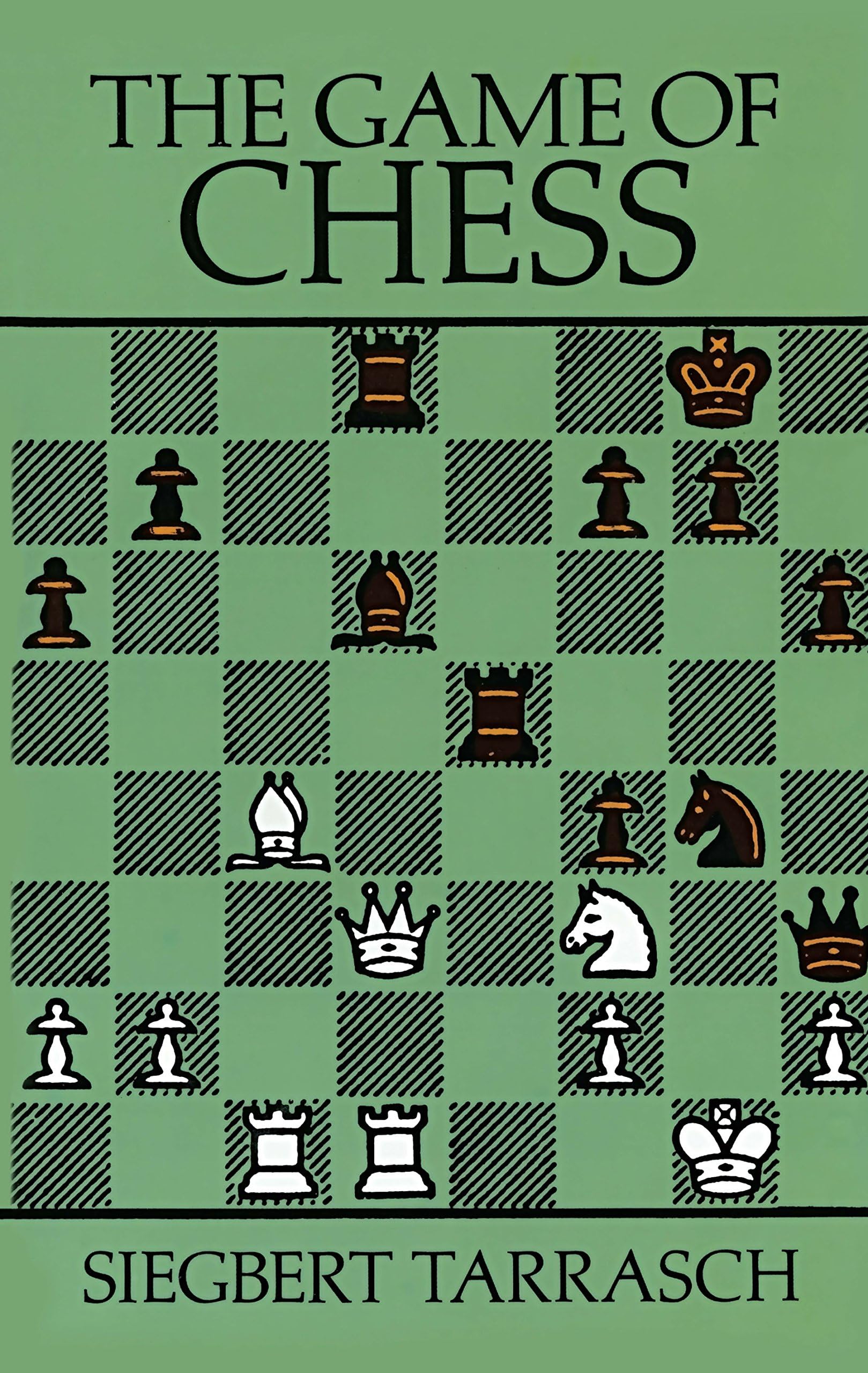
The Game of Chess (Dover Chess)
Product ID: 28140137
Desertcart purchases this item on your behalf and handles shipping, customs, and support to Sri Lanka.
"I have always a slight feeling of pity for the man who has no knowledge of chess, just as I would pity the man who has remained ignorant of love. Chess, like love, like music, has the power to make men happy. The way to this happiness I have tried to show in this book." — Author's Preface While there are many chess instruction books available, few have achieved the lofty stature of the present volume. Fewer still have been written by a legendary International Grandmaster whose pedagogical skills rivaled the chess prowess that enabled him to demolish opponents at the board. An immediate success upon its first publication, The Game of Chess has become one of the game's enduring classics, considered by some critics the finest book ever written on the game. Part of its success stems from Dr. Tarrasch's unorthodox approach to teaching chess: "I employ quite another method and one analogous to that a mother uses to teach her child to talk. I play with the beginner from the very start in that I put before him simple positions and from them explain the fundamentals of chess. It is the intuitive method of instruction. In this way the pupil learns chess quite easily, of that I am convinced." To make it easier for the beginning student, Dr. Tarrasch also reverses the order in which the game is usually taught. Instead, he begins with the End-Game, since "obviously it is easier for the beginner to deal with a few men than the entire thirty-two." Then follows the heart of the book, an important and extensive discussion of the Middle Game. Analyzing the most important parts of hundreds of games, Tarrasch presents a comprehensive treatment of combination play, an aspect of chess for which he was especially renowned. Finally, he deals with the most complex part of the game — the Opening — and offers enlightening comments on many historically important variations. Illustrated with over 340 diagrams and including 12 complete games, The Game of Chess remains one of the standard texts, a careful reading of which will improve the game of any player. Review: My favorite beginner's chess book. - This book is my favorite beginner's chess book, and I have worked through big chunks of it multiple times. I believe this book contains everything needed to go from a complete beginner to an intermediate player of 1500 FIDE or USCF strength. The general style of this book is to teach via examples. Every lesson has a diagram that the reader should set up on his or her own chess board, Tarrasch will explain the concept in words as well as having variations of chess moves to work through. This book has five sections: The Elements, The Endgame, The Middle Game, The Opening, and a collection of grandmaster games with Tarrach's commentary reinforcing everything learned in the previous four sections. The Elements is a short (around 30 pages) introduction to the rules of chess and basic movement patterns of the pieces. This section is cleverly written, as it also introduces fundamental ideas such as king opposition and the Rook+King versus King checkmate. While the novice is learning how the pieces move, they are also learning some basic checkmates, how the pieces coordinate in a basic way, and how the pieces play against each other (as in rook versus bishop). The Endgame is the second section (around 60 pages), and all of the basics are explained: the lucena and philidor positions, Queen vs. Rook, Bishop+Knight vs. King, Rook vs. Bishop, Rook vs. Knight, a little about pawn play, and a primer on rook endgames. In this section Tarrasch details a lovely trick for understanding pawn endgames, where the player should simply count the number of moves required to promote a pawn for both White and Black, and in this way can get a sense of which exchanges are advantageous or not. Of course, entire books have been written about the endgame, but I think there is enough in this section for anyone to hold their own in tournament or online play. In fact, when playing against my friends, I usually win or can equalize in the endgame based on what Tarrasch has taught me. My endgame play is noticeably better than theirs. The third section is The Middle Game (120 pages). This section is the most information-rich, which is appropriate considering the middle game is the most complex phase of the game. Tarrasch takes a tactical approach to the middle game- focusing on pins, skewers, forks, back rank mates, etc. However, there is much more here than just the classic tactics. Here are just a few of the subtitles of what Tarrasch teaches: The point KR6 as a point for attack, The Passed Pawn, The point QKt6 as a Target for Attack Turning a Flank, The Broken-up Castled Position, The Capture of the Queen After Her Penetation to QKt7. That sample of lessons should give you a sense that Tarrasch goes well beyond the basic Tactics and that this book cannot be replaced by any simple tactics primer. This section should probably be read multiple times for full absorption. The fourth section is The Opening. Tarrasch begins the section with an essay (?) on his theory of how the opening should be conducted, including his analysis of tempi. From there, he gives an full account of 28 different openings with multiple variations for each. Tarrasch himself states that this section is not intended to be read, but rather consulted in after-game analysis. This section gives you all the goodies- the Italian Game, the Ruy Lopez, Queen's Gambit (both attacking with and defending against it), King's Gambit, the French, the Danish, etc. I would doubt that there is anything a typical club player would see regularly which is not featured in this section. Some people have said that this section is where the book shows its age the most (for instance, Tarrasch doesn't approve of the Scotch, which nowadays is considered sound), but I think this is a minuscule complaint. If you're the class of player who would truly benefit from the most up-to-date opening analysis, then you're well past this book in playing strength. The last section is a collection of 12 grandmaster games. While this section is useful, interesting, and instructive, there isn't too much here that won't be found in any other collection of grandmaster games aimed at beginning-to-intermediate players. Overall, this book is 423 pages of rather dense chess instruction. This book makes Play Winning Chess by Seirawan and Logical Chess Move by Move by Chernev seem like a breeze to get through. But that effort is rewarded. The reader, by studying and working through large portions of this book, will gain more from this book than any other. Tarrasch has clearly thought very hard about the best way to teach chess, and he does a splendid job of it. If a student understands a large portion of what Tarrasch teaches here, he or she would be ready to understand some of the more formidable and advanced chess books out there such as My System. Review: A Great Book For Learning Chess - My chess instructor recommended this book. It might be more accurate to say he required me to buy it, as I need to read a little bit every week to improve my game. Anyway, I have not gone through the whole book yet. I am still a novice, so I tend to follow his lead when it comes to reading and studying. However, from what I have read so far, the author of the book really took his time putting this book together. I have come across no typographical errors yet. A lot of care and consideration for the novice player has been used. Moves are explained, and good alternatives are given. For those who are absolute beginners, this book might seem confusing. I recommend finding another player (in the event that you can't afford a chess teacher) who knows the old descriptive notation. This book doesn't use 1. e4 e5...etc., but uses notation such as 1. P - K4 P - K4 . The book teaches one a little bit about the descriptive notation, but it is easier to have someone go over it with you. By the way, the book is written with endgames first, middle-games second, and openings third. This might not make sense to everyone. However, there are fewer pieces on the board in the endgame, thus fewer distractions. Also, you want to learn how to win some endings (or survive them if you must strive for a draw) so that all your hard work in a given game isn't for nothing... You CAN go through the book without reading about endgames first. Your needs might be different. My instructor decided to start me on some openings he thinks I can handle. We have studied some endgames that are appropriate for someone at my level (my current rating is just over 1100).


| Best Sellers Rank | #388,010 in Books ( See Top 100 in Books ) #401 in Chess (Books) |
| Customer Reviews | 4.3 out of 5 stars 148 Reviews |
A**X
My favorite beginner's chess book.
This book is my favorite beginner's chess book, and I have worked through big chunks of it multiple times. I believe this book contains everything needed to go from a complete beginner to an intermediate player of 1500 FIDE or USCF strength. The general style of this book is to teach via examples. Every lesson has a diagram that the reader should set up on his or her own chess board, Tarrasch will explain the concept in words as well as having variations of chess moves to work through. This book has five sections: The Elements, The Endgame, The Middle Game, The Opening, and a collection of grandmaster games with Tarrach's commentary reinforcing everything learned in the previous four sections. The Elements is a short (around 30 pages) introduction to the rules of chess and basic movement patterns of the pieces. This section is cleverly written, as it also introduces fundamental ideas such as king opposition and the Rook+King versus King checkmate. While the novice is learning how the pieces move, they are also learning some basic checkmates, how the pieces coordinate in a basic way, and how the pieces play against each other (as in rook versus bishop). The Endgame is the second section (around 60 pages), and all of the basics are explained: the lucena and philidor positions, Queen vs. Rook, Bishop+Knight vs. King, Rook vs. Bishop, Rook vs. Knight, a little about pawn play, and a primer on rook endgames. In this section Tarrasch details a lovely trick for understanding pawn endgames, where the player should simply count the number of moves required to promote a pawn for both White and Black, and in this way can get a sense of which exchanges are advantageous or not. Of course, entire books have been written about the endgame, but I think there is enough in this section for anyone to hold their own in tournament or online play. In fact, when playing against my friends, I usually win or can equalize in the endgame based on what Tarrasch has taught me. My endgame play is noticeably better than theirs. The third section is The Middle Game (120 pages). This section is the most information-rich, which is appropriate considering the middle game is the most complex phase of the game. Tarrasch takes a tactical approach to the middle game- focusing on pins, skewers, forks, back rank mates, etc. However, there is much more here than just the classic tactics. Here are just a few of the subtitles of what Tarrasch teaches: The point KR6 as a point for attack, The Passed Pawn, The point QKt6 as a Target for Attack Turning a Flank, The Broken-up Castled Position, The Capture of the Queen After Her Penetation to QKt7. That sample of lessons should give you a sense that Tarrasch goes well beyond the basic Tactics and that this book cannot be replaced by any simple tactics primer. This section should probably be read multiple times for full absorption. The fourth section is The Opening. Tarrasch begins the section with an essay (?) on his theory of how the opening should be conducted, including his analysis of tempi. From there, he gives an full account of 28 different openings with multiple variations for each. Tarrasch himself states that this section is not intended to be read, but rather consulted in after-game analysis. This section gives you all the goodies- the Italian Game, the Ruy Lopez, Queen's Gambit (both attacking with and defending against it), King's Gambit, the French, the Danish, etc. I would doubt that there is anything a typical club player would see regularly which is not featured in this section. Some people have said that this section is where the book shows its age the most (for instance, Tarrasch doesn't approve of the Scotch, which nowadays is considered sound), but I think this is a minuscule complaint. If you're the class of player who would truly benefit from the most up-to-date opening analysis, then you're well past this book in playing strength. The last section is a collection of 12 grandmaster games. While this section is useful, interesting, and instructive, there isn't too much here that won't be found in any other collection of grandmaster games aimed at beginning-to-intermediate players. Overall, this book is 423 pages of rather dense chess instruction. This book makes Play Winning Chess by Seirawan and Logical Chess Move by Move by Chernev seem like a breeze to get through. But that effort is rewarded. The reader, by studying and working through large portions of this book, will gain more from this book than any other. Tarrasch has clearly thought very hard about the best way to teach chess, and he does a splendid job of it. If a student understands a large portion of what Tarrasch teaches here, he or she would be ready to understand some of the more formidable and advanced chess books out there such as My System.
M**L
A Great Book For Learning Chess
My chess instructor recommended this book. It might be more accurate to say he required me to buy it, as I need to read a little bit every week to improve my game. Anyway, I have not gone through the whole book yet. I am still a novice, so I tend to follow his lead when it comes to reading and studying. However, from what I have read so far, the author of the book really took his time putting this book together. I have come across no typographical errors yet. A lot of care and consideration for the novice player has been used. Moves are explained, and good alternatives are given. For those who are absolute beginners, this book might seem confusing. I recommend finding another player (in the event that you can't afford a chess teacher) who knows the old descriptive notation. This book doesn't use 1. e4 e5...etc., but uses notation such as 1. P - K4 P - K4 . The book teaches one a little bit about the descriptive notation, but it is easier to have someone go over it with you. By the way, the book is written with endgames first, middle-games second, and openings third. This might not make sense to everyone. However, there are fewer pieces on the board in the endgame, thus fewer distractions. Also, you want to learn how to win some endings (or survive them if you must strive for a draw) so that all your hard work in a given game isn't for nothing... You CAN go through the book without reading about endgames first. Your needs might be different. My instructor decided to start me on some openings he thinks I can handle. We have studied some endgames that are appropriate for someone at my level (my current rating is just over 1100).
D**A
Great book for beginners!!!
I believe it’s a great book, because it has the principles you need to learn to develop your chess skills. One thing I didn’t like was the descriptive notation, but I believe there’s a version with algebraic notations.
T**M
Yep
I have just gotten into this book and I am very pleased. Have enjoyed what I have read and what games I have played through. At the end of the text, there are 12 games Tarrasch has analyzed. The first chapter is basic and he presents the material in a rather motherly fashion. You just have to jump over that and get on with it. I believe it is going to be a good Chess Book and of value for its historical character. Please note that the games and instructions are all on the older notation as B-KB4 or Kt-KB3 and P-KKt4. Black follows the same pattern so you will have a bit of adjustment to make. Do I recommend the book. I sure do...good luck.
J**T
This is a cool book, but it has some drawbacks
This is a cool book, but it has some drawbacks. Specifically, it uses an old notation of the chess board that limits its usefulness for those who want to learn the board according to the commonly used system of assigning letters and numbers to ranks and files. Strategies and sequences are often described using this old written system, and not with lots of pictures of chess boards. Only buy if you are familiar with older board notation systems, can "see" the board from reading said notations, or are interested in seeing what old-school chess books are like.
H**N
The Game of Chess
Chess is one of those board games that go beyond far beyond learning just how to move the pieces. Fortunately, or unfortunately the are a plethora of literature to guide one to understanding this game. The Game of Chess is one such book. But, instead of just showing familiar openings & tactics... It gives one a deep understanding of the game. It teaches you the three parts of the game in the order needed to ground you in the fundamentals before you have ever actually moved one piece! HMan...
P**N
Nice item
This is mostly a review of the seller.... Book arrived today, so I haven't read it yet, BUT . . . book arrived in quick order. Neat and safely packed, in NEW condition. Thank you.
M**E
One of the best books on chess, together with Bobby Fischer's and Max Euwe's!
Or, at least, I thought so. He doesn't explain thoroughly, move by move, why each band plays what they play.
P**.
Good book!!
Book was in very good shape. Quick delivery.
M**N
Ottimo
Tutto bene
D**D
Very good overview of the game
Siegbert Tarrasch seems to have been someone with a real passion for the game, and an ability to put that passion down onto paper to help and encourage other players. This book covers the whole game, from early beginnings to some complex strategy in master games. Don't be fooled by the date - this was an important time in chess, and the way this era combined that proceeding it and sparred with (what is known as) hypermodern theory produced key ideas that are the basis of chess knowledge to this day.
A**.
Brilliant for chess enthusiasts!!!
This book is amazing for beginners as well as intermediate players. Seibert Tarash has the most epic way of explanation. He starts of with the least complicated part of the game and gradually increases the complexity. This book also has well printed diagram and the wording is easy enough to be understood by anyone. Middle game is well illustrated as well. Tarasch has explained many openings as well as practice games at the end of the book. Comming to the book quality it is nice over all. All in all I would say that the book is justified for its price. Just a small note:- tarsch follows different notations for the squares as this book was written in the previous century so you will have to learn those first but they are easy enough when you get the hang of them.
C**S
Brilliant Author.
One of the best chess books ever written!
Trustpilot
1 day ago
3 weeks ago