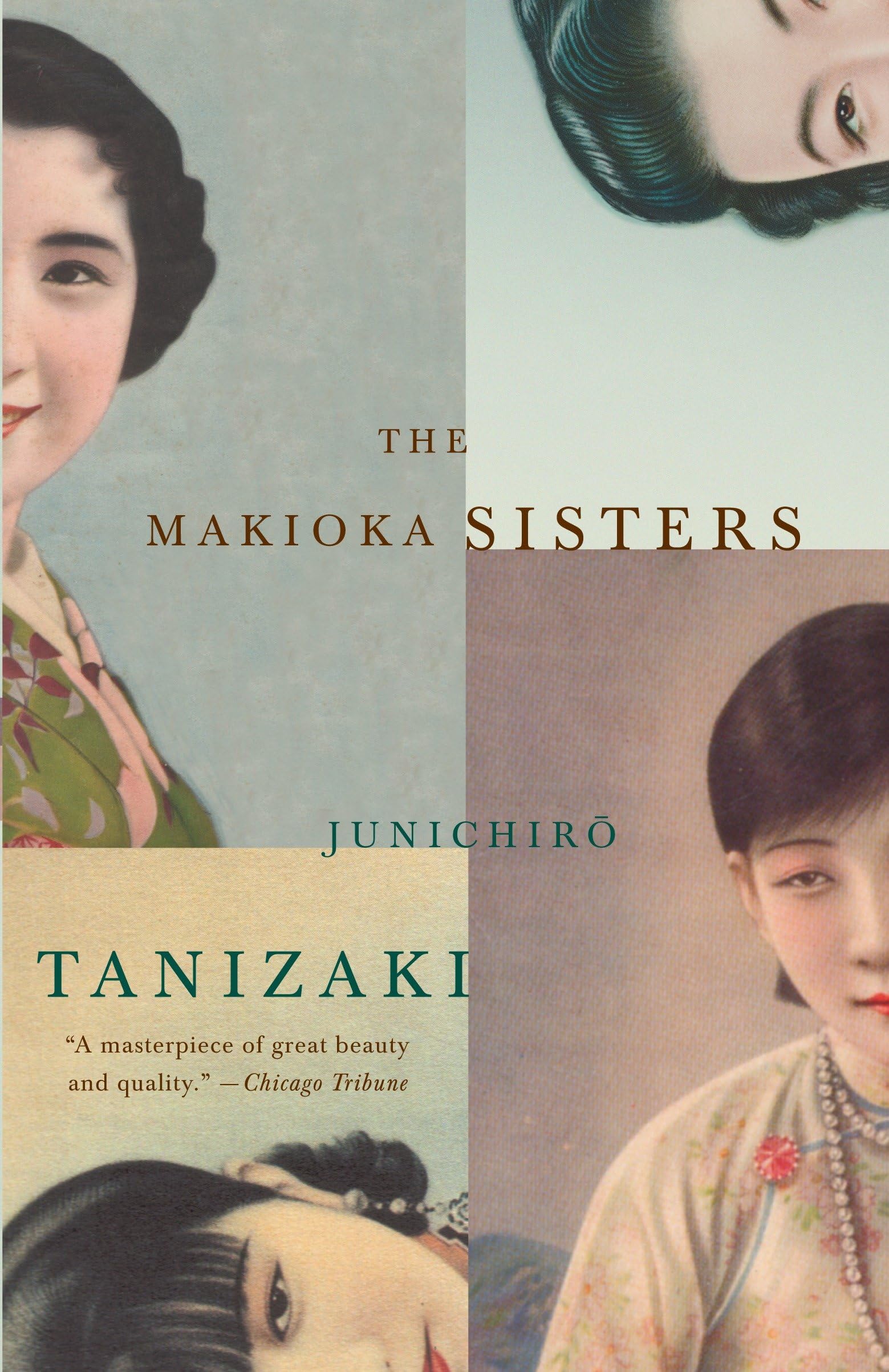
📖 Unlock the elegant secrets of Japan’s past—before they fade away!
The Makioka Sisters is a 500-page classic novel by Junichiro Tanizaki, offering a richly detailed portrayal of four aristocratic sisters navigating family, status, and modernity in pre-war Japan. This vintage edition, highly rated and beloved for its elegant prose and cultural depth, immerses readers in a nuanced historical period with subtle wartime undertones and timeless social themes.
| Best Sellers Rank | #90,207 in Books ( See Top 100 in Books ) #1,461 in Family Life Fiction (Books) #2,339 in Classic Literature & Fiction #4,911 in Literary Fiction (Books) |
| Customer Reviews | 4.4 out of 5 stars 814 Reviews |
A**H
Wonderfully-written book about women, status, and society in pre-war Japan.
A wonderful book about society, manners, status and creeping modernism in pre-war Japan. The book is delightfully and fluidly written. This edition is a great translation. The book also echoes Jane Austin and Trollope in it's evocation of an aristocratic society, where people are concerned about their status, their families reputations and the necessity of marrying well. In all, a delightful read
M**N
Riding the Swallow Express
Reading "The Makioka Sisters" is a bit like taking a long train journey on a local train that stops at every station. Tanizaki's novel, the story of four sisters of a once affluent family that has fallen into decline, moves along at a leisurely pace for most of its 500 pages. The novel is set in the years 1937-1941, a tumultuous period in the history of East Asia, yet events barely intrude. One hears of Japan's aggression in China as merely "the China incident," and December 1941, has more to do with the impending betrothal (after many disappointments) of the third sister, Yukiko, than it does with the onrush of war. This is a book that is set mostly within the walls of the Osaka household of the second sister, Sachiko, and her husband, Teinsuke, with whom the two unmarried sisters, Taiko and Yukiko, live. The eldest sister, Tsuroko, and her husband, Tatsuo, run the "main house" in Tokyo (the branch of the family with which decisions about money and marriage lie). The realism of the novel lies in its inclusion of intricate detail: a spot that appears and disappears over Yukiko's eye; the choice of restaurant for a "miai" (a social gathering to assess the suitability of a couple for marriage); the type of medications Sachiko carries in her bag; the type of dress (western or kimono) a sister is wearing, and so on. So minute is that detail that it may leave a reader who is unfamiliar with Japanese culture quite unhappy by the time yet another "miai" for Yukiko commences. Yet when the family goes forth into the world, in its circumscribed way, there are scenes of great beauty---of firefly watching, cherry viewing, Fuji-gazing. And this world IS circumscribed, so much so that the three sisters who live in Osaka never adjust to Tokyo (and indeed, their small disasters happen there). Every minute the Osaka sisters spend in the capital reminds them of how provincial they are; ashamed of even of their "western" accents, they are relieved to return home. Although modernity has crept into the sisters' lives(a phonograph, the films the narrator often mentions by title, cigarettes, permanent waves),they are still often startled by the brusque certainty of some of the more modern women they encounter, with their smart western clothing and lacquered nails. Within the family itself, it is Taiko, the youngest sister, who struggles the most with this tension between modern and traditional ways, and thus is is she who wears western dress with the most ease, while, paradoxically, she is a skilled practitioner of traditional Japanese dance. The last scene in the novel is set on the train that is carrying Yukiko, the third and most "Japanese" sister, to Tokyo for her marriage, at long last, to a dissolute aristocrat; his connections, the family hopes, may lift the Makioka name to some of its former luster. Even here, the novel moves as slowly as it ever did. There is no grand denouement, and the story closes on the most intimate and mundane of details. However, by this point, the accumulation of bits of information about the world at war has gained force, and it seems to carry the Makioka sisters straight into a long dark tunnel from which one knows they will not emerge unchanged. M. Feldman
P**D
A detailed view into the minds of a Pre WWII Japanese Family
In recommending Jun'ichirō Tanizaki’s The Makioka Sisters as translated by Edward G. Seidensticker, I caution readers that this is deep waters. The book is an adult read in the sense that the it will require concentration, patience and a constant awareness that the characters are of their time and their place. No doubt a 2022 reader can impose a great deal case study about the patrimony, feminism and whatever other 21century themes one wishes to espouse. In any good literature, there is an ability to find meanings never intended by the author. Against the other reviews who posit that the book is primarily about the conflicts within Japanese culture as it attempts to adopt its ancient traditions to a more modern international culture, I council caution. There were no obvious instances best described as being centered on modernism versus traditionalism. This brings me to two notions that I think helped me to understand what The Marioka saga is about. I will propose these ideas not because I am certain they apply but because they are all I know of Japanese culture that might apply. What follows is barely an educated guess. I am, in advance, grateful for any, better educated analysis. A term I have just had explained to me is “haragei” Indirect, largely nonverbal communication. Or as Japan inc explains it: “Haragei literally means ‘Art of the stomach’. Think of it as an elaborate style of intuitive communication. Almost like a ‘sixth sense’, Haragei drives people to exchange thoughts and feelings – ‘belly to belly’ – without using words. Instead, facial expressions, timing, sounds, and even silence convey messages, mask true emotions, and influence business meetings.” By entering the minds of our main characters, we are simultaneous listening to them make decisions about what to say and what to signal. It is also just possible that a person of this era would be so accustomed to this form of communication that even in their thoughts they are influenced to not think in direct thoughts. From a book by Lefcadio Hern, Japan: An Attempt at Interpretation, written about 30 years before the time frame of The Marioka’s Sissters, he describes a society, whose deepest cultural tragions were already fading, but were bed rocked on the belief that we all have direct responsibilities at once over and under each other. There are circles of loyalties, to household, to families-assuming a hierarchy in several branches of a family, and on up towards the Emperor. Hern cautions us to not read that as being absolute and always the lower position subservient to the upper. Power can be abused and the larger community can act to control the abuser, whatever their position. The result was remarkably stable and while fading, it was still ingrained in how people handled themselves in their public face and in their inter-family relations. Face again being an important part of decision making and interpersonal relations. To this day, the Japanese are known to be resistant to the kinds of direct person expressions of self, or inquiries into the other person’s feelings that are common conversations in much of the west. The scene for the Marioka Sisters is Osaka (location of the main house), and alternating with the branch house in Ashiya a suburb near Osaka. The time frame is immediately before the European outbreak of World War II circa 1936. Japan is already engaged in what will only be referred to as The Crises, Japan’s military aggression against Korea and China. The Marioka family is one generation past a time when it held an undisputed position as an old and powerful family. It still clings to some of the prerogatives and concurrent responsibilities of its prior standing, but has to make decisions based on straddling who they were and what they are. The oldest sister is Tsuruk. She is old enough to remember her families former standing and is the only sister who is married and has children (6). She is most acutely aware of the larger implications of how her family is seen , treated and has expectations to fulfill. Very important to her is that her family may have to relocate to Tokyo, where the Makioka family name will not have any social standing. Next comes Sachiko. She has vaguer memories, but carries with her the need to place family before herself. Third sister, Yukiko is, unmarried and much of the novel revolves around the many efforts to get her married. She is too shy to commit to much of anything or person, but is never satisfied with any proffered spouse. A couple of points about this. Being of her class, an arrange marriage is as carefully processed and as driven by tradition as ay mating ritual the reader may have any awareness. The senior family, referred/differed to as the big, or main house has a final say. The prospective bride has a final say. Younger daughters are expected to wait for their turn. Either side is likely to hire private investigators to speak with prior neighbors, teachers and check into financial status. Fine distinctions are made of prior marriage (for either the male or female) and if there are children from that marriage. Small things matter; like the particular medical history of family members. Much will be made of a spot that appears and disappears near Yukiko’s eye. According to WIKI, this book was published under the name, Sasameyuki and “means lightly falling snow and is also used in classical Japanese poetry. The image suggests falling cherry blossoms in early spring—a number of poets confess to confusing falling cherry blossoms with snow. Falling cherry blossoms are a common symbol of impermanence, a prevalent theme of the novel. The "yuki" (雪, snow) in Sasameyuki is the same as the yuki in Yukiko's name, suggesting that she is the central character of the novel.” The youngest sister is Taeko. She had been pledged in marriage to a son of an old and still wealthy family, Okubata. She is very independent minded, a capable artist. It is a possibility that she will be allowed to pursue her art by going to Europe or America to study. Her relationship with Okubata is complicated by his irresponsible ways. There are several plot lines and most of them are not key to the story. Things happen, some seemingly dramatic. A flood for example and other seeming less so, the role of at least one family servant. The events of the story are mostly a vehicle for the reader to spend long periods of time listening to characters think and exactly how they chose to speak to and interact with each other. What matters most is that the right implications are conveyed. That the paper chosen for a particular, not just hand written, but written in traditional calligraphy, note is all handled just so. Decisions about dining in a Japanese, Chinese or European style restaurant must suit the symbolic importance of that dinner. Often during the book, I was impatient. Too much time over thinking what seemed like necessary decisions. The point is, in this society there are very few small decisions Everything has implications that must be foreseen and made smooth. Everyone is highly attuned to how things interact. I came away feeling that this was a society in much need of change. I liked this family and its several generations. I chaffed at how much friction came with adherence to what was usually well-intentioned thought processes, but what were frequently all about the smoke and rarely about the fire.
M**T
Classic
If you want to learn about Japanese culture through 3 generations of females of one family, this is your chance - mesmerizing.
P**A
A beautiful insight into Japanese culture in late 1930s and early 1940s
This is a beautiful book. I bought it because of a quote I read somewhere that it was the Japanese version of "Pride and Prejudice". I don't know if that is true (it is more complex) but it certainly held my attention. I think the other reviewers have admirably covered the plot so I will just add a few comments. You feel like you are living with these people - even though it is an entirely different culture. And I was intrigued by the insights into that culture. The names are of course a mouthful for Westerners but fortunately in the beginning the book lists out all the main characters and their positions. In the beginning I was constantly referring back to that list but soon didn't need it. My only problem was envisioning all the beautiful descriptions, particularly of clothing (like kimonos and even western dress), and their hair and the rooms. So I went to NetFlix and found they had a 1983 Japanese film which I immediately got. It helped me a great deal even though it completely changed some of the plot. The book is much better than the film (which seems stilted and artificial to us today) but still I enjoyed the contribution that the film made to my insight. Now I want to look up more of Tanizaki's writings. I would love to see a sequel to this book to see how these characters managed in 1945.... I will look to see if any of Tanizaki's writings cover that period. I highly recommend this book
M**O
The end of an era story in Japan
The translation had only a few minor glitches. Usually I forgot I was reading a translation. Although it was nearly 500 pages, it was constructed with short chapters which gave it many good stopping points. I read it slowly which matched the pace of the writing. There was so much of the story in the long inner thoughts of the characters. Each sister was distinct so I had no confusion as to which one I was reading about. Some of the descriptions were so real that I can recall them easily. The depiction of the cherry blossom festival itself was worth the price of the book. I read the book with the sad knowledge that all this (1936 - 1941) was to radically change in a very short time. The book though does not have any feeling of dread for coming events. It is a lovely book by an obviously great writer. I can see why it is considered an international classic. The book itself, a selection from Everyman's was a joy to hold. The pages are silky and there is an attached bookmark made of black ribbon. For someone who likes to immerse themselves into long story of a rather short time span with credible people caught in history, this is a perfect book.
N**A
Love-Hate Relationship with Characters
This was 530 pages of tedious and complicated marriage negotiations to get the third sister of four married in the proper and traditional Japanese manner (around 1939, when society is changing quickly). The fourth, younger, sister had to wait her turn as the older had to marry first, with the two already married sisters and their husbands involved in finding a suitable mate. Meanwhile, fourth sister is a thoroughly modern girl and not worried about any trouble she may cause. She also gets in one scrape or another, causing the family to wring their hands. Hence, the rub. The traditional culture is a pain, and each sister has her fatal flaw, causing me to hate and love them all in turns. The typhoon and flood scenes and daring rescues added excitement, and eventually, I was caught up in who third sister would marry...if anyone ever, in part because of her extreme and annoying shyness. At one point, I'm almost screaming, "Tell the sister she's to find her own cotton pickin' husband! We're through with you." Also, would fourth sister ever stay out of scrapes and dangerous liaisons long enough to have a happy life, married or not?
D**H
The quintessential four-star book.
Five stars, the way I use them, mean that you'd have to have a serious screw loose not to LOVE the item being reviewed. The Makioka Sisters is a textbook case of a four-star book. It's exceedingly well written, represents a unique point of view, educates us about our past as world citizens, and a lot of it is quite interesting and compelling. Still, it seems to go on so. There are a few slow passages that are kind of painful. Although I think the book is a great achievement, there are bound to be a few reasonable people who find it too long. If you have liked other Tanizaki, by all means read this. It may be his masterpiece. But if you have not read Tanizaki, the much shorter and very good Some Prefer Nettles is a much better place to start.
Trustpilot
3 days ago
1 week ago