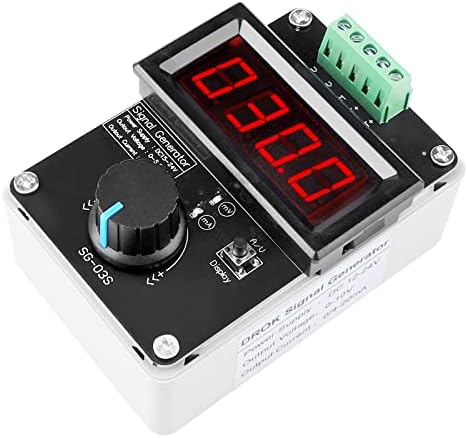


🎯 Nail your signal testing game with DROK’s precision power!
The DROK 4-20mA Signal Generator is a versatile, compact device designed for professionals needing accurate current and voltage signal simulation. It supports both 0/4-20mA current and 0-10V voltage outputs, adjustable via a precise multi-turn potentiometer. Powered by either a 24VDC supply or two 9V batteries, it offers portability and reliability for PLC panel testing and troubleshooting, making it a must-have tool for electrical testing and calibration.


| ASIN | B071NLGP6L |
| Best Sellers Rank | #60,243 in Industrial & Scientific ( See Top 100 in Industrial & Scientific ) #17 in Function Generators |
| Date First Available | May 1, 2017 |
| Is Discontinued By Manufacturer | No |
| Item Weight | 4.6 ounces |
| Item model number | 300482 |
| Manufacturer | DROK |
| Package Dimensions | 5.2 x 3.66 x 2.68 inches |
R**L
Perfect for testing and troubleshooting
Works as advertised, great way to check plc inputs, verify with a fluke 771, the output is accurate.
T**D
Nice tool for the price
This is a nice tool, and inexpensive. It can be powered by a 24VDC power supply, or I used 2 9V batteries in series. There is one terminal for V-Out, one for I-Out, and one for A- Com. If you do not know what any of these terms mean, this is not the device for you. There are capabilities to edit patameter set for both current and voltage. Another reviewer posted snip of settings and procedure. I used these to get I-Out from a 4-20mA down to a 0-20mA output. Relatively small device, great for portability. Approximately 4" x 2" x 2" I will probably locate a hard case and line it with foam pad to store device.
W**A
The signal was only off a small amount at first. But there as another problem.
I was using this to simulate the signal from a scale. At first it worked OK. Using my SIMPSON 260 I could see the signal was not quite as accurate as I wished but well within tolerance. Within a few days, the signal deteriorated until it was useless. We are a panel and programming shop. So I turned it off and said that's it. Luckily the main job I bought it for was done. But I cannot recommend this product. They are using cheap electronic components that quickly overheat. Probably the lowest of quality components. As the unit operates throughout the day, the signal gets worse. Probably due to heat from the device itself. The meter product is built nicely. After leaving it off for a week, I tried it again and the signal was fine (see my 2 pictures reading the output on a 4-10mA scale). But I will not rely solely on this meter. It is useful as a quick check in the field. Needs a 24vdc power supply to operate it. Do not leave it on if you want it to work right. And be sure you check it.
S**S
Good signal generator for PLC training
I bought this to supplement my learning of PLC Programming. I have a Micrologix 1100 which has two analog inputs that accept a 0-10v signal, and this unit fit the bill. I tested it with a digital multimeter first and overall the display is fairly accurate, certainly good enough for the price. Connected to the PLC, it does exactly what I need. I also tested the 0-20mA output and sure enough, it works also. I'm sure if I continue with PLCs I'll find more uses for it. It's good for the price!
W**N
Very good value!
So far this unit has performed very well. I checked the accuracy right out of the box with my Fluke 87 and it was right on! It does have a way to adjust both the voltage and milliamp output on the back of the board. I also put 2 - 9 volt batteries in series for the power supply and they fit inside the box. The PC board also has a pin out for a power switch which I added to turn off when not in use. I have used it for a week now, I experiment with vfd’s and other analog control devices and then put together installation and programming instructions. This is as good as any signal generator out there!
C**E
Low quality and inaccurate
This device looked like a good option for an inexpensive test tool, but it's not. There is no ability to power it from battery, making it useless in the field. The entire device is the circuit board itself, with components soldered on and no other form of stabilizing the parts from damage by bumping against something, also making it useless in the field. There is no way to get power in and measurement leads out other than screwing wires into the terminal block. This is fine for permanent installation, but way too fiddly and dangerous for field testing. Considering how easy it is to blow a 4-20mA circuit by either crossing wires or applying voltage, this is a built-in recipe for failure of your circuit sensors and transmitters. The only way to actuate the control the device to press the PC-mount button component (to switch btwn mA and Vdc output) and turn the PC-mount knob. These are not great ways to activate this device in the field or a benchtop. The more important part is its accuracy, which was off by 0.5V in the voltage scale. I was unable to test the mA scale at all because it just didn't work. There was no output at all. I tested with two different Fluke meters and got the same result. Useless. Lastly, the "box" part is just a mounting platform for the circuit board, so no real thought was put into the design as a tool or as a permanent benchtop tester. Even in a lab environment, you'd want to have this installed in a more usable box or DIN rack. Save your money and get something better designed and actually functional.
S**E
Simply Works
There is nothing fancy about this unit. It is build to meet a low price point, but does exactly what it needs to do. I measured it against my fluke 87V and it is aprox 0.01 error between my meter and the built in display for the 4-20ma setting. This may be able to be adjusted with the trim pot on the back but I have not looked as it is not a big deal to me. The meter uses a 5 turn pot as the adjustment knob. Unit is a little bit bulky and not designed to be used in a heavy industrial environment, but for the price it is going on my service truck.
S**W
Analog Generator added to Automation Lab
I seem to have 2 generations of these Analog Generators. I use them to produce an analog signal on my PLCs. The only difference is that the center generator will maintain it's last state after cycling power. the others return to 0V. No worries, does what I want them to.
B**N
Using a couple of these to simulate analog inputs on a PLC. Works perfectly. Have not tried the 0-10V functionality as 4-20mA is all I ever use. I really like that this device is in a plastic case. Everything feels solid! I do like that this is "hackable" to be used with a battery. I don't need this but it is nice to have the option. Wire this up to an M12 sensor cable and this can be used out in the field to test wiring as well. Good product and a solid buy if you need to simulate some analog sensors for programming.
A**M
Fácil de usar , económico y ayudamucho en las calibraciuobnes en banco y en campo.
R**D
I needed this to generate a 0-10volt analog control signal to test some ECM motors. It works perfectly. My only comment is that it should state that a 24volt DC input voltage is required. Fortunately the ECM motors I was testing required 24volts to power so I used the same transformer to power the signal generator. The LED display is also very useful and the fine adjustment is as well. A great little device for the price, if you need such a thing.
A**R
I use two 9-volt batteries in series to power it. Works well for setting up 4-20ma & 0-10v actuators
M**G
If you are looking for a low cost 4-20 mA signal generator, look no further. This provides values from 4 - 20 mA that are dead on to a Fluke meter.. Need it powered - check out the other reviews with instructions to power it with 2 x 9-volt batteries - very simple to do. It does exactly what you expect/need it to do.
Trustpilot
3 weeks ago
2 weeks ago