
DOWNLOAD THE APP


Customer Services
Copyright © 2025 Desertcart Holdings Limited
DOWNLOAD THE APP

⚡ Charge smarter, test deeper, power anywhere — the ultimate battery sidekick!
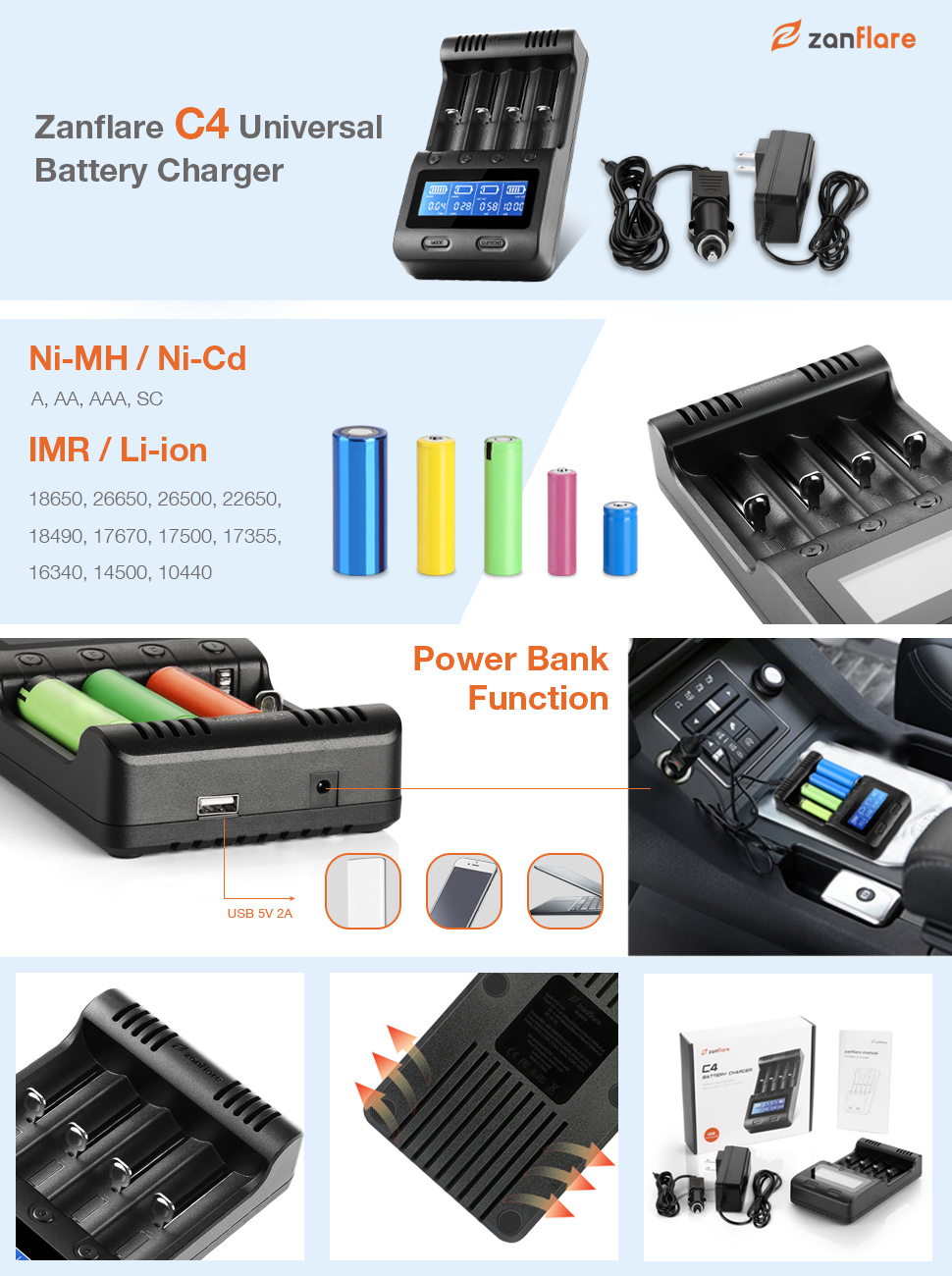
The Zanflare C4 is a versatile 4-slot smart battery charger and analyzer supporting NiMH, NiCd, and Li-ion batteries. It features an intuitive LCD display for real-time monitoring of voltage, current, capacity, and internal resistance per slot. Certified for safety with UL, PSE, FCC, CE, and ROHS standards, it offers multiple charging currents and modes including fast and normal testing. Bonus: it doubles as a 5V/2A USB power bank with included wall and car adapters, making it perfect for professional users who demand precision and portability.


| ASIN | B07428G1G2 |
| Batteries | 1 Lithium Ion batteries required. |
| Customer Reviews | 4.5 4.5 out of 5 stars (2,280) |
| Date First Available | July 19, 2017 |
| Is Discontinued By Manufacturer | No |
| Item Weight | 9.6 ounces |
| Item model number | C4 |
| Manufacturer | Zanflare |
| Product Dimensions | 7.09 x 3.94 x 1.57 inches |
A**E
Awesome charger does everything!!
The Zanflare C4 is Zanflare's entry into the Battery Charger market. The C4 is a 4 bay multi-functional smart charger which can charge and analyze NiMH, NiCd and Li-Ion batteries. The C4 is great for anyone looking to upgrade from their non-analyzing chargers. User Interface and Modes Each slot can operate completely independently (for example, slot 1 can be set to charge, slot 2 can be set to Fast Test and slot 3 can be set to Normal Test). In order to set different modes for each slot, you have to insert each battery one-at-a-time, set the mode and then wait a few seconds before inserting the next battery. Each slot can also have separate a current setting. The mode and current is set within 10 seconds of a battery being inserted. Operation: * When battery is inserted, press MODE within 10 seconds to rotate through the modes (Charge, Fast Test and Normal Test). * When battery is inserted, press CURRENT within 10 seconds to rotate through the current options (300/500/700/1000mA for Charge and 300/500mA for Test). 500mA is default. * Once charging/analysis has started, press the individual buttons (1, 2, 3 and 4) to rotate through the display for each slot. Modes: * CHARGE - Basic battery charge mode (300/500/700/1000mA) * FAST TEST - Discharge then re-charge and measure capacity (300/500mA) * NORMAL TEST - Charge, discharge than re-charge and measure capacity (300/500mA) Display: Each also has it's own individual display and can display: * mA - Charge/Discharge Current (Shows the setting, it does not fluctuate in real-time) * V - Voltage * mAh - Cumulative charge * mR - Internal Resistance * Time - Cumulative charge/analysis time Summary and Conclusion The C4 is a nice analyzing charger both in terms of function and appearance. It supports up to 4 18650s simultaneously and can charge up to 2 26650s simultaneously (non-adjacent slots). It can also support charging NiMH and NiCd so this makes it a good universal/family charger. It can also fit protected cells up to about 72mm in length although longer and wider cells like GAs feel cramped and tight. It does not support LiFePo or C/D cells. I like the charge and discharge current options (300/500/700/1000mA for Charge and 300/500mA for Test). I know that some people prefer chargers that can support more than 2A+ for charging or 1A for discharging. However, I prefer charging/discharging my cells at lower speeds for better longevity and less heat. I normally charge my 18650s at 500mA regardless of charger used. The 300mA charging option is also great for people charging smaller cells like 14500s. The charger has good size and ventilation and does not need a built-in fan. When charging 4 cells at 500mA, the charger gets warm. When charging 4 cells at 1A, the charger gets very warm (but not overly hot). If someone wanted to add cooling for heavy use, you could set this until on top of a cheap laptop fan since there are a lot of vents on the bottom. I like the display options and the ability to view actual voltage on top of accumulated charge. I also like that there is individual information for each cell so that I can monitor voltage for all 4 cells at the same time. However, I would prefer if the unit/interface was not "upside down" (design preference). I like that the unit is powered with a proper wall/car plug and not USB-powered. The sliders move well (not too stiff or too sloppy). The power bank functionality works well and charges my phone pretty quickly even on one cell (1A charge). Using cells as a power bank is also a good way to discharge cells (either for storage or testing) without "wasting" energy. My unit terminates charge around 4.16V and the voltage accuracy is within 0.3V when removing cells and measuring them with a voltmeter. Packaging and Contents 1 x Battery Charger 1 x Power Adapter 1 x Car Charger 1 x Manual I highly recommend buying this charger for all your needs!!
J**M
This Smart Charger / Analyzer keeps up with the big boys.
What can I say about the Zanflare C4 Smart Charger / Analyzer? I had mediocre hopes for the C4, assuming it wouldn't live up to its featured hype. But I am happy to say that it has thus far exceeded my expectations. I have lots of NiMh and LiIon batteries. LOTS, over 300. I also have 5 different smart chargers, and a slew of others. So my perspective comes from a comparison of things I already possess and use. My favorite Smart Charger / Analyzer up to this point was the Opus BT-C3400. So most of my perspective is related to that one. The ease of use and setting individual slot configurations is even nicer than the C3400. Additionally, like the C3400 you can set / reset the configuration of each individual slot "on-the-fly" with immediate response. The only feature the C4 doesn't have where the C3400 does is an automated REFRESH mode. Instead, you either manually use the Fast Test (discharge / charge [measure mAh on charge cycle]) or Normal Test (charge / discharge / charge [measure mAh on discharge cycle]) and simply do it manually 3 times to get the same process the Opus performs with its Discharge Refresh program. Sometimes it might be a hassle, other times it is nice to check the value between each cycle to see what kind of results you get at each point. What I've found is that when I need to refresh some old batteries, or ones that have not been used in awhile, where they seem to have lost some of their capacity, I can use the C3400 refresh and then "set it and forget it" until it is done. On the other hand, when I purchase new batteries, I find that if I use the C4 Fast Test manually, I might not need to do a full 3 cycle test to break them in. If the capacity is within 10% of the battery's rating, I then do the Normal test which provides the capacity from the "discharge" perspective (more accurate in my opinion), record my info and move on to the next set of batteries. The C4's display uses a white on blue background so is slightly less appealing than the C3400's LCD display, but is by no means difficult to read. In fact the C4 has a "virtual" battery that is always visible for each slot giving a nice and easy visual status without having to try and "read" something and without having to cycle through the "modes". Though you can cycle the modes just like the C3400 to indicate Voltage, mA charge rate, mAh capacity rate, Internal Resistance, etc. But that visual battery indicating a visual status is also always there, so you know "visually" about how close it is to being done with the discharge or charge state. Effect: I can look at it from across the room and just "know". The C4 appears to have good ventilation much like the C3400. It is a couple inches longer than the C3400, but it really doesn't require much more desk space as in either case you would want to have a bit of ventilation room anyway. I've used the unit on the major battery types (AAA, AA, 14500, 18650, 26650) and used the various current settings (even up to 1A * 4 slots) and the unit itself doesn't over heat or get any warmer than any other charger I own. So the "physical" characteristics are pretty similar. The exception is probably in the slots themselves. Rather than have a multi-tiered slot design like the C3400 has, they chose to simply make the slot "half circle" diameter the size needed for its largest battery support. This tends to make the smaller (AA, AAA) batteries "rock and roll" a bit when trying to place them. It takes more effort in other words. Not a lot more, but enough to certainly realize that it does. The C3400's two tiered system favors AA batteries for the smaller tier as they fit *almost* snug in that bottom tier. The wider batteries fit into the 2nd (upper) tier pretty nicely. So the C4 is not quite as nice as the C3400 in that respect. Additionally, the metal sliders are a little "bendy" (read as weak) so you may have to occasionally bend them to a straight vertical position for proper contact with the negative pole on the battery. Not a major problem, but something they should look at fixing in the future. So that I don't write a novel, I'll simply summarize here with possibly adding comments in the future as they become necessary: The Zanflare C4, much like the Opus BT-C3400, appears to be a solid Smart Charger / Analyzer and performs well. Could there be improvements? Maybe. But nothing major here is needed. I'm thoroughly pleased so far with the Zanflare C4, and the fact it is less expensive than my C3400 is simply icing on the cake.
D**J
Excellent battery charger!!
This is an excellent device! It's the best battery charger out there, in this price range...imo. I had a very basic charger before buying this; it basically charged the AA or AAA nimh batteries...nothing else. Plus, I could only charge either 2 or 4 batteries at a time. With this, I'm not limited. 1, 2, 3, or all 4 at a time. I finally NEEDED a charger that was more versatile & told me what I want to know about the the batteries. Well, this charger does it all really. It's great knowing the voltage, charging time, capacity, etc. No having to wonder about the status of the batteries you're charging! Very happy & impressed with this! Seems to be well built, & great quality. The display is very clear & easy to read too. I've been charging at 500 ma...& 300 ma, to be easier on the batteries. The default setting is 500 ma. I'm really into recharging my AA & AAA nimh batteries. Much better & really saves money. I was just tossing regular batteries in the trash can, which is wasteful in the long run. This is definitely the way to go! Thanks for making a great charger like this! Next, an upgrade on the battery tester I'm using. I know exactly the one I want too, from DIYlful. I included some photos. It really shows how consistent this charges. The Duracell did very well. I wasn't even aware they were 2500 maH. Nice.
S**4
Awesome Units When I clicked Buy I thought I was Only Getting 1 unit But it was for 2 .. I have am using this to test/check 18650 Batteries and it works Well .. took a while to figure out the menu .. press buttons .. done .. Very Easy to Figure out..
A**N
Very dissapointed. For a universal charger, it does not charge D type or 9 vrechargebale batteries. and the USB ouput does not work with NiMh batteries. If you're hoping to use this in conjunction with high capacity 2800mAh NiMh batteries to charge your mobile device, look elsewhere. Overall, unless you want to specially charge lithium ion batteries, this is not the best option.
J**N
Excellent battery charges and testers. These are invaluable tools for use in cell harvesting and testing large quantity of batteries. NiCad, Nimh, Li-ion.
Y**S
Facil pour la prise en main .3 charge 300ma 500ma 1A et 2 fonction de testeur normal et rapide je ne pouvais pas donne plus de cinq etoile
R**B
too big, lcd display need to be better
Trustpilot
2 weeks ago
2 weeks ago