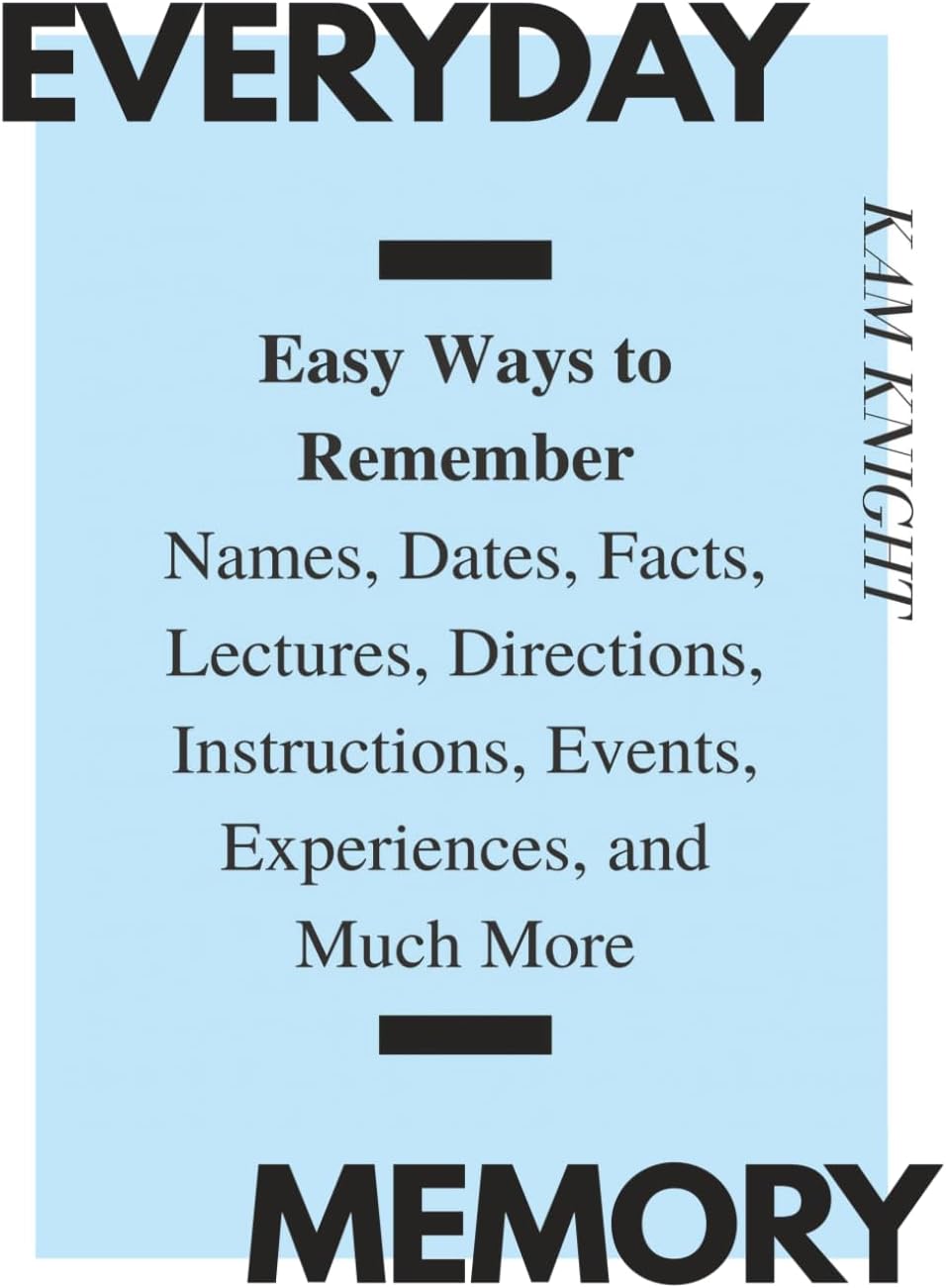
Everyday Memory: Easy Ways to Remember Names, Dates, Facts, Lectures, Directions, Instructions, Events, Experiences, and Much More (Mental Performance)
Product ID: 518553800
Desertcart purchases this item on your behalf and handles shipping, customs, and support to Sri Lanka.
The Most Innovative Look into Memory Improvement in Decades Times have changed. With so much information coming at us, you don’t have a lot of time to spend on outdated techniques that require a lot of time to learn and use. That's why traditional memory books and advice fail 1. They offer the same set of techniques taught for decades, like loci method, memory palace, and peg system. 2. The techniques are complicated, so to remember a simple number, you have to create a series of images & stories. 3. They are useful for a handful of information like lists, which is great for winning memory championships, but not everyday life. This book presents a completely new approach to improving memory It offers simple tips to remember most ANY information, ANY time, and ANY where. Whether that's names, dates, facts, presentations, directions, experiences, stories, and more. The tips work with the natural rhythm of how your brain likes to take in and process information, so you can start using them right away No need to spend hours learning complicated systems. So... How will the ability to remember the facts you read, conversations you have, and commitments you make improve your life? If you have been struggling with poor memory and want an easier way to improve and sharpen it, don’t miss out on the life-changing tips in this book! Review: Parker's book is a fine resource for memory enhancement techniques - John Parker's "Memory: Simple, Easy, and Fun Ways to Improve Memory" is dedicated to the process of "exercising" our memory in order to maintain our ability to register, store and retrieve information. Its multitude of chapters provide readers with various techniques - including repetition, maintaining (or even creating) interest in the topic or concept you want to remember, visualizing, the use of positive reinforcement and even dietary suggestions to keep the body-mind combination healthy and able to work properly. It tells us, for instance, that the brain and the body have distinct ways of storing and retrieving information, and that various methods are needed in order to enhance memory. It also tells us how repetition - a term which is often associated with boredom and lack of imagination - is actually a crucial element of memory enhancement: "You can use repetition to memorize any number of tasks and skills. To memorize new responsibilities at work, perform them several times. If you are learning to drive a car, go through the steps of checking the rear view mirror, breaking, putting the car in gear, pressing the gas, and steering several times before turning the ignition. Whether you are a white or blue collar worker, an athlete or artist, a student or caregiver, when you are presented with a new task to memorize, repeat it often." Though part of the book is about how and why memory works, the author delves deeply into the topic of how memory can be enhanced, particularly by the use of active methods such as associations - which often involves connecting something you wish to remember to something that you are already familiar with - and the employment of acrostics and acronyms. (A good example of an acrostic, according to the book, is "My Very Educated Mother Just Served Us Nuts", which takes the first letter of each of the names of our solar system's eight planets and uses it to form eight words that form a sentence to help us remember the names Mercury, Venus, Earth, Mars, Jupiter, Saturn, Uranus and Neptune. (Interestingly, this acrostic actually jogged an old memory about the acrostic I was taught in order to remember the nine planets of the solar system: Matilda Visits Every Monday, Just Stays Until Noon, Period." (The "Period," of course, stands for Pluto, which several years ago was re-categorized as a dwarf planet.) Parker explains both the concepts of memory and the techniques to maintain or enhance it in a clear and concise manner. He takes complex subjects and makes them understandable and interesting, which is a good approach for a writer to take since we all have memory issues of some kind. His prose is crisp and his tone is both authoritative and helpful, two very important traits that make "Memory: Simple, Easy, and Fun Ways to Improve Memory" a valuable resource to a wide range of readers. Review: Simple yet Powerful - I bought this book a little over 6 months ago. I'm not a memory expert, but have read more than my fair share of books on the subject to say this is one of the better ones I've encountered. One of the reasons I liked this book is because of the many examples. The author never assumes that just because a concept was explained that you will automatically know how to use it. Instead he provides numerous illustrations that show you what to do. Not only that, he shows you different ways to apply them in different situations. The examples are practical and reference information that you'll likely need to learn or remember, whether for school, work, or day to day life. Another reason I liked the book is because the author understands the limitations of each technique. He realizes that one method will not work for every situation. For example, you can't use acronyms to remind you of an appointment or a rhyme to remember where you misplaced your keys. Where one technique falls short, he provides others to compensate. Also, not all memory issues can be solved with a technique. Where a technique can't be used, he offers other strategies. He talks about everything from concentration, your diet, to getting organized. The most helpful chapter for me was the one on affirmations. The author says that your beliefs about your ability to remember have a strong influence on your memory - more than any technique you can learn. He gives you an affirmation exercise to improve your beliefs, which I've been affirming regularly for a few months. I have to say, that alone has had an astounding shift. I am able to remember everything from appointments, schedules, errands, deadlines, due dates, and meetings without the use of any method. It has made me more attentive and aware of my priorities without learning or applying techniques, and lately, I am rarely forgetting what's on my plate. Another chapter I really enjoyed was on using your sense of sight. Basically, you are showed ways to recall information similar to how people with photographic memory do. It sounds complicated and difficult, but it's not. For remembering a story or list, I'm not finding it too useful, but for complex processes and tasks, I'm getting really good results. I am able to remember the fine points of complicated procedures at work, which has impressed quite a few of my colleagues even those who put the procedure together. I will admit, I didn't find all the techniques useful. Not that they don't work, which I'm sure they do. Either I myself couldn't get into them or they didn't work with my mental habits. Though those that did work, have been working really well. There are a lot of tips in this book, so you'll definitely find more than a few that will click for you. Also, when it comes to memory improvement, most books and courses pretty much rehash the same tricks. In some respects, this book is no different. The author even admits that. In other respects, it presents unique ideas that I haven't heard discussed elsewhere. It runs the gambit from classic techniques such as acronyms, clustering, and the loci method to more unique ideas like facts association, mental practice, and the two I mentioned above. All in all, this is a great book on improving your memory. Majority of the content lives up to the title of easy, fun, and simple. If you are new to memory improvement, I recommend this book over others as it's not terribly long and the content is well presented and comfortable to read. It will be much help to students looking to excel in school, professionals wanting to manage their work, busy people striving to get a grip, as well as the elderly striving for a more youthful memory.
| Best Sellers Rank | #144,878 in Books ( See Top 100 in Books ) #2 in Memory Management Algorithms #6 in Teen & Young Adult College Entrance Aids |
| Customer Reviews | 4.3 out of 5 stars 391 Reviews |
A**S
Parker's book is a fine resource for memory enhancement techniques
John Parker's "Memory: Simple, Easy, and Fun Ways to Improve Memory" is dedicated to the process of "exercising" our memory in order to maintain our ability to register, store and retrieve information. Its multitude of chapters provide readers with various techniques - including repetition, maintaining (or even creating) interest in the topic or concept you want to remember, visualizing, the use of positive reinforcement and even dietary suggestions to keep the body-mind combination healthy and able to work properly. It tells us, for instance, that the brain and the body have distinct ways of storing and retrieving information, and that various methods are needed in order to enhance memory. It also tells us how repetition - a term which is often associated with boredom and lack of imagination - is actually a crucial element of memory enhancement: "You can use repetition to memorize any number of tasks and skills. To memorize new responsibilities at work, perform them several times. If you are learning to drive a car, go through the steps of checking the rear view mirror, breaking, putting the car in gear, pressing the gas, and steering several times before turning the ignition. Whether you are a white or blue collar worker, an athlete or artist, a student or caregiver, when you are presented with a new task to memorize, repeat it often." Though part of the book is about how and why memory works, the author delves deeply into the topic of how memory can be enhanced, particularly by the use of active methods such as associations - which often involves connecting something you wish to remember to something that you are already familiar with - and the employment of acrostics and acronyms. (A good example of an acrostic, according to the book, is "My Very Educated Mother Just Served Us Nuts", which takes the first letter of each of the names of our solar system's eight planets and uses it to form eight words that form a sentence to help us remember the names Mercury, Venus, Earth, Mars, Jupiter, Saturn, Uranus and Neptune. (Interestingly, this acrostic actually jogged an old memory about the acrostic I was taught in order to remember the nine planets of the solar system: Matilda Visits Every Monday, Just Stays Until Noon, Period." (The "Period," of course, stands for Pluto, which several years ago was re-categorized as a dwarf planet.) Parker explains both the concepts of memory and the techniques to maintain or enhance it in a clear and concise manner. He takes complex subjects and makes them understandable and interesting, which is a good approach for a writer to take since we all have memory issues of some kind. His prose is crisp and his tone is both authoritative and helpful, two very important traits that make "Memory: Simple, Easy, and Fun Ways to Improve Memory" a valuable resource to a wide range of readers.
A**N
Simple yet Powerful
I bought this book a little over 6 months ago. I'm not a memory expert, but have read more than my fair share of books on the subject to say this is one of the better ones I've encountered. One of the reasons I liked this book is because of the many examples. The author never assumes that just because a concept was explained that you will automatically know how to use it. Instead he provides numerous illustrations that show you what to do. Not only that, he shows you different ways to apply them in different situations. The examples are practical and reference information that you'll likely need to learn or remember, whether for school, work, or day to day life. Another reason I liked the book is because the author understands the limitations of each technique. He realizes that one method will not work for every situation. For example, you can't use acronyms to remind you of an appointment or a rhyme to remember where you misplaced your keys. Where one technique falls short, he provides others to compensate. Also, not all memory issues can be solved with a technique. Where a technique can't be used, he offers other strategies. He talks about everything from concentration, your diet, to getting organized. The most helpful chapter for me was the one on affirmations. The author says that your beliefs about your ability to remember have a strong influence on your memory - more than any technique you can learn. He gives you an affirmation exercise to improve your beliefs, which I've been affirming regularly for a few months. I have to say, that alone has had an astounding shift. I am able to remember everything from appointments, schedules, errands, deadlines, due dates, and meetings without the use of any method. It has made me more attentive and aware of my priorities without learning or applying techniques, and lately, I am rarely forgetting what's on my plate. Another chapter I really enjoyed was on using your sense of sight. Basically, you are showed ways to recall information similar to how people with photographic memory do. It sounds complicated and difficult, but it's not. For remembering a story or list, I'm not finding it too useful, but for complex processes and tasks, I'm getting really good results. I am able to remember the fine points of complicated procedures at work, which has impressed quite a few of my colleagues even those who put the procedure together. I will admit, I didn't find all the techniques useful. Not that they don't work, which I'm sure they do. Either I myself couldn't get into them or they didn't work with my mental habits. Though those that did work, have been working really well. There are a lot of tips in this book, so you'll definitely find more than a few that will click for you. Also, when it comes to memory improvement, most books and courses pretty much rehash the same tricks. In some respects, this book is no different. The author even admits that. In other respects, it presents unique ideas that I haven't heard discussed elsewhere. It runs the gambit from classic techniques such as acronyms, clustering, and the loci method to more unique ideas like facts association, mental practice, and the two I mentioned above. All in all, this is a great book on improving your memory. Majority of the content lives up to the title of easy, fun, and simple. If you are new to memory improvement, I recommend this book over others as it's not terribly long and the content is well presented and comfortable to read. It will be much help to students looking to excel in school, professionals wanting to manage their work, busy people striving to get a grip, as well as the elderly striving for a more youthful memory.
M**.
No AI, No Typos, Enough Goodness
Anytime I buy a book now especially on Amazn the first thing I check is the publish date and most early review. With so much stuff written by AI these days it’s the fastest way to weed out that junk. The book was published in 2011 and has reviews from that far back which lets me know it is time tested and human written cause AI as we know it didn’t come out until 2022. I also look to see if it has the Great on Kindle, because although I love Amazon there is too much tepid writing here and this tells me its free of spelling, grammar and other errors that take away from the reading experience. This passed on both fronts so I could move on to reading it I’ve been consuming a good amount of memory improvement lately and to me it was a clearer book to read and follow. Memory improvement can get quite confusing and I use to find my self in deer in headlights asking do I use this technique here, recall with that type of information, should I start with notes first? This book removed all that and made thinking about and improving memory plainless. It’s so clear it can seem common sense but it’s not common sense because no others are presenting memory like this. Too many memory products make big claims like you can remember anything or have limitless memory. That’s just not true and it’s setting people with very bad expectations mainly because they think they should be able to remember anything and when they don’t feel down about themselves. I took Jim Kwik’s course and his entire branding is about becoming “Limitless” but it had nothing that made my memory limitless. Not saying it was bad but nothing close to limitless. There are real limitations to memory and Kam is the only one in this space talking about that and his whole approach is around this exact point. And instead of giving you one technique to remember names and another for numbers that gets confusing, he focuses on principles of how your brain likes to receive and store information and how to combine the different principles in ways your brain works to remember just about anything from names, dates, facts, lectures, directions hence the title of this book. He goes beyond remembering facts and dates to things others aren’t addressing like if you want to be reminded of an appointment or a birthday you can’t technique yourself to have that memory come up on the specific day and time, or if you didn’t use a technique to remember something what then? He shows you how to access reminders, memories you’ve forgotten, experiences and other things other leave out But to set the record straight Kam isn’t a saint in his marketing either, he says to bringing a new perspective to memory but he is still teaching similar techniques. It’s a new look at them but some fundamentals are still the same so I’m taking a star off for that. I guess puffing your product is part of selling I don’t know. At the end of the day people are going to say what they’re going to say and everyone is entitled to their opinion. What matters is does this cover memory improvement, do the tips work, can you pick it up without a lot of time, is it as good as anything else out there and I’d say yes to it all. If you’re thinking about investing in expensive programs or courses like I did, spend a few bucks on a book first as you might be surprised to learn more with less
A**S
helped me study smarter during finals
As a first semester college student gearing up for finals, I picked up this memory book hoping it would help me retain a semester's worth of information in just a few weeks. It taught me a fresh way to approach learning, turning studying into something more helpful and less stressful. Instead of rereading the same pages over and over, I was connecting facts in a way that stuck. My recall felt sharper, and I could bring up details much quicker when writing essays or answering test questions. It is also surprisingly readable. The author explains everything clearly, with examples that are easy to follow, even for someone completely new to the topic. Once you get the hang of these tools, you can apply them to nearly any subject. There's no fluff, and it doesn't talk down to you. Just straightforward tools and examples that make sense when you're under pressure to perform. If you're studying for finals, or really any kind of exam, this book is a good book to have by your side.
J**L
Good Find
After following the instructions of reading this book a few times and after applying its lessons over the past months, I'm updating my review. I want to say I am really glad I bought it, there is a lot to learn here. I've read other memory books on the kindle and they are weak in comparison. It seems like Amazon has a very poor screening process. They seem to let any author publish a book, regardless of the content or quality. The kindle library is full of so called "memory" books that are big on promises but short on results. What's worse is that over half these books are 30 - 40 page pamphlets. The number of techniques you learn is limited, with very little substance. This is especially true of books in the Prime Lending Library. If you want to take the safe route, get this book. Although not all the tips are unique and innovative, and no memory book is, the presentation is excellent. More than anything, this book is a complete resources. It is not a 30 page pamphlet like others. It contains the most memory improvement strategies, for the most possible situations you will encounter - all in one place. An added bonus is that the reading is very relaxed, never too complicated or dull.
K**.
Great help
I recently stumbled upon Everyday Memory during one of my late-night online searches for study aids. Honestly, I wasn't expecting much but this book turned out to be a lifesaver for this semester. As a grad student juggling a million things I needed something straightforward to help with my forgetfulness and it delivered. The style of the writing is super relaxed and there's no complex jargon to sift through which is a breath of fresh air as I have plenty of complex jargon amidst the dense academic stuff I'm buried in. The chapters are short and hit the point quickly and that makes it really easy to squeeze in some reading between classes or during breaks. The memory techniques aren't only about memorizing textbooks but schedules, deadlines and networking details, all crucial for a grad student. I've tried a couple of the techniques on things like seminar dates and key points from lectures and it's impressive how much they've helped. The exercises at the end of each chapter are actually fun and get you to apply what you've just read which really help in retaining the information. It's practical and you see results right away. The book really makes memory improvement feel achievable that anyone can get better at it with a little practice. And for someone who's often doubting their ability to keep up with the rigors of grad school, this was a big plus. It's made a noticeable difference in how I handle my coursework and manage my extremely packed calendar. If you're a student feeling overwhelmed and a bit forgetful, give this book a shot, it's easy to get into and really makes a difference.
A**R
Nicely organized and readable memory book
I am a neuropsychologist and know a lot about memory. Yet it is hard to teach my clients simple and practical solutions to increase their memory skills. I really like "The Memory Book" by Harry Lorayne and Jerry Lucas because it presents ideas and strategies simply and in a funny way. After reading "Everyday Memory" by Kam Knight, I am a fan! This book covers many different memory techniques in a simple and effective way. All of the techniques presented in this book have much scientific evidence behind them. Almost anyone can read this book and improve their memory fairly quickly. I used some of the techniques from the book right away and they definitely worked well. Mostly, the book is very well organized, uses bullet points, summaries, real life examples, and many other techniques to help the reader follow what he is teaching. I would recommend this book for adolescents and adults who want to improve their memory in a fairly short amount of time. Once you have practiced the techniques that you like the best, then read the book more carefully when you have time so you can make your memory even better.
L**H
Waking up my brain.
I have enjoyed reading and practicing the technques. It wasn't easy for me at first. My brain was full with cobwebs and clutter, but slowly with just practicing, staying focus has help alot. Started taking Ginkgo Biloba just this week. This book is an easy read and I do recommend to others.
L**E
Easy to understand and thorough
In my opinion, it doesn't matter who you are, how old you are or what you do, it's always useful to improve your memory, even if you don't think you have a bad one. Mine's okay, but retaining information is important to me on both a work and personal level, so I read this book to learn some techniques. Perhaps the most important point made in the book is that your memory is like a muscle; the more you exercise it, the better it gets. The reverse is true, also; neglect makes it worse. So with that in mind I dove into this book, ready to learn and improve. There are many methods in here, the key is to read through each one, try it out, and see what works best. The methods include repetition--both mental and physical--taking notes, attention, focusing on positives, discarding negatives, affirmations and improving understanding to aid remembering. More advanced ideas include associations, clusters and visualization. Help with remembering certain types of information is also included; i.e., remembering names and faces, dates, locations, directions, addresses and events. All this information is coupled with ways to help these methods work better for you. Eating better removing stress, learning to relax, avoiding unimportant issues and learning to say no can all boost the memory-improvement process. The best part about it is that everything you're taught is easy to learn and apply. There's no point trying to learn something that's more likely to make your brain explode than improve your memory. Using some of the techniques, I've been able to control the things that I want to remember, and to access information more easily. Overall, this is an easy to understand, thorough book on improving memory. So if you're looking for a variety of methods to assist you, then this is a book worth checking out.
D**E
an excellent overview of memory techniques
This book is a must read for anyone wanting to improve their memory. It covers all the major points of developing and improving memory in an easily digested format that makes the task a positive pleasure. There is perhaps little that is novel in the book,but everything in it comes with a long history of success in the field. If you are keen to improve your memory this book is absolutely essential.
W**Z
Very helpful.
lots of ideas, science and philosophy to reason and aid memory. Fun games throughout. Will help anyone with memory problems or jsut if you want to improve memory for exams,etc.
L**Y
Only you can change your life
Oh dear, forgot I'd already read this book!
J**E
Five Stars
good book.
Trustpilot
2 months ago
1 month ago