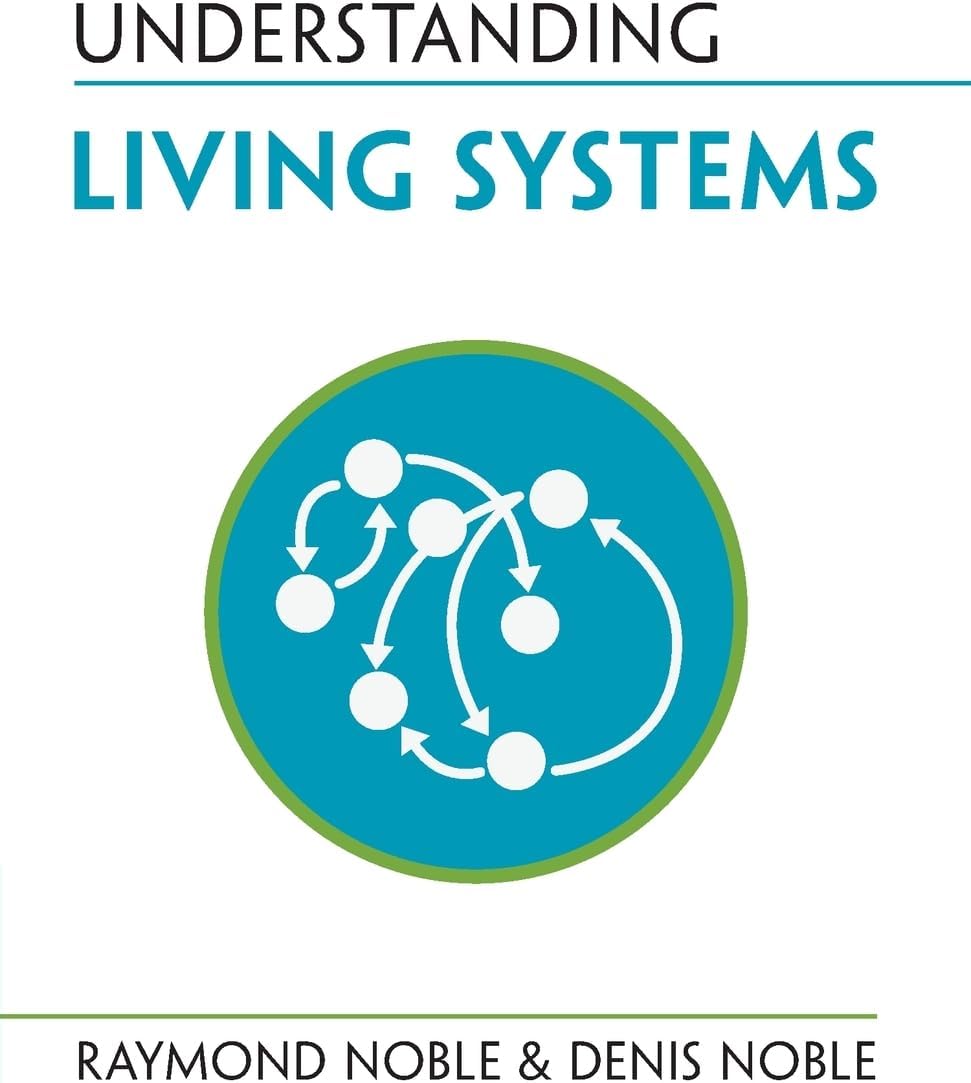
Understanding Living Systems
Product ID: 614267752
Buy anything from 5,000+ international stores. One checkout price. No surprise fees. Join 2M+ shoppers on Desertcart.
Desertcart purchases this item on your behalf and handles shipping, customs, and support to Sri Lanka.
Buy Understanding Living Systems by Noble, Raymond, Noble, Denis online on desertcart.ae at best prices. ✓ Fast and free shipping ✓ free returns ✓ cash on delivery available on eligible purchase. Review: Boek dat de nieuwe richting van biologiewetenshappen op een verstaanbare redenering en taal juist situeert. Review: This book re-establishes the role of choice and freedom in biology, after 100 years of being ignored and sidelined. These qualities are not merely characteristics of life, or "epiphenomena". They are the very signature of life. It cannot be understood any other way. This is plain enough to the average six year old, but the opposite is drilled into the heads of most biologists and medical students from the first day of their freshman year. This book canvases zoology, physiology, ecology, genetics, philosophy, and in the process delivers a takedown of the Selfish Gene theory. Everyone should watch author Denis Noble's debate with Richard Dawkins, easily found with an online search. The authors have impeccable credentials; Denis Noble, Oxford Professor, FRS, CBE, deciphered the mechanisms of the cardiac rhythm which made pacemakers possible; he's been nominated for the Nobel Prize and may yet win it. Ray Noble works at the Institute of Women's Health at University College London. Despite their lofty credentials they really do write in simple plain English and readers with a basic grasp of science and biology will have no difficulty following their arguments. The book delivers a careful study of the chain of causation in genetics, showing that it is not possible for "genetic determinism" [the idea that genes determine everything] to be true. Genes are mere organs of the cell and cells modify genes at will. To say the gene is the originator of everything is like defining a human being as "a stomach with legs." They challenge not only the medicine of reductionism, but the nihilism and despair as well. Though never explicitly stated, reading between the lines one can sense the authors' disdain for the pervasive belief that science has rendered life meaningless and narcissistic. It is clear from the stories and examples here that their views are as far from that as can be. In this book you'll get a detailed study of the failings of Neo-Darwinism, the version of evolution taught in most textbooks; and you'll get a preview of the "Third Way" evolution and systems biology which are replacing it. Quoting from page 90: "A major point in this book is that a consequence of a gene-centric approach to animals is that they become treated as machines, as automata. They become seen as the passive recipients of whatever environment they find themselves in. Yet organisms themselves create all the 'natural' environments on earth, and in doing so organisms have evolved in response to change." This attitude of treating animals plants and nature like machines drives environmental destruction and pill-prescribing laziness in medicine. One of the finest rewards of this book is how widely read the authors are, and how many fields they draw from. You'll encounter fascinating anecdotes, for example a detailed explanation of the biological systems foxes use to hunt and cooperate. Finally the book is a short, quick, pleasant read. Five stars all the way.


| Best Sellers Rank | #102,639 in Books ( See Top 100 in Books ) #57 in Genetics #525 in Biology #676 in Specific Philosophical Topics |
| Customer reviews | 4.5 4.5 out of 5 stars (60) |
| Dimensions | 12.7 x 1.14 x 17.78 cm |
| Edition | 1st |
| ISBN-10 | 1009277367 |
| ISBN-13 | 978-1009277365 |
| Item weight | 181 g |
| Language | English |
| Print length | 182 pages |
| Publication date | 6 July 2023 |
| Publisher | Cambridge University Press |
P**P
Boek dat de nieuwe richting van biologiewetenshappen op een verstaanbare redenering en taal juist situeert.
P**L
This book re-establishes the role of choice and freedom in biology, after 100 years of being ignored and sidelined. These qualities are not merely characteristics of life, or "epiphenomena". They are the very signature of life. It cannot be understood any other way. This is plain enough to the average six year old, but the opposite is drilled into the heads of most biologists and medical students from the first day of their freshman year. This book canvases zoology, physiology, ecology, genetics, philosophy, and in the process delivers a takedown of the Selfish Gene theory. Everyone should watch author Denis Noble's debate with Richard Dawkins, easily found with an online search. The authors have impeccable credentials; Denis Noble, Oxford Professor, FRS, CBE, deciphered the mechanisms of the cardiac rhythm which made pacemakers possible; he's been nominated for the Nobel Prize and may yet win it. Ray Noble works at the Institute of Women's Health at University College London. Despite their lofty credentials they really do write in simple plain English and readers with a basic grasp of science and biology will have no difficulty following their arguments. The book delivers a careful study of the chain of causation in genetics, showing that it is not possible for "genetic determinism" [the idea that genes determine everything] to be true. Genes are mere organs of the cell and cells modify genes at will. To say the gene is the originator of everything is like defining a human being as "a stomach with legs." They challenge not only the medicine of reductionism, but the nihilism and despair as well. Though never explicitly stated, reading between the lines one can sense the authors' disdain for the pervasive belief that science has rendered life meaningless and narcissistic. It is clear from the stories and examples here that their views are as far from that as can be. In this book you'll get a detailed study of the failings of Neo-Darwinism, the version of evolution taught in most textbooks; and you'll get a preview of the "Third Way" evolution and systems biology which are replacing it. Quoting from page 90: "A major point in this book is that a consequence of a gene-centric approach to animals is that they become treated as machines, as automata. They become seen as the passive recipients of whatever environment they find themselves in. Yet organisms themselves create all the 'natural' environments on earth, and in doing so organisms have evolved in response to change." This attitude of treating animals plants and nature like machines drives environmental destruction and pill-prescribing laziness in medicine. One of the finest rewards of this book is how widely read the authors are, and how many fields they draw from. You'll encounter fascinating anecdotes, for example a detailed explanation of the biological systems foxes use to hunt and cooperate. Finally the book is a short, quick, pleasant read. Five stars all the way.
P**S
Important for understanding life, including human life. In particular this book provides a persuasive account of the limitations of the reductionistic gene-centred approach to biology. I would recommend reading this book in order to free oneself from the psychologically damaging reductionist approach of orthodoxy biology.
S**H
"Understanding the living system" the paperback book that i received in India is clearly a counterfeit book. I am returning it.
T**R
I have read MANY,MANY books on evolution. This relatively short book is the very best. Like all sciences, the ideas in evolution get refined and changed over time. STILL, some incorrect things live on for some reason. This book destroys some of the fallacies that are still proffered and especially points out the fallacies about the "selfish gene" and about our offered ideas about genes in general. VERY informative book.
Trustpilot
2 months ago
4 days ago