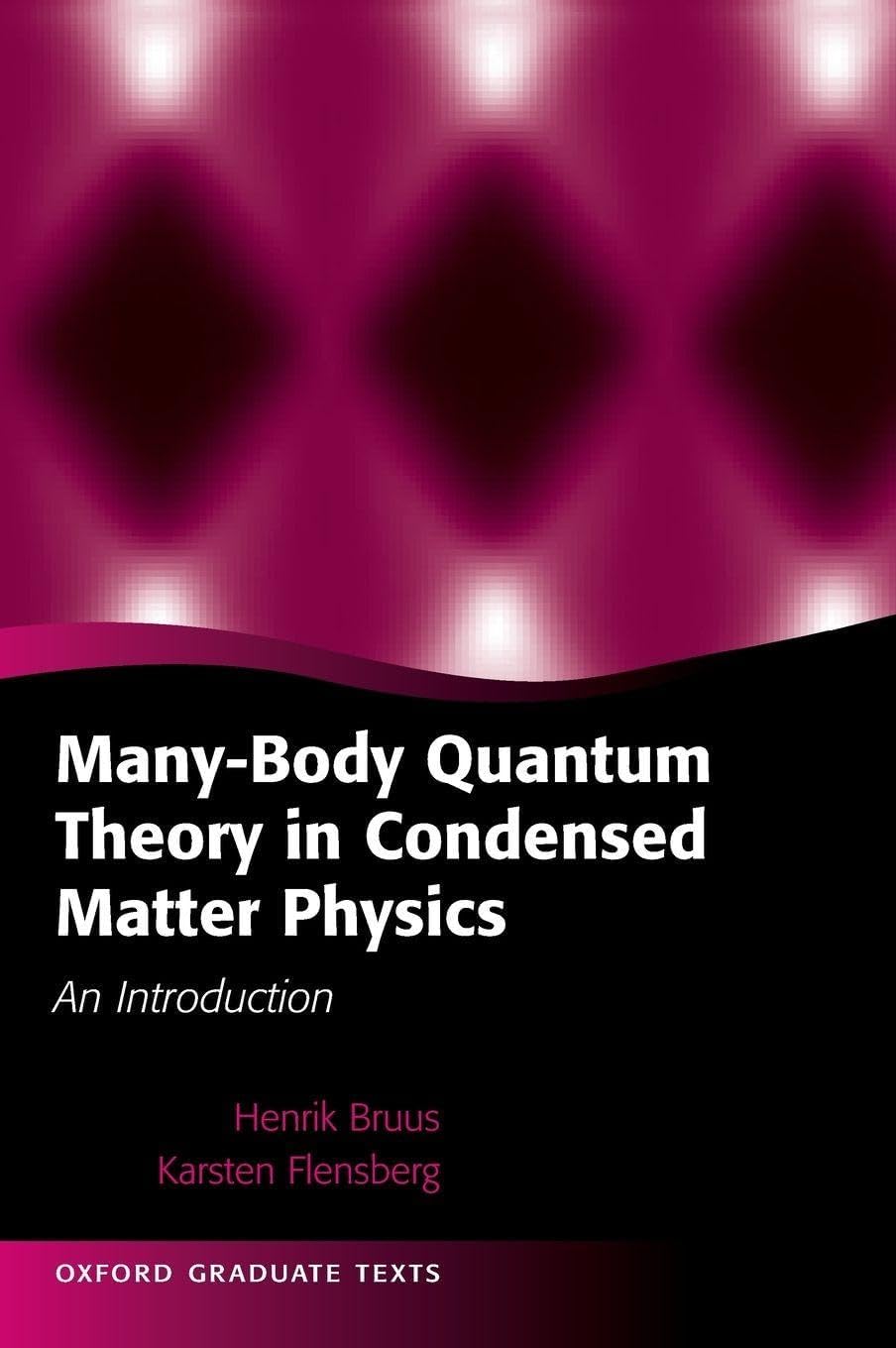
Many-Body Quantum Theory in Condensed Matter Physics: An Introduction (Oxford Graduate Texts)
Product ID: 6487138
Desertcart purchases this item on your behalf and handles shipping, customs, and support to Sri Lanka.
This book is an introduction to the techniques of many-body quantum theory with a large number of applications to condensed matter physics. The basic idea of the book is to provide a self-contained formulation of the theoretical framework without losing mathematical rigor, while at the same time providing physical motivation and examples. The examples are taken from applications in electron systems and transport theory. On the formal side, the book covers an introduction to second quantization, many-body Green's function, finite temperature Feynman diagrams and bosonization. The applications include traditional transport theory in bulk as well as mesoscopic systems, where both the Landau-Büttiker formalism and recent developments in correlated transport phenomena in mesoscopic systems and nano-structures are covered. Other topics include interacting electron gases, plasmons, electron-phonon interactions, superconductivity and a final chapter on one-dimensional systems where a detailed treatment of Luttinger liquid theory and bosonization techniques is given. Having grown out of a set of lecture notes, and containing many pedagogical exercises, this book is designed as a textbook for an advanced undergraduate or graduate course, and is also well suited for self-study. Review: Quantum theory - Good book Review: Very low number of errors, insightful, dense, yet pedagogical - The strength of this book is the low number of errors, compactness of its presentation, pedagogy, collection of exercises, emphasis of fundamentals, and careful calculation. Rarely is the reader left, unaided and unguided, to fill in gaping holes in logic. It is somewhat slow to work through the dense presentation. Also, the book treats some rather advanced topics (e.g., Matsubara sums, Feynman diagrams, etc.) with the same compactness. I had trouble understanding what the book was trying to communicate while taking a course. However, on revisiting the material after I'd finished the course, I realized the presentation was quite clear, and it was just my extremely-stressed state that was causing me to misinterpret the material. I should also say the extremely-ambitious course I took out of this book tried to cover almost the entire book, _and_ I was underqualified to take the course (I was concurrently taking only my first semester of introductory solid state physics). The book does say it is designed for a 2-semester course, not 1! It should be a statement about the book's clarity that the course wasn't a complete disaster for me...indeed, studying under such an ambitious instructor in such an unprepared state could have been a perfect-storm of a disaster!
| Best Sellers Rank | #852,356 in Books ( See Top 100 in Books ) #108 in Solid-State Physics (Books) #354 in Electromagnetism (Books) #769 in Quantum Theory (Books) |
| Customer Reviews | 4.7 out of 5 stars 35 Reviews |
C**G
Quantum theory
Good book
B**T
Very low number of errors, insightful, dense, yet pedagogical
The strength of this book is the low number of errors, compactness of its presentation, pedagogy, collection of exercises, emphasis of fundamentals, and careful calculation. Rarely is the reader left, unaided and unguided, to fill in gaping holes in logic. It is somewhat slow to work through the dense presentation. Also, the book treats some rather advanced topics (e.g., Matsubara sums, Feynman diagrams, etc.) with the same compactness. I had trouble understanding what the book was trying to communicate while taking a course. However, on revisiting the material after I'd finished the course, I realized the presentation was quite clear, and it was just my extremely-stressed state that was causing me to misinterpret the material. I should also say the extremely-ambitious course I took out of this book tried to cover almost the entire book, _and_ I was underqualified to take the course (I was concurrently taking only my first semester of introductory solid state physics). The book does say it is designed for a 2-semester course, not 1! It should be a statement about the book's clarity that the course wasn't a complete disaster for me...indeed, studying under such an ambitious instructor in such an unprepared state could have been a perfect-storm of a disaster!
A**R
This is a very good textbook for beginners to learn many body theory
This is a very good textbook for beginners to learn many body theory. The 2016 edition has corrected a lot of misprints.
B**U
I used this book for my master's project on superconductivity ...
I used this book for my master's project on superconductivity. It gave me a solid basis on many-body theory.
L**T
EXCELLENT BOOK!
This book is exactly what a new student (with some training in basic grad courses in solid state, statistical mechanics, etc.) needs to grasp condensed matter physics without a "research-based bias." Todays programs are so focused on application that a thorough treatment of pedigogical materials get superfically taught. Philip Anderson warns about this in his timeless classic "Basic Notions." This book uses QFT in canonical picture (bootstraps), no mention of path integrals. I started out in HEP, so I got trained fairly well in path integrals, some may find this a barrier with the book. Luttinger theory is the most modern topic touched on, applications to materials science. I recommend Wen's book if you want to look at Quantum Hall Effects and Topological Orders (post 1980's).
B**D
Four Stars
Very condensed and easy to read, probably not a beginners book.
H**N
Nice but not perfect condiction
A little bit broken ridge
D**L
Provides some very good insight and details, in the midst of a heap of mistakes
In its third edition it still contains an unacceptable amount of syntactical and grammatical errors, missing words, wrong formulas and nebulous explanations. For example, the 6th chapter explains linear response theory crystal clear, but the accompanying derivations of the conductivity and conductance formulae are erroneous and do not follow the recipe of linear response theory, which is extremely unpedagogical. Moreover, the book lacks rigour: When one wants to rederive some formulae it can happen that one gets stuck because the authors missed to provide proper definitions. In conclusion, the book by Bruus and Flensberg introduces some concepts in a very clear and pedagogical manner. Other than that the book has some serious faults. The reader has to devote more time to clearing up the mathematics than to understand the physics.
C**N
Excellente introduction aux fonctions de Green en physique du solide
Excellente présentation des applications de la méthode des fonctions de Green en physique du solide. De niveau M2 Physique Théorique.
J**O
Good book to learn
A well-organized book to learn many-body.
A**O
Perfetto
Ottimo rapporto qualità-prezzo. Consegna impeccabile!
M**C
Excellent book. The book was delivered directly from UK
Excellent book. The book was delivered directly from UK. Very fast.
T**S
Gut mit Fehlern
Grundsätzlich finde ich den Aufbau und das Konzept des Buches sehr gut. Allerdings finden sich doch einige Fehler in den Rechnungen. Teilweise kommt es einem vor als seine Vorzeichen eingemogelt wurden um das Ergebnis auf das erwartete zu führen, es werden imaginäre i's vergessen etc. Dennoch ein brauchbares Buch, da, wie schon erwähnt das Konzept sehr gut ist. Man muss während des Lesen nur etwas acht geben.
Trustpilot
1 month ago
3 weeks ago