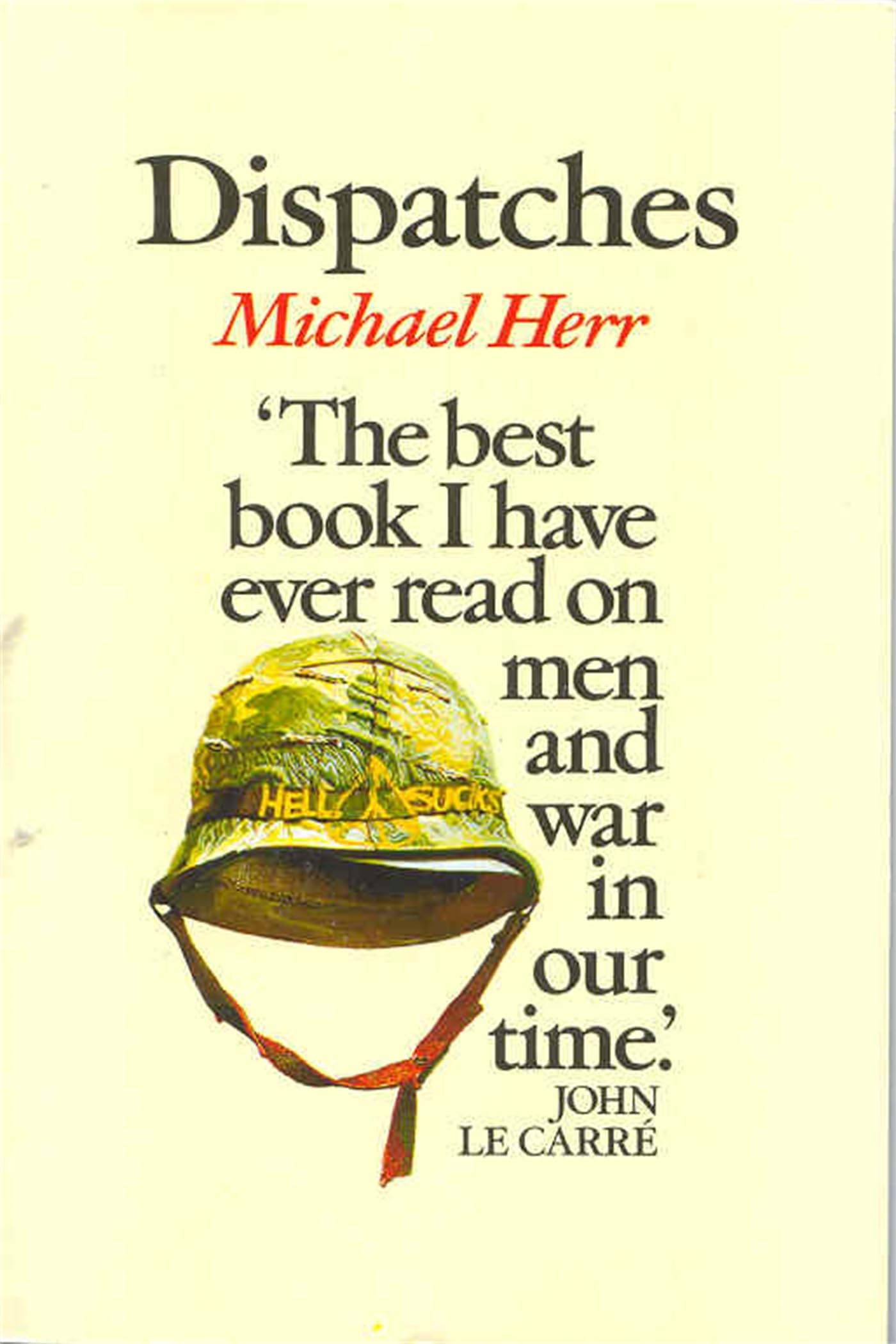
Dispatches
Product ID: 66458538
Buy anything from 5,000+ international stores. One checkout price. No surprise fees. Join 2M+ shoppers on Desertcart.
Desertcart purchases this item on your behalf and handles shipping, customs, and support to Sri Lanka.
Buy Dispatches by Herr, Michael (ISBN: 9780330255738) from desertcart's Book Store. Everyday low prices and free delivery on eligible orders. Review: A wild trip - My friend Eric, a prominent journalist in his own right, is off to Southeast Asia to retrace his illustrious father’s steps, who reported on the Vietnam War 50 years ago. In preparation for his findings, he’s having me do some reading. “Dispatches” is what he recommended, and I can see why: it’s a total assault on the senses. It’s visceral, epic, humble, bombastic, naïve and cynical all in one. And it’s laugh-out-loud hilarious. It’s not a history, of course. It’s a trip, rather. Michael Herr proudly offers a view from the lowest possible vantage point. His account may not even be 100% factual: rather than waste his time interviewing the officers, he spends all his time with “the grunts;” it’s their story he sets out to tell, and if some of it they made up, so be it. In short, if you want to find out what it FELT like to fight the war, if you want to feel the horror and the confusion, if it’s the Vietnam era “All Quiet on the Western Front” you’re looking for, then you’ve come to the right place. Review: Great book - A really good book that gives a really good idea of the true horror of war. I would recommend this book to anyone who thinks war is in any way glamorous.
| Best Sellers Rank | 415,359 in Books ( See Top 100 in Books ) 267 in Historical Essays, Journals, Letters & True Accounts 2,547 in Essays, Journals & Letters 6,905 in Society, Politics & Philosophy |
| Customer reviews | 4.5 4.5 out of 5 stars (2,949) |
| Dimensions | 12.9 x 1.6 x 19.7 cm |
| ISBN-10 | 0330255738 |
| ISBN-13 | 978-0330255738 |
| Item weight | 186 g |
| Language | English |
| Print length | 272 pages |
| Publication date | 25 Oct. 1991 |
| Publisher | Picador |
| Reading age | 18 years and up |
A**N
A wild trip
My friend Eric, a prominent journalist in his own right, is off to Southeast Asia to retrace his illustrious father’s steps, who reported on the Vietnam War 50 years ago. In preparation for his findings, he’s having me do some reading. “Dispatches” is what he recommended, and I can see why: it’s a total assault on the senses. It’s visceral, epic, humble, bombastic, naïve and cynical all in one. And it’s laugh-out-loud hilarious. It’s not a history, of course. It’s a trip, rather. Michael Herr proudly offers a view from the lowest possible vantage point. His account may not even be 100% factual: rather than waste his time interviewing the officers, he spends all his time with “the grunts;” it’s their story he sets out to tell, and if some of it they made up, so be it. In short, if you want to find out what it FELT like to fight the war, if you want to feel the horror and the confusion, if it’s the Vietnam era “All Quiet on the Western Front” you’re looking for, then you’ve come to the right place.
M**K
Great book
A really good book that gives a really good idea of the true horror of war. I would recommend this book to anyone who thinks war is in any way glamorous.
D**W
What is this?
As a university teacher I am forever telling my students to "Define your terms." Before any Literary work can be fully judged and evaluated a clear and binding set of parameters must be established; benchmarks against which the piece in question can be compared, contrasted and most importantly evaluated. If no terms are defined, and no frame of reference draw or defined, then there is no way we can evaluate writing, because what are we comparing it to? My problem therefore with this book, is how to evaluate it. What is it? What does it want to be judged as? Where should we put it in the library? Amongst whose company should it sit? These are very fundamental questions that require unambiguous answers if we are to set about processing this work as it clearly deserves to be processed. Whilst I understand this work to be Herr's catharsis, on a more practical level is it a novel? a memoir? a historical document? Is it fiction? non-fiction? Is it journalism? war correspondence? Maybe I could set it in one of these boxes, but it would not sit comfortably in a single one. And the one I might elect might not be the same one Herr would wish it to be read as. It's rather akin to a person of mixed ethnicity going through immigration and not knowing which is the better of the boxes to tick - there being no one that correctly denotes their ethnicity. All of this confusion does not really allow the Work to be fully appreciated and accurately processed and as I tell my students who don't define their terms correctly, whilst I CAN read your submission - because I can't accurately appraise it, your score will suffer as a consequence. To the work: There is no doubt that this is an important piece of social and cultural heritage which undoubtedly adds to the Historical Record for the latter half of the 1960s. However, because it is so clearly a period-piece it suffers somewhat from both its tone and use of language and this is something that makes it difficult reading. Linguistically, the '60s was a fascinating period which gave brief rise to a wealth of youth-driven modes of communication and an abundance of periodic vocabulary. Fortunately (or unfortunately) when the door was closed on flower-power etc. linguistics returned to normal. This work therefore, and the language contained within the prose often reads akin to Shakespeare and therefore requires additional commentary to clarify and contextualize the somewhat dated language. As per the previous point and comments made by other reviewers, this work is a hard slog. Due in part to the aforementioned dated linguistics, and due in part to the 'Gonzo' style of rendering, Herr really does make you take a machete and hack your way through the terrain. Certainly before it lets up in the Fifth Act 'Colleagues' the reader is right there with the action, not necessarily the physical 'blood-and-guts', but rather the spiritual, the metaphysical, the psychological and the ontological. In summation: This is a very fascinating period-piece and a bona-fide part of the Historical Record. It should be read as part of a wider trawl through the unprecedented volume Literature that both the '60s and the Viet Nam War gave rise to. Viewed as a historical document set in the linguistic form of the late '60s 'Counter-Culture', this text works admirable and justifies its longevity and abundant praise. Recommended.
M**H
Read this book. Timeless - and still relevant.
Back in the day I read Dispatches, ChickenHawk, If I Die In A Combat Zone, Bright Shining Lie and A Rumour Of War. They were so good I read them several times. They were so good, I still remember them. If you haven't read them before, I recommend them. If you have, then read them again - I intend to. And, if you have children, encourage them to read them too. Dispatches is, in my opinion, the best of the five - and one of the finest books ever written. A couple of the reviews have suggested the book is 'badly written'. I'm not a book critic, so I don't know the technical terms, but I'd say the writing style of Dispatches is a lot closer to disjointed 'flow of consciousness' than chronological 'this happened because, then then this happened because, then this happened .....'. Its more like poetry than prose. Whether thats good or bad is probably personal preference. In my view, given the subject, that makes it better rather than worse.
M**C
Still Excellent 40 Years On From My First Reading
Not a book to be devoured in a couple sessions. Best read 5-10 pages at a time with plenty of thinking time allowed. I first read this in the early 80s and was interested to see how well it had aged. Answer: The book is timeless, the prose can be dense and sometimes hard to interperet but it succeeds in taking us into the author's mind and explaining the addictiveness of the war correspondent's lifestyle. Harrowing and brutally graphic at times, beautifully written. Recommended reading for anyone interested in an insider's account of war,
G**S
Outstanding book if you can get past the first section
I found the first chapter "Breathing In" rather hard going. Much of that first chapter reads to me like the author came down off a bad trip and was writing everything down as he was doing so. This book reads so much better when Herr drops the so-hip-it-hurts prose and reverts for the rest of the book to a more gritty take on the whole thing, In fact I'd go as far to say that the rest of the book deserves all the praise it gets. I did like his cynicism about the pen pushers fighting a war from their desks, wishing (perhaps?) they were actually the grunts facing off against the VC. Who among us could not at least grimly smile about the "mad Colonel" stories. Would have been nice to get at least a paragraph as to why he was there in the first place, as there are several mentions of the reporters being able to go home whenever they wished.
R**X
Michael Herr was an excellent writer and correspondent. Using my Kindle, I was able to search the background for references and certain metaphors offered in the chapters. It made for a more complete and thought-provoking reading experience and understanding of the abject insanity spawned by global elites/powers and how it was/is manifest "on the ground". Kindle has "re-kindled" my love of reading and Dispatches was my first read.
P**J
Good read, very interesting insights. Like the other very very interesting "Once Upon a Distant War: David Halberstam, Neil Sheehan, Peter Arnett--Young War Correspondents and Their Early Vietnam" it is very much focused on the early 1960s, before the US entered the war with full force. I am looking for some book about the later, of course not - with all due respect - the memoirs of some vets (and not "We Were Soldiers once ...", but the bigger picture. Would be grateful for any useful hint.
C**S
Michael Herr's book, Dispatches, is a powerful literary work with its journalistic documentary immediacy, its emotional impact, and its historic implications. It speaks of the bravery and irony and ability to deal with absurdity that is so characteristic of America's young men. It tell of the idiocy when tremendous resources are put into place with little insight into history, culture, human nature, and the ability of ideology to blind leaders so that they ignore reality. Herr's writing style is testosterone-driven, machine-gun paced with clipped character studies of the many men he met in combat. Of course this is what I got from this book but I came to these conclusions from reading the realistic, earthy, often crude and rough, experiences of front line Marines as they experienced events beyond their control and often beyond comprehension. This book is gutsy and gives a gritty description of the conditions that our young men faced in a poorly led war. Blood, wounds, filth, anger, violence, irrationality, sex, and poverty are often ugly and messy and Herr does not shy away from straight-forward narration of these all too human conditions. Herr focuses on the soldiers on the front lines and gives a very real description of wartime. Herr's heart is with the soldiers and this shows in every description and event in the books. By giving the nitty-gritty details of life in wartime he becomes a defender and advocate for those young 19 year olds who underwent this ordeal. When the enemy can disappear into the forests and crowds and homes of the South Vietnamese, when the primary style of warfare is guerrilla warfare, then increased firepower and destruction is counter productive and bound for defeat. The Vietcong controlled the underground world of tunnels and caves whereas the United States controlled the air with our tremendous war machine. When we protect people by destroying their villages, fields, and forests we should not be surprised when they support the enemy. When entire forests and rice fields are destroyed so that the `enemy' has no cover, the war is lost, for those whom we claim to protect have now joined forces with the enemy. The US Forces had a slogan "Only you can prevention forests" that displays the irony these men felt at destroying a country to save it. Entire Vietcong units were supposedly destroyed only to appear in a matter of days elsewhere. Herr relates that whereas we were suppose to be supporting the South Vietnam government, that the corrupt bribe-hungry government could hardly maintain a police force in Saigon. As Herr says, all this means is that the country could not be saved, only destroyed. Herr's observations on racial relationships and tensions are fascinating. He relates how black and white soldiers supported each other in the field under hardships. He also relates what a blow the death of Martin Luther King Jr. was to the black servicemen. Herr does a great job of revealing the strength and patience of black servicemen who were fighting for their country in Vietnam. The chapter on the Khe Sanh base is the most focused narrative work in the book. There is a sense of paranoia as the trapped Marines wait for the assault of the Vietcong upon the base. Herr relates how the American command appeared to be implementing a strategy to draw out the Vietcong to mass troops around Khe Sanh to repeat their strategy against the French in the Battle of Dien Bien Phu. However, by concentrating their forces around Khe Sanh, they offered a better target for American airpower. However the Marines felt out-numbered and completely surrounded as they endured the most brutal artillery barrage of the war. The evacuation roads were completely under the control of the Vietcong and the monsoon season had 6 more weeks to run making retreat much more difficult. Herr relates the considerable tensions that grew as the confrontation built up and reports of increased but unseen Vietcong troops increased. He is at his best as he relates the effects of this tension upon the front line soldiers. The chapter on the war correspondents is also first class literature. Herr doesn't respect all his colleagues by any means since some took the easy way out and reported only what General Westmoreland and his staff wished reported back to US citizens. Many officers felt that Westmoreland made a critical error in allowing so many correspondents to observe the war and report back their observations to an American public that had cognitive dissonance trying to interpret the chaos and horror. However he does observe that the bravest correspondents tended to be the most compassionate. I found the sections on photographer Sean Flynn, son of actor Errol Flynn, to be an interesting observation of the role of the correspondent under war conditions. Herr conveys the sense of the time with the mix of contemporary culture that the young Marines experienced including the works of Jim Morrison and the Doors, Jimmy Hendrix, and others. The cultural context of the war and times permeated both the United States and Vietnam and Herr captures this background perfectly. I would end this review with one image and one quotation. Herr relates how after a village that was deemed to be sympathetic to the Vietcong was destroyed, a Vietnamese man holds his dead baby girl in his outstretched arms in the road as the Americans pass. He says nothing; he just looks into their faces and holds up the dead baby for them to see as they drive by. Herr says: "Those who remember the past are condemned to repeat it too, that is a little history joke."
A**O
One of the best war relates I've ever read. Human and fully involved, never cynical, nor bombastic, nor approximate in his descriptions of context, feelings, ...and wounds. A must-read about the US in Vietnam
A**S
It's like if Hunter S Thompson went to Vietnam. Love it as a history buff, provides so much insight into the conflict. Also love it as a film buff as Herr co-wrote Full Metal Jacket and the Narration for Apocalypse Now. The influence this book has had on both films is obvious once you've read it. Anyone interested in the Vietnam war and the movies it inspired should pick up this book. It's informative as any good nonfiction but written in a style that's as entertaining and creative as most fictional books. It's no wonder Hunter S Thompson and Stanley Kubrick both spoke so highly about this book.
Trustpilot
1 month ago
2 weeks ago