Desertcart purchases this item on your behalf and handles shipping, customs, and support to Sri Lanka.
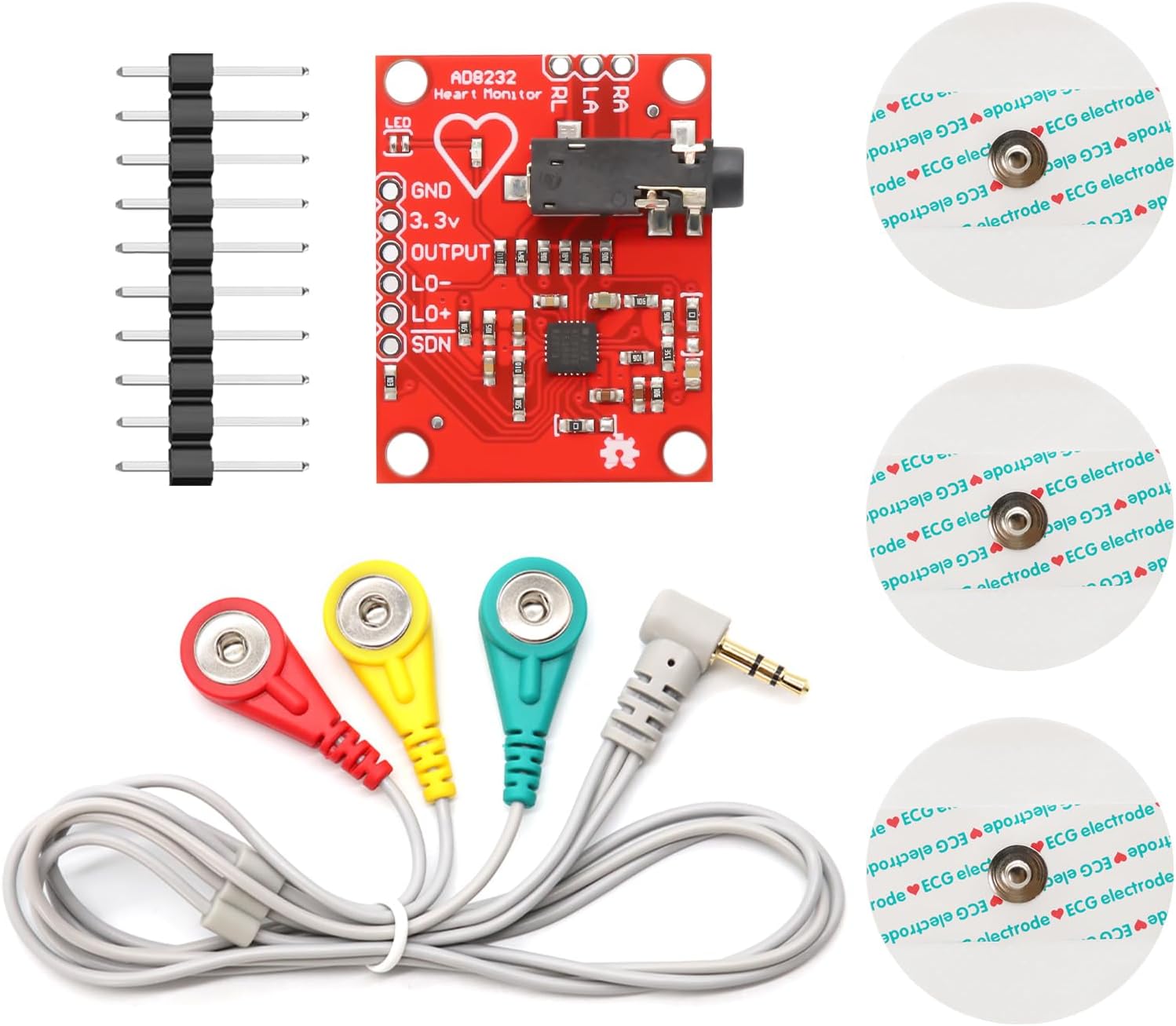
Product overview: The AD8232 is an integrated signal processing module designed for the acquisition and processing of electrocardiograms (ECG) and other bioelectric signals. This AD8232 module efficiently extracts, amplifies and filters weak bioelectrical signals for applications such as fitness and training heart rate monitoring, portable ECG devices, remote health status monitoring and capturing bioelectrical signals. Pin Definitions: HPDRIVE: high pass driver output, connects to the capacitor in the high pass filter +IN: Positive input of instrument amplifier, connects to left arm electrode (LA). -IN: negative input of the instrument amplifier, connects to the electrode of the right arm (RA). RLDFB: feedback input for right leg drive RLD: output for driving the right leg, connects to the electrode of the right leg. SW: pin for quick recovery switch, connects to the output of the second high pass filter OPAMP+: In phase input of the operational amplifier. REFOUT: reference voltage output, used as virtual ground OPAMP: inverting input of the operational amplifier. Out: output of the operational amplifier, output of the processed heart rate signal. LOD: output of the derivative comparator (DC mode). LOD+: output of the derivative comparator (DC mode). SDN: shutdown control input, low level to switch to power saving mode AC/DC: control input for derivation mode. FR: Control input for quick recovery GND: electricity mass. +VS: power supply pin REFIN: reference voltage buffer input IAOUT: Output pin of instrument amplifier HPSENSE: input for high pass detection of the instrument amplifier. Connection steps. 1. Connect the power supply: connect the GND pin of the AD8232 module to the power supply ground and +VS pin connect to the power supply (3.3V or 5V). 2. Connect electrodes: +IN to the electrode of the left arm. -Connect IN to the electrode of the right arm. Connect RLD to the electrode of the right leg. 3. Read signal: Connect OUT pin to Arduino's analogue input pin (e.g. A0). 4. Select working mode: adjust AC/DC and SDN pins according to the application requirements. Package includes: 1 x AD8232 ECG module kit. Review: Incompleto - Arrivato senza connettore jack per i sensori sul PC. Inutilizzabile. Fatto reso Review: Top Starterkit für ein DIY EKG - Bei mir war alles Nötige im Lieferumfang enthalten, um direkt mit dem Projekt starten zu können. Lediglich die Verbindungskabel zum Mikrocontroller muss man selbst mitbringen. Ansonsten steht dem Einstieg in Programmierung und Messungen nichts im Weg. Ich habe mir den Beispielcode aus verschiedenen Projekten aus dem Netz zusammengesucht und konnte das Modul problemlos in Betrieb nehmen. Das AD8232 Breakout Board arbeitet mit normalen Logic Leveln und lässt sich daher sehr einfach über Jumperkabel an einen Arduino anschließen. Die Messungen funktionieren zuverlässig und stabil. Für Bastelprojekte, Lernzwecke oder erste Experimente im Bereich EKG und Herzfrequenz ist das Modul aus meiner Sicht sehr gut geeignet. Insgesamt ein solides Kit, das genau das tut, was es soll.
| ASIN | B0DKJ8ZSX7 |
| Brand | Binghe |
| CPU socket | NOT |
| Chipset Family | ADI AD8232 |
| Chipset Type | AD8232 |
| Chipset type | AD8232 |
| Compatible Devices | Personal Computer |
| Compatible Processors | M |
| Compatible devices | Personal Computer |
| Compatible processors | M |
| Customer Reviews | 3.8 out of 5 stars 7 Reviews |
| Graphics Card Interface | PCI Express |
| Main Power Connector Type | 20-Pin |
| Manufacturer | Binghe |
| Memory Slots Available | NOT |
| Model Name | AD8232 |
| Model Number | AD8232 |
| Number of Ports | 20 |
| Processor Socket | NOT |
| RAM Memory Technology | NOT |
| Ram memory technology | NOT |
| Total SATA Ports | 20 |
| Total Usb Ports | 20 |
| Unit Count | 1 Count |
D**O
Incompleto
Arrivato senza connettore jack per i sensori sul PC. Inutilizzabile. Fatto reso
T**G
Top Starterkit für ein DIY EKG
Bei mir war alles Nötige im Lieferumfang enthalten, um direkt mit dem Projekt starten zu können. Lediglich die Verbindungskabel zum Mikrocontroller muss man selbst mitbringen. Ansonsten steht dem Einstieg in Programmierung und Messungen nichts im Weg. Ich habe mir den Beispielcode aus verschiedenen Projekten aus dem Netz zusammengesucht und konnte das Modul problemlos in Betrieb nehmen. Das AD8232 Breakout Board arbeitet mit normalen Logic Leveln und lässt sich daher sehr einfach über Jumperkabel an einen Arduino anschließen. Die Messungen funktionieren zuverlässig und stabil. Für Bastelprojekte, Lernzwecke oder erste Experimente im Bereich EKG und Herzfrequenz ist das Modul aus meiner Sicht sehr gut geeignet. Insgesamt ein solides Kit, das genau das tut, was es soll.
Trustpilot
1 month ago
1 month ago