
DOWNLOAD THE APP


Customer Services
Copyright © 2025 Desertcart Holdings Limited
DOWNLOAD THE APP

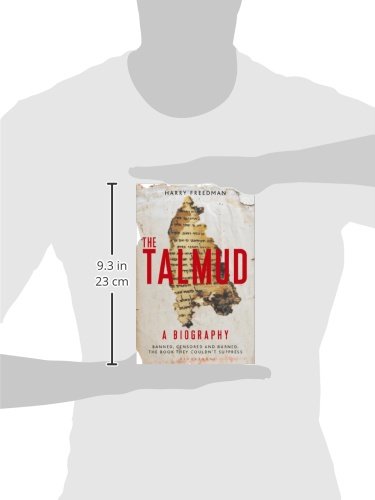
The Talmud – A Biography: Banned, censored and burned. The book they couldn't suppress
J**A
interesting history of the Talmud, but with too many digressions
This "biography" of the Talmud is an interesting overview of complex history that has many things going for it, but also suffers from a number of minuses. On the positive side, Dr. Freedman does an excellent job of tracing the evolution of the Babylonian Talmud from its origins as an accumulation of discussions among the rabbinic sages over several centuries, which were transmitted orally from one generation of scholars to the next, until its compilation, redaction and commitment to written form. Among the negatives, the author can't seem to decide whether his subject is a history of Judaism or of a series of books that were central to its development. While this is understandable, given the historical (and continuing) importance of the Talmud, the author still devotes too much space to extraneous material, much of which is quite subjective. To cite just one example, the saga of the false messiah Shabbtai Tzvi is recounted in detail, yet it has no relevance whatsoever to the story of the Talmud. On the other hand, there is some material on the Vilna Gaon, a towering figure who was the Lithuanian equivalent of one of the ancient Jewish sages; but the author, who is so wrapped up in recounting irrelevant anecdotes, doesn't communicate the full significance of the role of the Gaon and the world he lived in. In fact, the Vilna Gaon was the ultimate product of a culture where the study of the Talmud reigned supreme, where thousands upon thousands of young men attended hundreds of Yeshivas in Poland and Lithuania taught by some of the greatest minds of 18th and 19th century Judaism. This dimension of the story of the Talmud - its dominant role in the lives of Eastern European Jewry - is underemphasized.Separately, "The Talmud: A Biography" would have benefitted from a more attentive editor. There are, for example, numerous instances where sentences have an odd structure because they are either missing a conjunction or are simply two sentences written as one. One example will suffice: "His teacher Yehudai had tried something similar and had been rebuffed, the heirs to the Jerusalem Talmud were not going to be dictated to by those of the Babylonian version." (p. 70) In some cases, multiple sentences should have been formed into one unit: "There was a far more urgent battle looming. Against a Jewish sectarian group known as the Karaites. Who, like the Sadducees some centuries earlier, did not accept the Oral Law at all." (p. 71)Despite the intermittent lack of focus, I found "The Talmud" to be interesting and informative, and would recommend it as an introduction to the Talmud's formation and evolution. For a summary of the Talmud's content, I would recommend Solomon Schechter's "Aspects of Rabbinic Theology" and Abraham Cohen's "Everyman's Talmud."
B**K
Excellent Introduction to a Difficult Book(s)
I've tried to read parts of the Talmud independently and found it confusing, convoluted, meandering. The middle management meeting from hell. By telling the story of this book, and the story of the people who protected it and nurtured it, Freedman's work adds some perspective and humanity, giving a sense of why the Talmud is important, how its own history reflects the history of the Jewish people, and how its very existence is a testament to its own survival and the survival of the people who kept it.I like the parallels he draws between the Talmud and the methods behind Islamic law. It's always been a truism that many ideas from Jewish law were copied into Islamic law, but what I found interesting was that the work points out similarities in handling oral precedent and disputes without falling back on some central authority. Which, some scholars suggest, inspired English Common Law.I liked how Freedman discussed the oft-forgotten tradition of gentile Hebraists (of whom I count myself), and how they reluctantly waded their feet in the Talmud when the Torah wasn't clear enough.And finally, I liked how Freedman showed that the Talmud was, in a way, ahead of its time. The Talmud is a hypertext, encouraging readers to find meaning between arguments. The Mishna is a commentary on the Torah. The Gemara is a commentary on the Mishna. Rambam and Rashi comment on that, and then there's the Tosafot, and all the books written to summarize what is said in the Talmud ... He even talks about the teku, the unresolvable paradox, the assumption that something is in two states at once. Shroedinger's cat, Akiva's mouse. Did the Talmud catch up with the world, or did the world catch up with the Talmud?Unlike the Torah, which has an electric, forceful, dramatic quality, the Talmud is quiet, domestic, and indirect, and it requires much more patience to grapple with. Freedman's book is an excellent starting point, and I'm sure Rabbi Eliezar and Rabbi Akiva would agree. Or would they?
S**T
It's a good overview of how the Talmud come to be and ...
This book contains no original material and is not written for the serious scholar but it combines a lot of material in one volume and to my knowledge, this has not been done before. It's a good overview of how the Talmud come to be and how it influenced the world from it's inception to the present day. There are many books about the Talmud but none that give you this wide an historical overview. It's very readable for the layman and I recommend it for anyone who wants to know what the Talmud is all about.
A**T
fascinating
A more appropriate title would be "The History of the Jews over the Past 2,000 Years from the Perspective of the Talmud." At times spellbinding and addictive, the book gives a taste of the contents of the Talmud and a sense of the history of its development and of Jewish and inter-religious events.
P**R
More breadth than depth
Although it contains many facts I did not know, it has more breadth than depth. Lots of names with one-sentence descriptions become a distraction.
N**E
excellent.
a major read.
H**
This is a wonderful book, there's nothing like it to enable non-experts ...
This is a wonderful book, there's nothing like it to enable non-experts to appreciate the importance of the Talmud, except maybe the chapters on the Talmud in Surpassing Wonders.
R**N
Totally engrossing history lesson!
What a fantastic history lesson. I was totally engulfed with this tale. The Talmud really has a lifeof its own and deserves a biography.
Z**E
Highly recommended
This is a great introduction to the fascinating history surrounding the Talmud - how and when it came to be written and subsequently regarded by both religious communities and the secular world. It is packed with interesting insights; and Dr Freedman's style makes it an easy read. A real treat.
C**S
Easy reading about a complex topic.
Easy to read and understand for a non-Jewish person.
A**U
Recommended merchant
Arrived in time and as described, thank you
E**K
Interesting and readable introduction
An extremely well-written interesting and readable introduction to a highly complex subject
G**H
Prompt delivery Item as described Good service Many
Prompt deliveryItem as describedGood serviceMany thanks
Trustpilot
1 week ago
1 month ago