
DOWNLOAD THE APP


Customer Services
Copyright © 2025 Desertcart Holdings Limited
DOWNLOAD THE APP
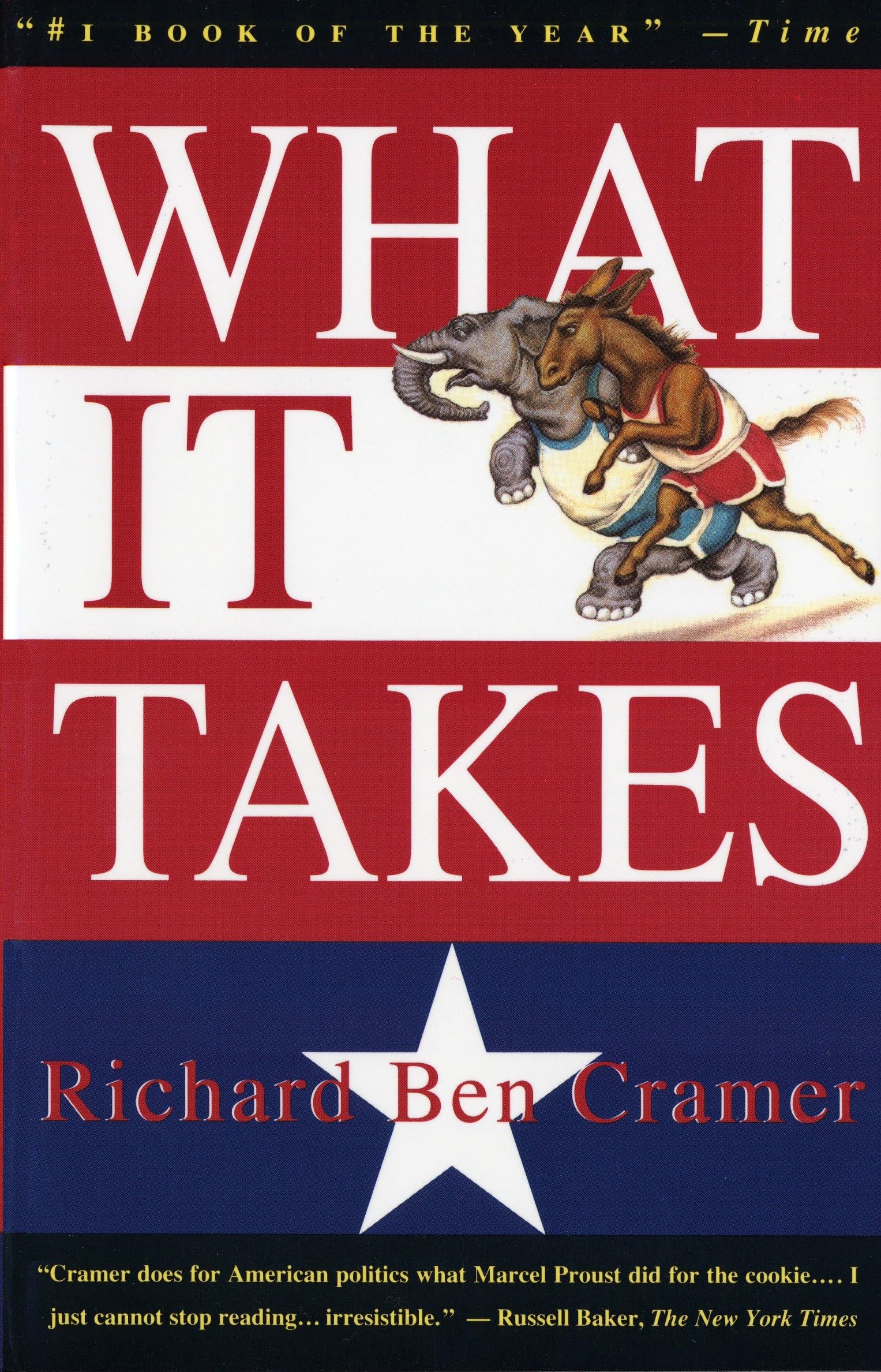
What It Takes: The Way to the White House [Cramer, Richard Ben] on desertcart.com. *FREE* shipping on qualifying offers. What It Takes: The Way to the White House Review: Lives Up To The Title - Best book I’ve read about what it’s like to run for president and what types of people succeed. Great storytelling that explores the personality traits, background and life experience that work for and against the people who go for it. Review: Required reading! - An amazing, in-depth description and analysis of the main contenders for the White House in 1988. Cramer somehow offers biographical insight mixed with a fast-paced coverage of the key moments in the presidential election. Impressive, important and a great read!

| Best Sellers Rank | #393,328 in Books ( See Top 100 in Books ) #66 in Elections #379 in United States Executive Government #1,299 in History & Theory of Politics |
| Customer Reviews | 4.5 4.5 out of 5 stars (659) |
| Dimensions | 5.15 x 1.72 x 7.9 inches |
| Edition | Reprint |
| ISBN-10 | 0679746498 |
| ISBN-13 | 978-0679746492 |
| Item Weight | 1.6 pounds |
| Language | English |
| Print length | 1072 pages |
| Publication date | June 1, 1993 |
| Publisher | Vintage |
S**C
Lives Up To The Title
Best book I’ve read about what it’s like to run for president and what types of people succeed. Great storytelling that explores the personality traits, background and life experience that work for and against the people who go for it.
M**G
Required reading!
An amazing, in-depth description and analysis of the main contenders for the White House in 1988. Cramer somehow offers biographical insight mixed with a fast-paced coverage of the key moments in the presidential election. Impressive, important and a great read!
J**N
Ponderous, yes. Tedious, no.
Another reviewer calls this book "ponderous and tedious." At 1051 pages, there's no disputing that it's ponderous. I wondered more than once when I'd see the end and it's hardly a quick or an easy read. Nonetheless, I wouldn't call it tedious; "wordy" is the worst I'd say. But it's informative and entertaining in its own slangy, psycho-analytical style. I have to credit the author with keeping his own politics out of the story. I can't guess how (or even whether) he voted in 1988. And he seems to achieve his goal of showing what it's like to be a candidate for President: what the stresses and strains are for the candidates themselves as they endure the process. At the end, he concludes that the successful candidate must give up any hope of having a private life. Most of the book is focused on the 1988 primary contests between four Democrats (Biden, Dukakis, Gephardt and Hart) and between two Republicans (Dole and Bush - "Bush 1", of course). There's a little, but not very much, description of and comment on the final, inter-party contest between Dukakis and Bush. I'm tempted to say that the book felt gossipy - except that I don't think the author is peddling gossip. I think that's just the way the book reads in places. The book certainly talks a lot *about gossip* and its role in the primary races. But the author's treatment of his subjects is very even-handed, I think. All of the six candidates have mistakes revealed and character quirks exposed. The reader is left to form his own judgment of which combination of mistakes & quirks is the worst - or best. (See some of the other reviews, where such judgments are expressed.) The author covers the six contenders from their early childhoods, focusing on their political development. In effect, he presents six piecemeal, political mini-biographies in addition to describing them during the 1988 race. This is what makes the book so long and, to some, tedious. Had the time frame been limited to just the primary year, this would have been a much shorter book. In his biographies, the author tries to give us some idea of the candidates' motives and thoughts. Naturally, the reader wonders how much veracity there is to biographies that seem to be revealing their subjects' thoughts. The author claims in a foreword that everything he quotes can be attributed and that all quotes were read back to the person quoted for verification. He also claims that he interviewed more than 1000 people and that all scenes in the book come from firsthand sources or from published sources that were verified by participants. So presumably his characterizations are reasonably accurate and weren't disputed by the subjects. This book is a phenomenal piece of research if nothing else. I found the book particularly interesting for a couple of reasons. First, it's been nearly 25 years since the events described, so it's like a Wayback Machine for those interested in politics. But it wasn't like reading old newspaper columns or editorials. It's an entertaining, though long, word picture of the process for each of the six candidates. Second, and more important to me, it was very descriptive of the press' role, behavior, and motives during the primary campaign. My view is that if anyone comes off poorly in this book (and few are spared), it's the reporters and editors. In fact, one reasonable take on this tale might be that it's a Reporter-in-the-Trenches' complaint about how media competition and ambition manages to screw up candidacies and therefore elections. The penchant of reporters to try to "bring down" a candidate is discussed at length in the parts about Gary Hart and Donna Rice. To smaller extents, this penchant affected all of the six candidates. They all had to deal with the press' perceptions of them - seemingly as often as they had to deal with the issues of the day. While I'm all about First Amendment freedoms and I don't like *any* attempt to regulate speech (McCain-Feingold, for one example), I had to agree that the feeding-piranhas result the author describes in the press may not always serve the public very well. Aside from those, one of the things that struck me about this book was the author's slang. Maybe these terms are (or were) current among political reporters but they were news to me. The book is rife with "smart guys" (Issue or Message experts), "wise guys" (reporters who ask smart-ass questions, I think), "diddybops" (TV/radio reporters), "TVs" (television/video crews), "white men" (well-connected political consultants) and "big feet" (well-known print reporters). The most amusing aspect of this usage is that by the end of the book "big feet" had morphed into "triple-E pundits".
C**.
A Must for Anyone with Political Interest
When I look back a few weeks after reading "What it Takes", my first emotion is disorientation. For over a thousand pages, I immersed myself into 6 different candidates' backgrounds, lives, political ascent, scandals, and ultimate view on politics/life. What truly is breathtaking isn't each of the candidate biography, which any half competent author could have done on an ambitious pol. What really separates Richard Ben Cramer's magnus opus is the writing style that matches the tenor of each candidate's thoughts. You can hear the Bob Dole Kansan drawl or the welcoming George Bush greeting. Every Gary Hart chapter had the special aura of change after the Cold War. Joe Biden's pages were slick and Michael Dukakis's neatly efficient. Yet if there was one candidate who summed up the theme of "What It Takes", it was Dick Gephardt's process and message in the race. The biography - squeaky, clean Eagle Scout - informed the candidate, a man who knocked on every door and helped every constituent. By opportunistic luck, he happened to rise in St. Louis politics fairly quickly. Yet through the chapters you feel a lingering sense of doom for his candidacy, a man who has stretched the limits beyond what his creator set for him. This culminates in 5% approval rating a month before the Iowa Caucus, after campaigning there for more than two years. If the story ended there, this book would simply be a biography on the 1988 election. Instead, Gephardt rises from the ashes with no money or political structure. His indomitable need to BE the president carries him, the essence of what the title of this book infers. Even with this Herculean effort, his lack of capacity and life-long grooming for the job submarine his chances. In all, "What It Takes" is a titanic adventure which can be divided into two parts. The first delves the reader into what innate talents, accomplishments, and desires leads a man into becoming the leader of the free world. The second part shows how every successful candidate must do what is necessary to become necessary, something they would never do if they did not have that unquenchable thirst for the office. It's not supposed to teach you history, we all know Bush wins. It is not a thriller or mystery as well. It also may not be the greatest political book of all time, but I have read no better.
D**N
incredibly well written and informative political junkies like myself could not put it down
C**N
El contenido del libro podría ser muy interesante, pero la edición con letra tan minúscula hace difícil e incomoda su lectura. No lo recomiendo si tienes mas de 50 años
D**Y
It doesn't get any better than this remarkble story
A**N
Detailed, engrossing. Page turner. It’s actually just about the primaries, but wonderful all the same.
V**A
Bought as a gift for someone. Will give it four stars though, aa it came highly recommended and the receiver was thrilled. Sorry I can't rate it properly.
Trustpilot
2 months ago
3 weeks ago