
DOWNLOAD THE APP


Customer Services
Copyright © 2025 Desertcart Holdings Limited
DOWNLOAD THE APP

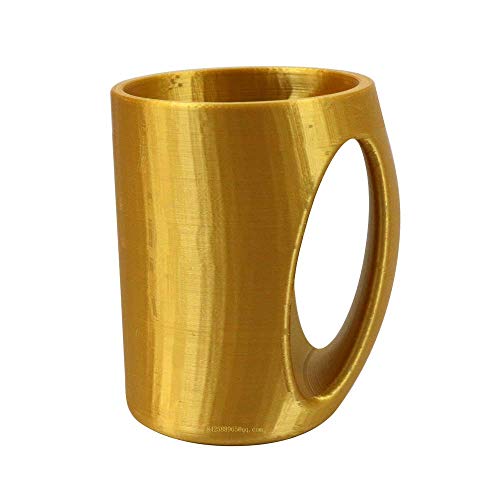


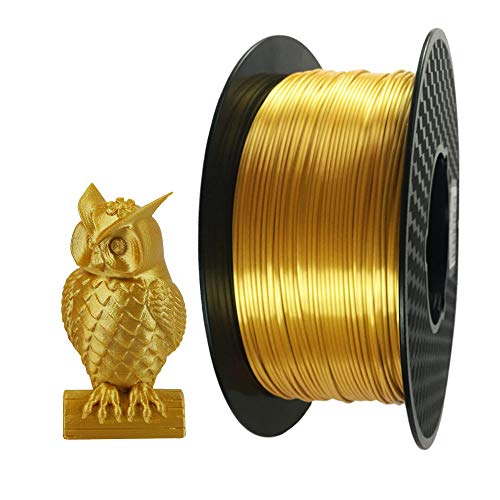


✨ Print Like a Pro, Shine Like Gold ✨
CC3D Silk Gold PLA Filament is a premium 1.75 mm, 1KG spool of shiny metallic gold silk PLA designed for FDM 3D printers. Made from high-quality American raw materials, it delivers a polished, gold-like finish without post-processing. Compatible with most FDM printers and optimized for print speeds of 30-45 mm/s, it offers reliable, vibrant results favored by professionals and hobbyists alike.


| ASIN | B06XRPYXP2 |
| Batteries Required? | No |
| Batteries included? | No |
| Best Sellers Rank | 36,677 in Business, Industry & Science ( See Top 100 in Business, Industry & Science ) 503 in Filament 3D Printing Materials |
| Colour | Silk Gold |
| Customer Reviews | 4.5 4.5 out of 5 stars (2,413) |
| Cutting Diameter | 1.75 Millimetres |
| Date First Available | 21 Mar. 2017 |
| Item Package Quantity | 1 |
| Item Weight | 1 kg |
| Item diameter | 1.75 Millimetres |
| Item model number | Silk Gold |
| Manufacturer | CC3D |
| Material | Polylactic Acid |
| Part number | C000428 |
| Size | Silk PLA Filament |
M**N
Very good quality filament with great finish
Fantastic silk pla used on my Creality Hi in the CFS Not had a single issue with it
D**O
Prints beautifully
It prints really well on my A1 Mini and it's a very beautiful gold (some gold filaments come through as yellow but this one is really shiny.
M**D
Good value.
Good, easy to use filament.
K**.
Nice gold colour
I’m comparing 3 prints so you can see the colour. One is a metallic gold spray the other two are eSun (this product) and eryone. I really like this gold - it’s really a high gloss yellow, but works well. It’s more convincing than the eryone brand whilst it lacks the metallic feel that I think a gold should have, it’s certainly convincing. It’s nice and bright and the best gold I’ve seen so far. Gold is incredibly hard to photograph in a way that shows it’s true colour, but I’m pleased with this. Eryone is more glossy caramel/orange Real cold is metallic and is hard to replicate in PLA Esun gold is a convincing compromise. I’ll be using this in future
A**R
Good quality
Little disappointed had to make an adapter before use on 3d printer. Quality of filament is great and it makes sime impressive pieces. Goes well with other colours.
N**E
Great for Xmas Decs
I have been making Christmas Decorations and they are lovely, very study and look great.
P**L
prints well
prints turn out good
M**N
Well impressed.
Really impressed. We used it with a Handheld Pen. Came out a good speed. Dried really strong.
G**Y
Great price for a silk metallic finish filament. Prints well on my bambu lab A1 3d printer. Needs a little temperature adjust and retraction adjustment only.
V**G
I had been wanting to try one of these mega-gold filaments for a while, so I decided to google around looking for "the best". Everyone has their own idea of what that means of course, but I had to start *somewhere*, and this stuff did come with some decent recommendations, so I figured "what the hell, it's worth a shot", and bought a spool. I've never printed with "silky" filament before, let alone this brand, so it's new territory for me. This stuff is inexpensive ($19.99/kg at the moment), made in China, and people were talking it up, and everyone knows how THAT usually goes -- "if sounds too good to be true, it probably is". I figured if it doesn't stack-up, it won't be a huge loss. At first, I had jamming problems, intermittent starved lines, brittleness, bad overhangs, ooze... the works. So, I didn't get a very good first impression of it. I figured, well, if I can't get this to print nicely, maybe I can just get it going barely well enough to use it for things where it's okay for the part to look ugly or where the color won't matter. But... I didn't want to settle for that, and kept poking at my settings until I finally got it figured out. Over the course of about 20 meters' worth of filament printing calibration objects, I got it dialed-in decently, and all those issues just... went away. Afterward, I printed a couple of small non-calibration items, then put the spool away for the time being. I still have some fine-tuning to do before printing anything big or important, but that's to be expected when playing around with a new filament, and it was already past time to shut things down for the night. So, yeah... that first impression was wrong. I mean, dead, fracking wrong! This really is a good product. As I wrote in the headline, the photos I saw didn't lie, and I'm certain mine don't either. It really does look as nice as the claims. One of the defining properties of this stuff: between the overall glossy/shiny/silky appearance and the way light interacts with the texture of the printed surface, it's hard to see the layer lines on flat vertical or curvy/"organic" surfaces (like the side of a cube, or the hull of a Benchy), making prints look a lot smoother than normal. At least, at 0.2mm layer height, anyways. Of course, mechanically, the layer lines are no different from any other plastic. This effect doesn't hide the "terraced terrain" look of gently-sloping top/bottom surfaces (like the Benchy's gunwale or cabin roof), but as with any other filament, you can mitigate that to some degree by using a finer layer height where it's needed, or maybe with that non-planar slicing method that's making the rounds. This leads to another nice quality: it's slick to the touch, even coming from my old printer (which doesn't produce the smoothest of surfaces to begin with). In fact, it almost feels "oily", compared to my other filaments. Of course, it's probably just as dry as any other plastic. It's simply *that* smooth right out of the hotend. I now wonder what vapor smoothing would do to it (and what solvent one would need for this product, for that matter). One thing that surprised me is that this stuff wants (in fact, demands) a lot less retract than any of the other filaments I use. As in, they all need around 2 mm of retraction length, while this gold does great with just 0.5 mm). I'm certain that too much retract was what led to jamming, starved lines, and ooze (paradoxically). Now, on the questionable side, this filament does have a LOT of die swell. For those who don't know, this is the effect where extruding into free air too fast (for a given temperature) will cause the extruded plastic to distort, shrinking lengthwise while also getting fatter, not unlike a muscle contracting. Or, as someone else described it, "like a hanging worm reacting to being touched". This isn't too much of a problem during normal printing, though, and can be beneficial in one case: if you anchor a line of hot plastic to something, stretch it across open air, and anchor the far end to something else, then let it cool, the filament's tendency to shrink lengthwise will cause it to pull itself taut between those anchor points (at least, with reasonably thin lines). Of course, we all know that this is how bridging works in 3d printing, and this behavior leads to *great* bridges with very little droop, but it has the negative side effect of making partial overhangs less than ideal, as they'll want to curl up if printed too fast. This is particularly apparent on parts with a small horizontal cross-section, which lead to short layer times, such as the 30-85° overhang test pictured above. The behavior of bridges and overhangs is comparable to ABS, but less severe, and like that material, these issues can be dealt with with appropriate settings or using things like a dwell tower or just adding more parts to the plate, so that there's more to print at heights where the problematic overhangs show up. And...well... it doesn't smell sweet when printing, like PLA normally does. Gotta have that delicious smell of waffles. :-) Also bear in mind, this is a standard-size 1kg spool -- the photo attached to this Amazon listing makes it look bigger than reality. ## End of review ## The following settings were used to print most of the items seen in the photos attached to this review (ignore the object on the far left, it's a bad print and is NOT representative): * Hotend: 195°C (precisely calibrated) * Bed: 65°C * Diameter: 1.73 mm * Flow: 94% * Geometry: 0.2 mm layer height, 0.4 mm line width * Speeds: I use Slic3r's autospeed mode, with a 5 mm³/s volumetric flow rate target, which works out to around 70 mm/s on most print moves. Travels at 300 mm/s, and retract and unretract speeds are both set to 40 mm/s. 1000-1500 mm/s² acceleration. X/Y jerk is set to 20. * Cooling: fan at 85% on print moves, 100% on bridges ( I usually run it flat-out 100% at all times on other PLA's, and PETG typically gets 15 to 25% on print moves and 50 to 100% on bridges, depending on color). The printer is just an old acrylic Prusa i3 MK1 clone that I've modded, upgraded, and just generally tinkered with over the years. It is equipped with a genuine RPW-Ultra all-metal hotend, with 12v/40W heater and 0.4 mm nozzle, a direct-feed, geared extruder of my own design, and Printbite-covered glass for the print surface. Layer cooling is provided by a 5015 blower, through a duct that aims the airflow at both the left and right sides of the nozzle. The whole kit is controlled by a BigTreeTech SKR v1.3 loaded-up with TMC2208 driver modules, and running Marlin (bugfix-2.0.x branch).
M**�
Ottimo filamento, si stampa benissimo! Lo consiglio
P**G
Mooi goud super shiny
J**Y
fungerar jätte bra inga problem med någon utskrift och ser bra ut. guld silk filament borde alla ha hemma
Trustpilot
1 day ago
3 weeks ago